Transforming Municipalities Into Engines of Economic Growth
LOCAL GOVERNMENT ELECTIONS
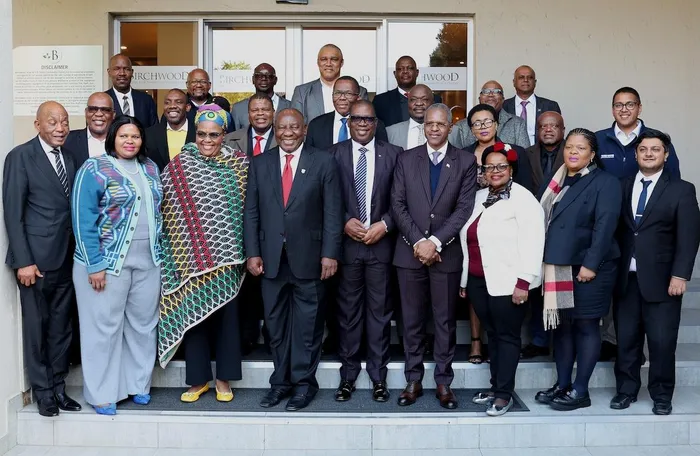
President Cyril Ramaphosa, Ministers, Premiers and Executive Mayors of Metropolitan Municipalities in a group picture following an engagement on aligning national and local government's service delivery, infrastructure investment, and economic growth strategies held in Boksburg on April 30.
Image: GCIS
Zamikhaya Maseti
As we draw closer to 4 November 2026, the question confronting South Africa cannot simply be who will govern our municipalities after the Local Government Elections.
The more fundamental question is: what kind of municipalities does South Africa require for the next phase of its development?
We require municipalities that understand that their historic mission extends far beyond collecting refuse, repairing potholes, issuing municipal accounts and administering regulatory functions.
Important as these responsibilities are, the municipality of the future must become an active developmental state at the local level, an engine of investment, production, employment and social transformation.
This is particularly urgent because South Africa desperately needs higher levels of economic growth, fixed investment and employment creation. Globally, cities already account for around 80% of GDP and 88% of private-sector job creation. Our municipalities therefore cannot exist as islands outside the national economic project.
After November 4, economic development must become part of the DNA of local government. Five pillars should anchor this new developmental municipality.
The first transformation must be financial.
Our municipalities should move away from seeing themselves primarily as recipients of conditional grants, equitable-share allocations and other fiscal transfers from the national fiscus.
Transfers will remain necessary, particularly for poorer municipalities with limited revenue bases. But there is a fundamental difference between receiving national support and developing a permanent culture of dependency.
A developmental municipality must ask: what economic assets do we possess, how do we develop them, and how do we expand our own revenue base?
The international evidence is instructive.
World Bank-supported municipal programmes in Ethiopia more than doubled local revenues from US$68 million in FY2020 to US$156 million in FY2023. Participating Ugandan municipalities recorded an 83% cumulative increase in own-source revenues, while municipalities participating in Ghana's secondary-cities programme achieved a 148% increase.
South African municipalities must similarly become more innovative around municipal property, development charges, properly governed municipal entities, infrastructure partnerships, land-value capture, investment partnerships and, where financially appropriate, access to responsible long-term capital. The municipality must cease being merely a consumer of the national fiscus and increasingly become a producer of local economic value.
Secondly, every municipality must regard investment as its business.
The investor wanting to establish a factory should not spend eighteen months travelling between municipal departments seeking planning approval, electricity connections, water approvals, environmental authorisations and building permits.
We need municipal investment war rooms capable of accompanying strategic investments from conception to operation. Consider Shenzhen (in Southern China); its transformation was not an accident of geography. Government assembled land for industrial development, adjusted land arrangements to attract industry and invested in enabling infrastructure such as roads and water.
What began as an experiment in 1980 became one of the most extraordinary examples of city-led economic transformation in modern history. I'm not suggesting that South Africa mechanically reproduces Shenzhen. Municipalities must understand the economic value of speed, infrastructure, land, planning certainty and institutional coordination.
Every municipality should know its comparative advantage. Buffalo City must understand its automotive and ocean-economy potential. Nelson Mandela Bay must leverage its ports, manufacturing base and industrial infrastructure. Johannesburg must consolidate its position as Africa's great commercial metropolis.
Rural municipalities must identify opportunities in agriculture, tourism, renewable energy, agro-processing and logistics. Economic development cannot be something buried inside one under-resourced LED directorate. It must become the responsibility of the entire municipal administration.
Thirdly, municipalities must declare war on unemployment.
Every mayor should know the unemployment rate of his or her municipality with the same urgency with which they know the state of the municipal budget.
Local government must actively build local economic ecosystems around township enterprises, cooperatives, informal traders, tourism businesses, manufacturing SMEs, technology enterprises and young entrepreneurs.
Barcelona offers an interesting lesson. Its district economic-development plans deliberately target areas with weaker socioeconomic indicators and integrate employment, business development, markets, social economy and neighbourhood development.
Its Sants-Montjuïc Economic Development Plan for 2024–2027, for example, contains four strategic pillars, 15 objectives and 39 actions, including improving employability and strengthening the local socioeconomic fabric. That is the mindset required.
Municipal procurement itself should become an instrument of productive localisation, within the Constitution and procurement law, helping viable local businesses enter sustainable value chains rather than creating politically connected tender intermediaries. The objective must be to turn townships into productive economies rather than permanent dormitories of unemployment.
Fourthly, municipalities must recognise urban food insecurity as a developmental emergency. Hunger is no longer exclusively a rural question.
Research on Cape Town's food system has revealed alarmingly high levels of urban food insecurity, compounded by spatial inequality. Researchers at the University of Cape Town argue that the central problem is often not the absence of food in the system, but the inability of poorer residents to access nutritious food because of income, distance, and transport costs.
This requires a new municipal response. Every municipality should identify unused municipal land that can support community gardens, commercial urban farming, food cooperatives and youth agricultural enterprises.
Municipal fresh-produce markets must be modernised and linked more deliberately to emerging farmers. Barcelona has already adopted an Urban Agriculture Strategy running to 2030, integrating agriculture, environmental sustainability and citizen participation into city planning.
Its municipal market network is similarly treated not merely as retail infrastructure but as a driver of neighbourhood economic development, employment and access to fresh food. Imagine similar thinking in Soweto, Mdantsane, Khayelitsha, Motherwell, Tembisa and Umlazi.
Urban agriculture will not by itself eliminate hunger. But combined with functioning food markets, logistics, social protection and employment, it can become part of a comprehensive municipal food-security economy.
Finally, none of this will happen without capable institutions.
The developmental municipality requires engineers, economists, planners, accountants, investment specialists, project managers, and competent municipal managers. Political leadership must provide direction without destroying professional administration.
Medellín in Colombia offers an important lesson. Its municipal leadership revived long-term metropolitan strategic planning, developed mechanisms such as a Quality of Life Index to track poverty, and deliberately built internal analytical capacity, including scenario planning and city-level economic analysis.
Our municipalities similarly require economic intelligence. Every council should know what its economy produces, where investment is occurring, which sectors are declining, where jobs are being created, where poverty is concentrated and which infrastructure constraints are preventing private investment.
Municipal Integrated Development Plans must therefore become genuine economic transformation programmes, not voluminous compliance documents prepared principally to satisfy legislative requirements.
The municipality is where the citizen encounters the state. It is where the entrepreneur opens a business, where the worker seeks employment, where the child requires water and sanitation, where the investor requires electricity and where the hungry household searches for affordable food.
Therefore, the battle for South Africa's economic recovery will ultimately be won or lost partly in our municipalities.
As we approach 4 November 2026, we must demand more than municipalities that merely survive from one financial year to another.
* Zamikhaya Maseti is a political economy analyst.
** The views expressed do not necessarily reflect the views of the National Media Group.