Women in Africa: The Unseen Victims of Crisis and Conflict
The Bujumbura Dialogue
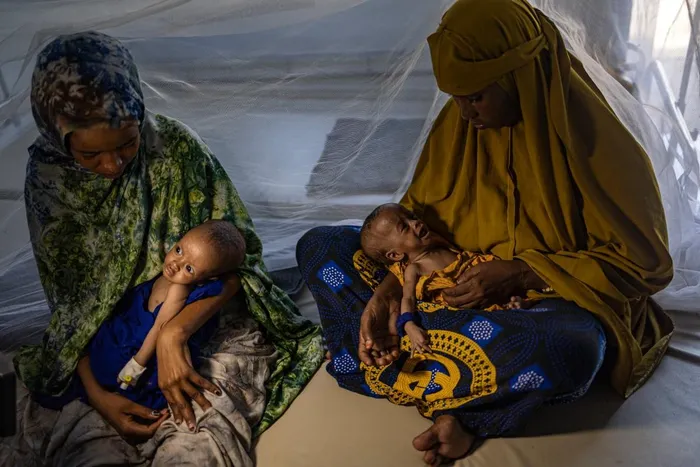
Displaced Somali women hold their severely malnourished babies in a stabilization centre for children suffering severe accute malnutrition in Kismayo, Somalia on April 22. Today across Africa, women and girls remain caught in a confluence of armed conflict, forced displacement, food insecurity, climate shock and systemic poverty, says the writer.
Image: AFP
Kim Heller
On Sunday, as South Africa commemorated the 70th anniversary of the 1956 Women's March, Nobel Peace Prize laureate Malala Yousafzai stood at the Union Buildings in Pretoria and delivered a heartfelt tribute to the brave women who had participated in this historic march seven decades ago.
Close to 20 000 women had marched to the seat of power to protest the apartheid pass laws which deprived Black South Africans of their right to move freely in their own country. Yousafzai spoke of how Black South African women had to battle racial discrimination and patriarchy. "Yet they chose to lead and demanded to be seen. It is their legacy of courage that brings me back to South Africa today," she said.
Her presence carried symbolic significance. It reminded the gathering that the struggle for women's emancipation knows no borders or geography. In 2012, at the tender age of fifteen, Yousafzai was shot in the head by the Taliban in Afghanistan for insisting that girls be allowed to learn.
Today across Africa, women and girls remain caught in a confluence of armed conflict, forced displacement, food insecurity, climate shock and systemic poverty. Every major crisis on this Continent is a gendered devastation.
The girl child continues to carry the highest cost. When families flee their homes in a desperate escape from seething conflict, it is young girls who face the greatest risk of sexual exploitation. When food runs short, it is the girl child who is too often removed from schooling or married off prematurely.
When water sources dry up, it is typically young girls who walk lengthy, dangerous distances to fetch it. Violence does not always abate when wars end. Poverty, displacement, patriarchy, and structural exclusion continue to impair the lives of millions of women and girls long after the guns fall silent. The female body has become a battlefield — in wartime and peacetime.
In Sudan, more than three years of sustained conflict have produced a real-life horror show. The UN Human Rights Office confirmed 546 incidents of conflict-related sexual violence between April 2023 and mid-April 2026.
Two hundred and eighty-four girls were affected, some as young as 9 years of age. Women and girls have been subjected to rape, gang rape, sexual slavery and forced marriage. In the Democratic Republic of Congo, UNICEF recorded more than 35 000 cases of sexual violence against children in the first nine months of 2025.
These attacks against women and children are not residual impacts of war but active devices. Anna Mutavati of UN Women has argued that sexual violence has been purposefully used to terrorise and control.
Against this backdrop, the African Union's Fifth Continental Dialogue on Youth, Peace and Security and Women, Peace and Security, held this week in Bujumbura, is key.
Assembled under the theme "Water, Peace and Inclusive Leadership in Africa," the three-day gathering seeks to amplify the role of women and young people in conflict prevention, crisis management, peacebuilding and resource governance.
Water is a peace, security and gender issue. When water insecurity collides with conflict, poverty and displacement, the burden falls most heavily on women and girls, who remain predominantly responsible for securing household water across much of Africa.The Continent has a raft of frameworks.
The Women, Peace and Security agenda, the Maputo Protocol, and the African Union Convention on Ending Violence Against Women and Girls assert the right of women to peace, participation in conflict prevention and resolution, and protection from war. Despite all the impressive declarations and measures, women remain on the sidelines, excluded from major decision-making and unshielded from violence.
The AU's Special Envoy on Women, Peace and Security, Ambassador Liberata Mulamula, has stressed the need for women's participation and protection. She has argued that Africa cannot afford to exclude "half of humanity from decisions that determine the future of nations". She has warned against empty symbolism.
Peace processes that fail to give pride of place to women are structurally flawed and will inevitably reproduce the very same patterns of exclusion and violence. Women need to have decision-making power in peace processes, water governance, and climate adaptation.
Significant and sustained ring-fenced funding of women-led organisations is a strategic necessity. Accountability for conflict-related sexual violence must move from mere condemnation to real consequence.
The Bujumbura dialogue, like many of these initiatives before and after it, will enthusiastically revitalise institutional commitments. However, it may not translate fully into a shift in gender power relations and protections. The girl child whose present and future are being contorted by a war she did not start is likely to remain vulnerable and unprotected.
At the same time, lofty declarations are being celebrated in the towers of privilege.Africa hardly needs yet another declaration that women's lives matter. It needs leaders prepared to treat that declaration as binding, through concrete budgets, measurable mandates, and the redistribution of decision-making power.
This commitment needs to be firmly based on a political determination to ensure that the price of harming women is higher than the cost of protecting them.
On Sunday’s Women's Day commemoration, Yousafzai said. "No culture, religion, government or ideology can justify reducing women to lesser human beings. The freedom of women is indivisible."
The women of 1956 did not wait for permission. They organised, marched and confronted the state. This may well become the most viable option if states and continental bodies continue to ensure full-circle women's safety and participation.
* Kim Heller is a political analyst and author of No White Lies: Black Politics and White Power in South Africa.
** The views expressed do not necessarily reflect the views of IOL or Independent Media.