Land Expropriation: The DA, AfriForum's Bid to Preserve Historical Imbalances
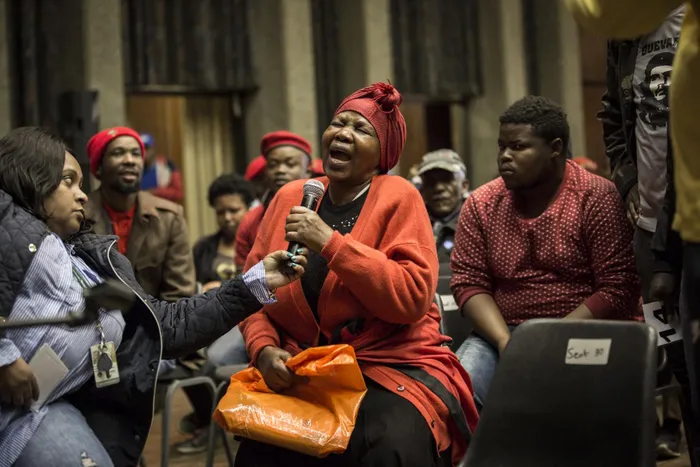
Roselina Seaga (67), speaks out on whether Section 25 of the Constitution regarding the expropriation of land without compensation, should be amended at a public hearing held in the Sedibeng Town Hall, Vereeniging on July 27, 2018.
Image: AFP
Sechaba Nkoana
The consolidated court cases of the DA, supported by their surrogates, the AfriForum and the Institute of Race Relations Legal, are aiming to have the land expropriation law declared invalid and unconstitutional on both procedural and substantive grounds.
The DA argues that their case is about every family’s home, every entrepreneur’s business, every worker’s pension and every South African who hopes one day to own something they can call their own.
The DA contends that Section 19 of the Act is irrational, pointing out that it enforces an impossible 180-day time limit to approach a court over compensation disputes relative to when the notice of expropriation is issued.
Their core legal arguments are that Parliament passed the Act unlawfully because several provincial delegates in the National Council of Provinces (NCOP) voted on the bill without valid mandates from their respective provincial legislatures.
The AfriForum and the IRR Legal, on the other hand, are targeting specific clauses—such as sections 12(2)(e), 12(3), and 12(4)—that permit nil or zero compensation during land expropriation. They argue that this distorts the constitutional property clause by shifting the burden of land reform entirely onto individual property owners.
Background
Land dispossession in South Africa spans centuries of colonial conquest and apartheid rule. It began with Dutch and British settlements seizing indigenous lands that culminated in the Natives Land Act of 1913, which restricted Black land ownership and engineered a cheap migrant labour system for mines and farms. South Africa’s journey towards land reform is rooted in over a century of profound land dispossession, racial segregation, and systemic inequality.
The land reform in the country is a story of struggle, resistance, and ongoing challenges, all of which can be traced back to the landmark 1913 Natives Land Act. The ripples of this historical injustice continue to shape South Africa's political and social landscape today.
The passing of the Natives Land Act was a defining moment in South Africa’s history. This legislation marked the beginning of legal land dispossession, which restricted Black South Africans from owning land in the majority of the country.
Sol T. Plaatje, a prominent journalist and political figure of the time, captured the essence of this bleak moment with his haunting words: “Awaking on Friday morning, June 20, 1913, the South African Native found himself, not actually a slave, but a pariah in the land of his birth.”
The Natives Land Act allocated only 7% of the country’s land for Black ownership. Over time, this would expand to a mere 13%, a stark contrast to the 87% of land held by the white minority. This unjust division set the stage for generations of dispossession and suffering.
The next several decades saw further entrenchment of racial segregation in land ownership. In 1936, the Native Trust and Land Act expanded the reserves for Black South Africans, but only to 13%, solidifying racial divisions. In the following years, laws like the Native Urban Areas Act and the Group Areas Act led to the forced removals of entire communities from urban centres, including places like Sophiatown and Lady Selbourne.
The 1950s and 1960s were marked by the violent destruction of vibrant communities, with over 60,000 people displaced from areas like District Six in Cape Town. During the apartheid era, the introduction of Bantustans and policies of forced removals intensified land dispossession, creating a spatial reality that continues to affect the lives of millions of South Africans today.
The long road to land restitution began in the early 1990s with the fall of apartheid. Following the first democratic elections in 1994, the ANC government made land reform and restitution a top priority.
The Commission on Restitution of Land Rights was established in 1995 to investigate land claims, but its progress was slow, and the scale of the task proved overwhelming. By 1999, only 670 out of 70,000 land claims had been settled.
The post-apartheid era saw the introduction of several reforms aimed at returning land to the dispossessed. However, despite some progress, the pace of land redistribution remained insufficient. By 2005, only 5.4% of commercial farmland had been transferred to Black ownership, far below the government’s target of 30% by 2014.
The debate over land reform reached new heights in the 2010s, with a push from the ANC Youth League for the nationalisation of land without compensation. Public opinion became more divided after the Marikana massacre in 2012, which brought issues of inequality and land reform to the forefront.
In 2018, the National Assembly passed a motion to explore land expropriation without compensation. Public consultations were held, and while there was widespread support for expropriation, concerns about the economic viability of such a policy persisted, especially from the white farming community.
The issue took centre stage again in 2019 when the Constitutional Review Committee introduced a draft bill to amend Section 25 of the Constitution, aiming to allow land expropriation without compensation. Although the bill did not secure the required parliamentary majority, it remained a key issue for national debate.
The South African government has continued to grapple with the complexities of land reform. In 2020, the Expropriation Bill was introduced, outlining a legal framework for expropriation and clarifying how the government would approach land redistribution.
The Bill provided a distinct path for land expropriation without constitutional amendments and ensured that expropriations are carried out in a fair and just manner.
In 2025, after years of deliberation, President Cyril Ramaphosa signed the Expropriation Act into law. This landmark moment concluded a long process that began in the early 2000s, with updates in 2015 and 2020. The Act now governs the procedures for land expropriation, providing clear guidelines for “just and equitable” compensation, aligning with constitutional principles of fairness and equity.
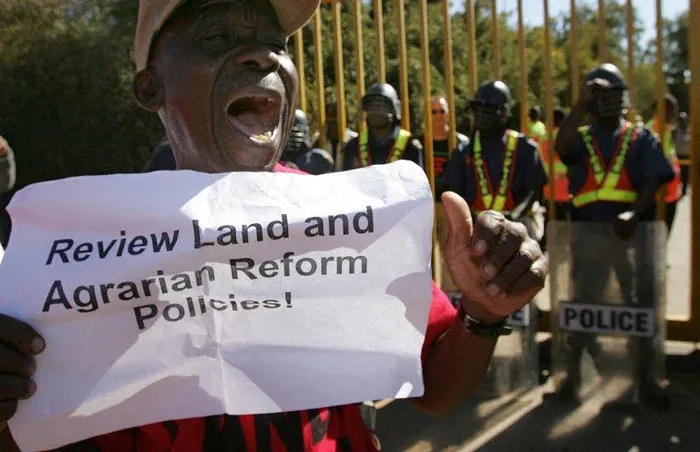
Members of the Landless Peoples Movement of South Africa demanding reforms to the country's land polices at the National Land Summit held in Johannesburg on July 27, 2005.
Image: AFP
Current Realities
Anyone who travels over the vast expanse of South Africa is immediately struck by the great variations in its landscape and the differing contexts and conditions under which black rural people live.
The picture of black rural South Africa in the hinterland of the former Transkei, Natal and Limpopo, where there is still attachment to the soil, differs greatly from that of the Free State and the Cape countryside where, to a large extent, rural people eke out a living as farm workers on commercial farms. These in turn are very different from the coastal areas where subsistence fishers face a daily battle for survival.
Despite these differences, however, there are many commonalities. The first is the abject poverty and underdevelopment, the daily battle for survival that confronts the rural poor. But there are other similarities too.
There are, for example, few, if any, places in the country where black rural people can sustain themselves off the land alone. In fact, in many of our rural villages, people have lost all contact with the soil, subsisting almost completely from social grants and urban remittances.
These peculiarities can only be understood by going back to the past - to the history of land dispossession and the manner in which European settlers accumulated capital and laid the foundations for their own well-being at the expense of the indigenous people.
The struggle between Boer and Briton, the mining revolution, the struggles of the white working class, the creation of the Bantustans, the ravages of the migrant labour system and the pass laws have left an indelible mark on the landscape of the country and on the lives of the indigenous population that endures to this day.
Overcrowding and underdevelopment in the former Bantustans, poor soil quality in the marginalised lands that people were coerced onto, lack of resources, landlessness and land hunger are but some of the problems that the new democracy in South Africa has to confront.
It is a matter of outstanding concern that there is a deep-rooted sense of deprivation and injustice amongst the majority, who daily have to live side by side with the opulent wealth of the few; accompanied by their experience that being black still means being desperately poor with few options for escaping the poverty trap.
Underpinning this inequality is a racially skewed distribution of land. Land policy in South Africa over the past one hundred years actively supported the emergence of white commercial agriculture and capitalist profiteering through, among other measures, eliminating independent African production and restricting access to land in small communal reserves designated solely for African occupation.
While acting as reservoirs of cheap and largely male labour, these communal areas were also 'dumping grounds' for those (the elderly, women, and children) deemed surplus to the labour needs of the white economy. The resolution of the land question in favour of white capital was thus central to the making of contemporary South Africa.
The Constitution of South Africa was adopted to:
"...Heal the divisions of the past and establish a society based on democratic values, social justice and fundamental human rights..." (Preamble of the Constitution of the Republic of South Africa, Act 108 of 1996). This was the promise made to all the citizens of South Africa, black and white, rich and poor. As we celebrate thirty-two years of democracy and its astonishing achievements, we need to recall this promise and ask to what extent the poor have had access to social justice and fundamental human rights. Reflection suggests the wisdom of acknowledging that land is key to redistributive justice in South Africa and that without an equitable resolution of the land and agrarian question, there can be no lasting peace.
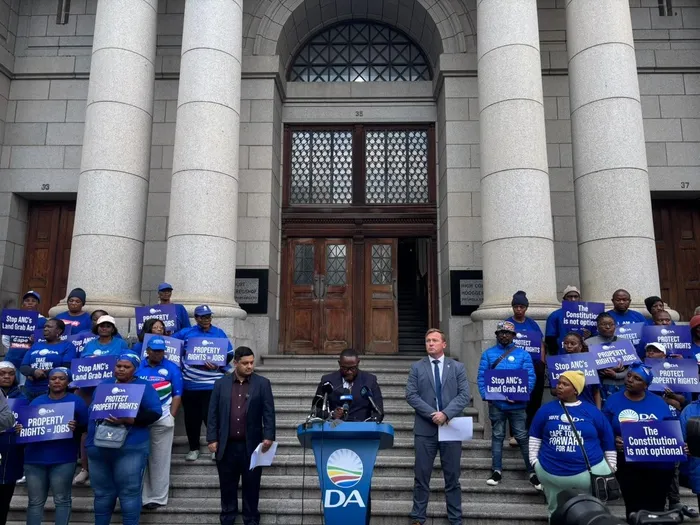
Democratic Alliance leaders at a media briefing on the party's legal challenge to the Expropriation Act in the Western Cape High Court on August 3.
Image: DA/X
Legal Challenges
The DA, AfriForum and the Institute for Race Relations are focusing on protecting private property rights and opposing state land expropriation without compensation. They desperately want to maintain racial inequalities rooted in apartheid, while they contend that they are safeguarding the constitution and economic stability.
A majority of South Africans are of the view that protecting current property ownership structures preserves historical imbalances where the white minority owns a major share of agricultural land.
Furthermore, a colourblind stance to the current racially skewed distribution of land fails to actively rectify the systemic dispossession suffered by black South Africans under colonial and apartheid rule. The opposition to the broad-based interventions by the state therefore frustrates the agrarian reforms and limits our emerging black farmers’ access to land ownership.
The DA falsely claims that they will build a people-driven economy in which South Africans own more, invest more, build more and create more jobs, protect private property, broaden ownership and build a South Africa that works—for everyone. The DA currently governs the Western Cape with mixed reviews.
Official statistics highlight severe spatial inequality, showing that poorer townships face service delivery backlogs, poor sanitation, and housing delays. Critics and the Public Protector point to major disparities, arguing that rich historical areas receive high-level maintenance while low-income townships like Khayelitsha and Langa experience severe service delivery backlogs and infrastructure neglect.
Progress on affordable inner-city housing has faced intense legal and logistical holdups, leading to community grievances and delayed developments.
During the National Council of Provinces (NCOP) meeting held recently, President Ramaphosa slammed the DA’s pro-poor investments that follow the same pattern as apartheid policies, saying that per capita, rich white areas were far better maintained.
Frankly speaking, a government that prioritises the optics of chasing vulnerable people out of well-located and well-resourced suburbs in the name of development to the affluent white enclaves – while stridently reminding anyone who’ll listen that it is fantastic because it sometimes gets clean audits is embarrassing and repulsive.
The DA leaders are accused of being influenced by the ideology of the Afrikaner Broederbond to undermine the human dignity of black people as a race. Their modus operandi is known for promoting white nationalist and white supremacist views which are inherently discriminatory, violent, separatist, and harmful to black people in general.
* Sechaba Nkoana is the author of “South African Land Reform Complexities: The Marobala O Itsose Experience” and is the Provincial Secretary of the ANC Veterans League in Limpopo Province.
** The views expressed do not necessarily reflect the views of IOL.