From Protest to Power: Women’s Vote Poised to Reshape Local Elections Trajectory
NATIONAL WOMEN'S DAY
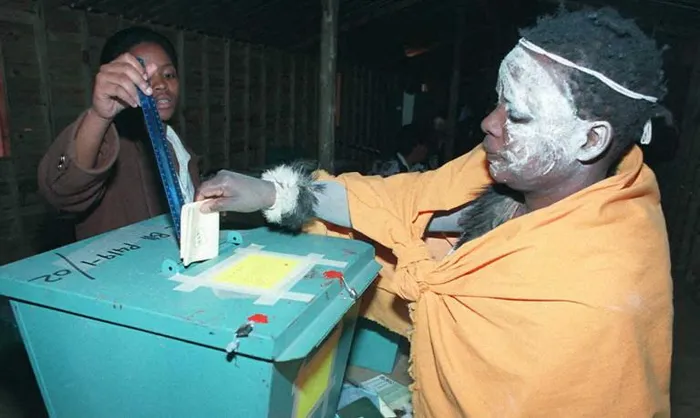
A woman casts her vote in Ntuzuma outside Durban on 26 June 1996 during South Africa's first local government elections in the democratic era. Every woman who votes can help create a more just, equal and democratic society. The ability to achieve real change lies with the more than 16 million women who are registered to vote, says the writer.
Image: RAJESH JANTILAL / AFP
Dr. Reneva Fourie
The 9 August 1956 women's protest against the Pass Laws was a unified act of resistance that directly challenged the authority of the apartheid-colonial state. They refused to accept enforced subordination and the denial of their basic rights.
To commemorate this event effectively, we must understand the nature of power in present-day South Africa and recognise the available methods for change. One of these methods is the local government elections of 4 November 2026. Using elections to effect change requires the active and progressive participation of women.
The structural oppression of women in South Africa has deep historical roots. The concept of triple exploitation, introduced by women in the Sandinista movement and later adopted by the anti-apartheid movement, frames class, race and gender oppression as interconnected.
Under apartheid-colonialism, patriarchy subjected women to sexual exploitation, cheap labour and the expectation to produce the future workforce. The struggle against class, racial and gender oppression was therefore integral to broader efforts to improve conditions for the most marginalised.
Since South Africa’s first democratic elections in 1994, women’s voter registration and turnout rates have been higher than those of men. The Independent Electoral Commission states that by 3 August 2026, 55.28% of registered voters were women, equating to over 16 million people. This shows a degree of sustained civic engagement.
However, this numerical majority has not translated into equivalent political leadership or substantive influence over public policy. Bridging this gap is essential if women's electoral strength is to produce lasting structural change.
The upcoming local government elections offer another opportunity to address this issue, as municipalities have a direct impact on daily life. Women bear the greater burden of service delivery failures.
Whenever the infrastructure fails due to leaking pipes, the use of untreated water, or unpaid bulk bills, many women have to spend more time collecting water, looking after people who fall ill with preventable diseases such as cholera, and buying medicine with their limited household incomes. Poor sanitation is particularly a serious threat to women's health, dignity and security.
The housing backlog, estimated at 2–2.6 million units, has a severe impact on households headed by women, who are more likely to live in informal settlements and poor-quality housing, thereby limiting their economic mobility and endangering their safety.
Public transport systems, which are marked by unreliability and safety problems, create difficult travel conditions for women who have to make multi-purpose trips for both work and childcare, and, as a result, restrict their ability to participate in the economy.
Community safety is also undermined by poor street lighting and the lack of attention given to public spaces, increasing the constant risk of gender-based violence.
Moreover, the stagnation of the local economy, often connected with unreliable electricity and poor infrastructure, reduces opportunities in the informal and small-scale enterprise sectors, where women are heavily involved. Women's involvement as both voters and candidates is therefore essential if municipal planning and budgeting are to take these gender-specific concerns into account.
When women are in the legislature, they often emphasise issues that have not always been prioritised in the past, such as gender-based violence, reproductive health, social care and poverty. Even though women politicians hold a variety of political views, their involvement broadens public debate and challenges the idea that leadership is primarily a male domain.
The situation worldwide shows a continued need for political action. When the Beijing Declaration and Platform for Action was adopted in 1995, it set up an international framework for promoting women's rights. UN Women's Beijing+30 review in 2025 found that although there have been some important advances, gender inequality remains deeply rooted in political, economic and social institutions.
As shown in the UN Women and Inter-Parliamentary Union Women in Politics 2025 map, women hold only 27.2% of parliamentary seats worldwide, make up about 22.9% of cabinet positions, and serve as heads of state or government in just 25 countries.
Simply having the right to vote and achieving numerical majorities in elections is not enough. If representative institutions are to become more inclusive, there needs to be ongoing political engagement.
South African women have always been involved in activism. In the mass anti-apartheid organisations, women focused on meeting immediate needs while also helping to politicise the communities, as the 1956 march showed.
Leaders like Febe Potgieter-Gqubule, Dipuo Peters and Madelaine Fullard further developed it. In the trade unions, we had activists such as Sophie De Bruyn, Connie September, Gertrude Mtsweni and Pat Horn. Women such as Thandi Modise, Geraldine Fraser-Moleketi and Jenny Schreiner took part in Umkhonto we Sizwe, the armed wing of the ANC and SACP.
The combined contribution of these women shows that transformation needs not only representation but also agency and strategic purpose. It was a basic accomplishment of the campaign against apartheid-colonialism, and it is necessary to exercise this right deliberately.
The local government elections on 4 November 2026 involve more than just picking councillors; they offer an opportunity to accelerate the creation of the society South Africans want.
Voting can lead to change. As women make up the majority, we can use this advantage to create a strong political mandate by supporting candidates and parties that advance gender-responsive, socially inclusive, economically just and globally conscious policies.
Beyond voting, elected officials must be held accountable. It is essential to build parallel organs of people's power – such as street committees, consumer cooperatives and workers' locals – to ensure sustained community engagement and amplify our collective influence.
The women's march seventy years ago called for freedom, and the 2026 elections offer a chance to intensify that struggle. Women have the numbers, the historical record, and the fundamental right to determine South Africa's future.
Every woman who votes can help create a more just, equal and democratic society. The ability to achieve real change lies with the more than 16 million women who are registered to vote. The issue is not whether this power exists but whether and how it will be used.
* Dr Reneva Fourie is a policy analyst specialising in governance, development and security.
** The views expressed do not necessarily reflect the views of IOL or the National Media Group.