Battle For The Metros Will Be A Complex Showdown
LOCAL GOVERNMENT ELECTIONS
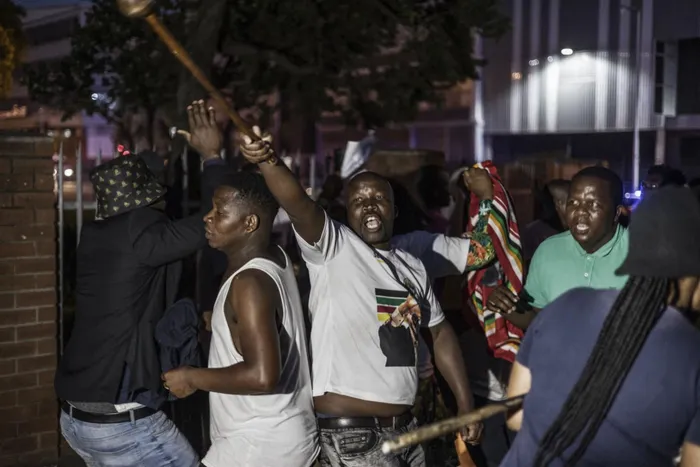
Inkatha Freedom Party members demonstrate in front of a polling station in Durban, on November 1, 2021 during the last local government elections. What is clear is that the battle for the metros is not straightforward. All political parties must dig deeper to retain or win these metros, says the writer.
Image: AFP
Prof. Bheki Mngomezulu
The weekend of August 1-2 marked the last official voter registration period organised by the IEC. In the few days after this date, those who still wanted to register could do so via the online registration option.
The IEC reached several milestones during this last registration weekend. One of them was the announcement by the IEC that over 29 million people are now accounted for on the voters’ roll.
Another achievement was that during this last registration weekend more than 1.7 million people interacted with the IEC either to confirm their registration status or to register for the very first time. As many as 291 806 or 16% of South Africans registered for the first time.
Intriguingly, the youth used this voter registration window profitably. Those aged between 16 and 29 accounted for 485 757 or 26% of the registrations. Importantly, 46% of all brand-new voter registrations during this registration period came from voters under the age of 29. While this figure might look small, it is impressive compared to previous registrations.
Perhaps the IEC should be commended for trying its level best to speak the language of the youth by using technology to appeal to the youth who are reluctant to wait in long queues to register for elections.
Three of the nine provinces did well in youth registration. KwaZulu-Natal came top after registering 137 046. The Eastern Cape came second with 79 417I registrations, followed by Gauteng in position three with 78 405 registrations.
Another glaring observation was the urban/rural divide. The IEC reported that urbanised provinces used online registration more than their rural counterparts. For example, Gauteng led the pack with 86 492, followed by urban KwaZulu-Natal with 41 334, and the Western Cape with 33 783.
What do these statistics tell us about the 2026 LGE?
Firstly, the fact that 1 502 245 or 84% of people already registered, inspected and updated their registration details in one way or the other leads to the conclusion that public interest in this year’s LGE surpasses the interest shown in the 2021 LGE. This assumption will either be confirmed or negated by the voter turnout on November 4, 2026.
During the 2011 LGE, the voter turnout was 57.6. In 2016, this figure was almost the same, with only a slight increase to 57.94%. Ironically, this upward trajectory was reversed in 2021 when the voter registration came down to 45.79%. If the released figures are anything to go by, this year’s LGE will see an increase in the voter turnout.
Secondly, the picture painted by these statistics – coupled with recent pronouncements by various political parties on who will be their mayoral candidates is that the battle for the metros has officially started.
Currently, South Africa has eight metropolitan municipalities or metros. These are Buffalo City, Cape Town, Ekurhuleni, eThekwini, Johannesburg, Mangaung, Nelson Mandela Bay, and Tshwane.
On the eve of the 2024 general election, all eyes were on Gauteng and KwaZulu-Natal provinces for three main reasons. The two provinces are the highest contributors to the country’s economy. Moreover, they were leading the pack in terms of registered voters. Lastly, they were the battleground for the ANC and the MKP.
Little has changed in the upcoming election. The IEC reported that KwaZulu-Natal recorded the highest volume of registrations with a figure of 427 592. Gauteng came second with a figure of 314 856. The Eastern Cape came third with a figure of 313 797.
Given that each of these three provinces has metros, any party that commands support in each of them stands a chance of controlling the metro. Whether these parties will obtain enough votes to lead the metros alone or will lead coalition governments remains to be seen.
Disgruntlement among the youth occasioned by the high unemployment rate, lack of service delivery and other factors is a critical factor. Given the increased number of the youth that has registered for this election, any party that does not enjoy support from the youth will be at a disadvantaged position – generally and in the context of the battle for the metros.
Of the country’s nine provinces, KwaZulu-Natal has attracted more attention. Since the province only has one metro (eThekwini), this means that the battle for eThekwini will be very intense. Parties must be strategic when deciding who their mayoral candidates will be.
With three metros (Ekurhuleni, Johannesburg, and Tshwane), Gauteng will also be another battleground. Various political parties such as ActionSA, IFP, DA, and Rise Mzansi have already announced their mayoral candidates, while parties like the ANC are still considering their candidates. The stakes are high in this province since it is the country’s economic hub.
While the Eastern Cape is one of the ANC’s strongholds, there is no guarantee that the ANC will certainly win the two metros in the province (Buffalo City and Nelson Mandela Bay) with an outright majority. Currently, the mayors in both metros are from the ANC. But the constant changes of mayors in Nelson Mandela Bay, the current lack of service delivery, the high crime rate and other factors could influence voters to vote in a particular way.
In Mangaung, the ANC is dominant. Despite many concerns about the performance of this metro, the ANC is likely to do well, either emerging as the outright winner or governing the municipality through a coalition.
While the ANC remains dominant in Limpopo and the Northern Cape, these provinces do not have metros. The same goes for Mpumalanga, where the ANC enjoys support, albeit not absolute support given that other parties like the EFF and MKP have made inroads.
In the Western Cape, the DA is almost guaranteed that it will retain that metro.
Therefore, a lot has been revealed by the statistics presented by the IEC. What is clear is that the battle for the metros is not straightforward. All political parties must dig deeper to retain or win these metros.
* Prof. Bheki Mngomezulu is Director of the Centre for the Advancement of Non-Racialism and Democracy at Nelson Mandela University.
** The views expressed do not necessarily reflect the views of Ithe National Media Group.