The Role of Public Trust in the Upcoming Local Government Elections
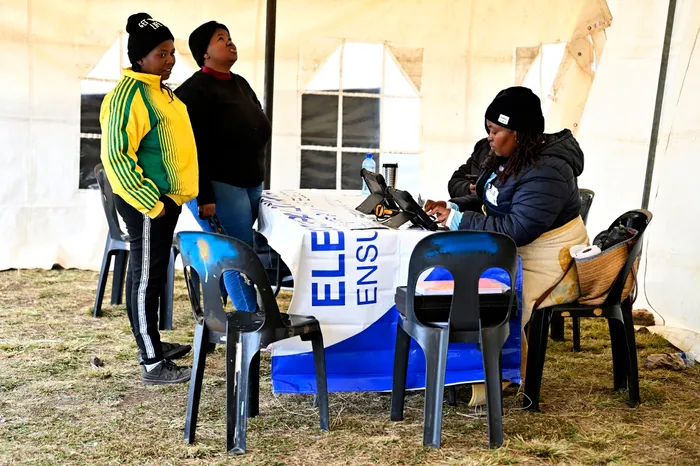
Residents of Elias Motsoaledi informal settlement in Soweto, register to vote at a voter registration station on June 21. Service delivery improvements and matters related to the quality of life of residents are predicted to dominate the elections, says the writer.
Image: Itumeleng English/ ANA Studio
Prof Dirk Kotzé
Registrations for the local government election (LGE) close on Friday, 7 August. The election timetable will then be activated, including candidate nominations.
Several parties have already launched their election manifestos, so we know their focus areas for the election. Most of them have converged on the same issues, namely municipal service delivery.
Such a consensus on the issues implies that the main focus will not be on the content of the message to the public but on from whom it comes and to whom it is addressed. As a result, the focus will be very much on the campaign strategies of the various parties.
In this respect, the voter registration process and the final composition of the voters’ roll are all-important, because the decision will be made by those who have voted. The issue of public trust in elections is therefore at the forefront – which has implications for democracy in South Africa.
The main components of democracy are well-established in South Africa. But the quality of that democracy depends on several variables; one of which is the public trust in it. Trust is influenced by perceptions, which in turn are important in motivating voters to vote.
The voter turnout is therefore for us a good indication of the public trust in elections, and therefore also the quality of our democracy.
For many years already, the most important issue in voter participation is the youth. They are the majority of the South African population and the ones with the longest future in the country. Voter registration is the earliest indication of public trust in elections and the potential level of public participation.
If younger eligible voters are not registered, they remove themselves from the formal elements of democratic participation. The informal means of participation (such as social media or involvement in civil society activities) remain available for them, but that does not have a direct impact on who the public decision-makers are on all the major issues affecting our quality of life daily.
Civil action can remove the incumbent decision-makers, but it cannot determine who will replace them. In a democratic dispensation, only elections can do it. The recent IEC-led registration process has been focused to a large extent on the youth. Increases in the youth component on the voters’ roll have been subdued and did not change the dynamics of the registered voters’ composition.
What does this mean for the LGE of 2026?
Political parties will use a campaign strategy which can maximise their presence in municipal authorities. These strategies are kept secret in a highly competitive environment, and therefore we do not know who they will target and where they will do it.
The strategies are determined by several factors, and one of them will be: who are the most profitable target groups, because the electorate is not homogeneous?
An analysis of the demographic composition of the 29 million registered voters can be very useful for the parties and candidates in the coming LGE. Depending on how parties will plan their campaigns as either predominantly, nationally or provincially focused or focused on local environments, a national or local analysis will be required.
Based on the latest registration statistics, the gap between male and female registered voters is about 10.5% in favour of the latter. This already suggests that parties will benefit from concentrating on issues important for women. Based on the statistics, this is most relevant for Limpopo and the least relevant in Gauteng and the North West.
These gender statistics can also be combined with generational ones. It speaks to the question about how the young voters might determine the outcome of the elections. In generational terms, four groupings have materialised: the first is the age groups 30-39 years and 40-49 years who constitute the same percentage of the total number of voters. The second similar group are those of 50-59 and 60-69 years old, with the same sizes. The third group is the age groups 18-19 and 80+, who are of the same size.
The combined group of 30-49 years constitutes the biggest part of the voters’ roll: 44.86%. They are followed by the 50-69 years group (22.84%) and the 18-29 years group (18.95%). When parties have to prioritise their campaigning, their options in terms of generations and gender should therefore be clear.
The voters roll also gives us an indication in terms of space (combined with generations) where the potential voters are located. That would be relevant for parties who will diversify their campaigns to distinguish between provinces.
The smallest gap between the sizes of genders is in Gauteng and the Northern Cape, while the biggest gap is in Limpopo and KZN. What are the implications of this for the youth? Though the IEC’s focus in their communication strategy so far is much on them and most parties acknowledge them as the most important generation in this election, the composition of the voters’ roll dictates a different reality.
The election can only involve citizens who are registered. As already indicated, in the latest voters’ roll only 18.95% of the registered voters are 29 years or younger. It already tells us that their impact on the elections will be limited, despite the importance of their issues for the future. Parties are first interested in winning elections, and therefore they will concentrate on issues that will mobilise support for them.
Service delivery improvements and matters related to the quality of life of residents are predicted to dominate the elections. But can the elections make a difference in this respect when almost all the parties agree on the importance of it? If the party programmes focus on the same issues, what will this election be about?
The main answer is that the elections – and there are 257 of them - will therefore not be about policy changes (i.e., about what must be changed) but about changes in who must implement the policies (i.e., who must do it). Most likely, the answer will be that a combination of parties must do it – in other words, a multiparty coalition group.
* Prof Dirk Kotzé, Department of Political Sciences, Unisa.
** The views expressed do not necessarily reflect the views of IOL or Independent Media.