Industrialisation Key To Advancing SADC's Regional Growth
DURBAN SUMMIT
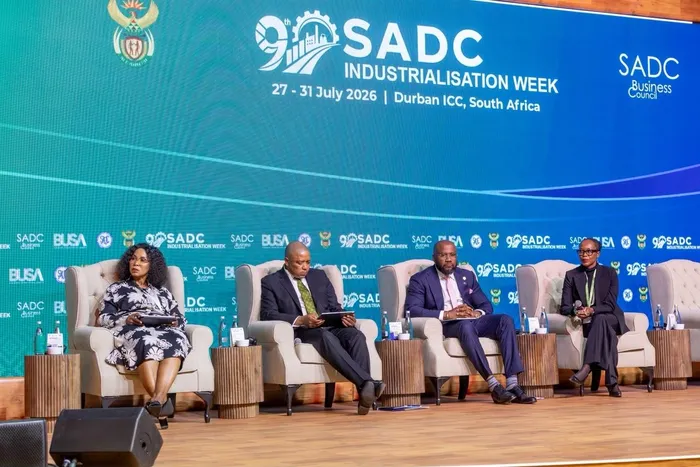
Regional leaders participating in a SADC panel discussion on industrialisation held in Durban on July 27. SADC leaders will gather for their 46th Ordinary Summit to be held in Durban on August 17 at a time when the region is battling political conflict, security challenges, economic stagnation and rising anti-immigrant tension.
Image: SADC/X
Kim Heller
Southern Africa faces a confluence of crises that place strain on economic development and regional cohesion.
Heads of State gather in Durban on 17 August for the 46th Ordinary Summit of the Southern African Development Community (SADC) at a time when the region is battling political conflict, governance and security challenges, economic stagnation, catastrophic youth unemployment and rising anti-immigrant tension.
These are interconnected manifestations of a deeper structural failure: Southern Africa has yet to dismantle the colonial economic ecology and produce self-determined, prosperous economies.
The Summit's theme “Resilient, Sustainable and Inclusive Industrialisation through Infrastructure Development, Agricultural and Critical Minerals Transformation in Pursuit of a Just World" — is a clear acknowledgement that leveraging industrialisation for regional development across SADC is a crucial pillar of the region's development agenda.
The pressing question now is whether SADC leaders will move beyond recognising this imperative and begin implementation. Former Executive Secretary of the United Nations’ Economic Commission for Africa, Carlos Lopes, said, "Industrialisation in Africa is not only possible but desirable… It will happen… only if strong industrial policies do promote them. This requires bold leadership and a very prominent role for the State."
Bold leadership is required now as migration increasingly becomes a source of stress and rupture.
In most instances, people leave their home countries due to crumbling economies, the absence of jobs, political conflict, poor governance, or climatic disasters. Uneven and failed economic development is the greatest trigger for mobility across Southern Africa.
SADC leaders need to confront and manage the economic conditions that spur migration at the upcoming Summit.
The SADC region has close to 30% of the globe's critical minerals. Africa as a whole accounts for approximately 85% of the world's platinum group metal reserves and more than half of the world's cobalt.
This mineral wealth continues to enrich Europe, Asia and North America through an extractive global economy that thrives on Africa's structural underdevelopment. Weak indigenous industrial capability keeps this global system in play.
SADC needs to treat industrialisation as far more than a growth strategy. For massive industrial development, it is a necessary lever of economic sovereignty. Locating mineral beneficiation, manufacturing, agro-processing, pharmaceutical development, and the activation of green technologies within the region would develop critical value chains, create employment, and allow mineral wealth to serve local development.
It would also begin to address the structural conditions that drive migration and fuel political fragility. In 2024, SADC Executive Secretary Elias Magosi stressed that no products should leave the region without value addition. "That way", he said, "we not only create the much-needed jobs locally… but also… add our own mark to the global value chains."
Implementation continues to be painfully slow. The long-delayed operationalisation of the SADC Regional Development Fund exposes the large gulf between diagnosis and remedy. The Fund was developed to finance large-scale regional infrastructure and cross-border industrial projects that individual states cannot bear alone.
Slow ratification and weak capitalisation have, however, left the development fund largely powerless. If the Durban Summit fails to produce concrete progress on powering up the Fund, the industrialisation rhetoric is pointless.
The real challenge now is for SADC to advance and action a development agenda to stimulate regional growth radically. This will mean that industrialisation is treated as the central pillar of the developmental agenda in the region. It will also require an understanding that industrial transformation is a regional commitment, rather than the work of individual countries.
Industrialisation demands dependable electricity, efficient transport networks, communication and digital infrastructure, and well-coordinated industrial policy. Its success has direct consequences for both migration and political stability.
Ongoing conflict in the eastern Democratic Republic of Congo continues to displace millions and destabilise the wider region. Insecurity in northern Mozambique continues to downgrade investment and threaten socio-economic recovery.
Across much of the Southern Africa region, economic exclusion deepens social grievances, making sustainable peace and development harder to achieve. Without economic development, country and regional security is always unsteady. In the same way, regional development without security is unsustainable.
The intensive contestation for critical minerals gives Southern Africa strong sway. Member States must act collectively as a regional bloc. This should top the agenda at the upcoming Summit.
As the region's most industrialised economy and SADC Chair, South Africa is well positioned to drive a coordinated industrial policy, fast-track regional infrastructure investment, and push for the speedy and effective operationalisation of the Regional Development Fund.
Southern Africa has the potential to become a major manufacturing hub. Its current status as a supplier of raw materials must be deemed both undesirable and untenable by SADC leaders.
Adebayo Adedeji, the former Executive Secretary of the UNECA and principal architect of the Lagos Plan of Action, has stressed the importance of Africa reclaiming the right to define its own development path. Adedeji has warned that externally imposed models have systematically undermined industrialisation and self-reliance.
Industrialisation is crucial to SADC's ability to retain its wealth, build productive capacity and achieve political stability.
Regional industrial development will convert Southern Africa's highly valuable resources into employment, industrial depth, and lasting economic sovereignty. Industrialisation is the region's preeminent investment strategy.
The Durban Summit must be remembered as a critical moment where the leaders of Southern Africa finally acknowledged and meaningfully actioned industrialisation as the central instrument of regional development and long-term sovereignty. If geared towards serving ordinary citizens and building self-sufficient African economies, industrial development is an instrument of decolonisation.
SADC Executive Secretary Elias Magosi's words should be inscribed into the Summit's outcomes. Magosi said, "It has become clear that industrialisation remains the most effective and trusted pathway to economic transformation."
* Kim Heller is a political analyst and author of No White Lies: Black Politics and White Power in South Africa.
** The views expressed do not necessarily reflect the views of IOL or Independent Media.