Fearless in the Quest for Justice, Truth and Accountability
NATIONAL WOMEN'S DAY
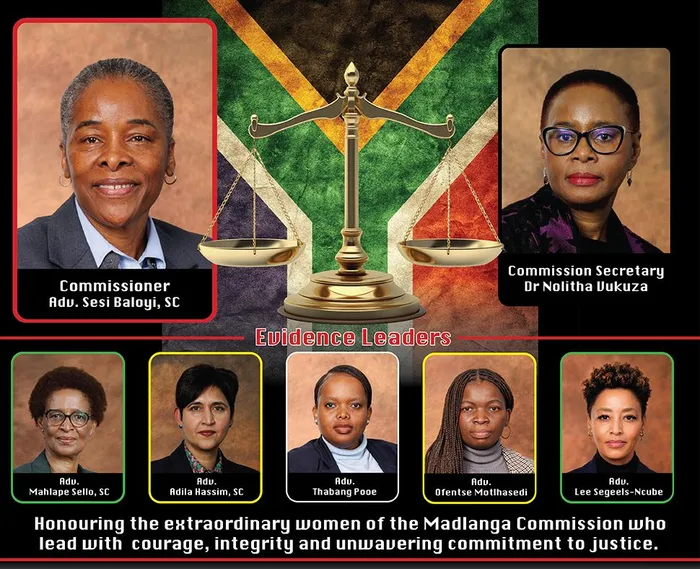
The women leaders of the Madlanga Commission show great valour amid treacherous and hostile circumstances, demonstrating a resolute determination in pursuit of truth. By emulating the courage displayed by the women who opposed apartheid seven decades ago, they are now bravely dealing with the corruption within the criminal justice system, says the writer.
Image: Solomon Ravell/ANA Studio
In August, South Africans are once more celebrating the anniversary of the 1956 Women’s March. On that occasion, about 20,000 women assembled to protest against the extension of the pass laws to black women and presented their petitions to the office of Prime Minister J.G. Strijdom.
The slogan they shouted, "wathint’ abafazi, wathint’ imbokodo", which translates as "you strike a woman, you strike a rock", became a permanent symbol of women's resilience in the country. The bravery of those marchers now finds its contemporary echo in the women of the Madlanga Commission.
It is not surprising that some people are sceptical about the Madlanga Commission, since South Africa has a well-documented record of commissions that failed to bring about change. Much time and resources have been devoted to previous inquiries, and substantial evidence has been gathered. Unfortunately, their recommendations have often been ignored.
However, even the greatest cynic must concede that the Madlanga Commission’s performance is impressive. The conduct of the commissioners and their support staff, across the board –though, especially the women – commands respect and admiration.
They are articulate, efficient and highly competent. Their conduct instils pride despite the shocking and reprehensible outcomes that are being brought to light. Such professionalism sets a standard other public institutions would do well to follow.
Patriarchy, racism and discrimination based on class remain prevalent in South Africa, making the struggles of the women who marched to the Union Buildings in 1956 as relevant today as they were then.
But the women leaders of the Madlanga Commission demonstrate that, given the opportunity, women excel as professionals, leaders, and drivers of change. They are instrumental in shaping the narrative and the outcomes of the proceedings.
Their presence and performance challenge the entrenched norms that have historically marginalised women from positions of authority, particularly in the legal and judicial spheres. Their example offers a clear template for institutional reform grounded in competence rather than rhetoric.
Advocate Sesi Baloyi, a distinguished Senior Counsel, acts as co-commissioner with Advocate Sandile Khumalo SC and Justice Mbuyiseli Madlanga, who chairs the Commission. Her successful legal career, including extensive expertise in constitutional and administrative law, gives her the knowledge, sound judgement and judicial temperament needed to carry out the Commission’s responsibilities.
Through careful and systematic examination of witnesses, strict assessment of evidence and consistently even-headed behaviour in court, she earns reverence across society. Throughout the inquiry, she demonstrates a steadfast allegiance to the rule of law, fairness and the proper administration of justice, thereby strengthening public confidence in the Commission’s work.
Evidence leaders, Advocates Mahlape Sello SC, Adila Hassim SC, Lee Segeels-Ncube, Ofentse Motlhasedi, and Thabang Pooe all have strong professional and personal qualities that influence their contributions to the Commission.
Each woman has a formidable sense of morality and demonstrates principled leadership by quietly yet firmly resisting the intense political pressure of the inquiry. Their combined record shows that thorough and principled legal work can succeed within a severely compromised system.
They show great valour amid treacherous and hostile circumstances, demonstrating a resolute determination in pursuit of truth. Intellectually, they display authority, astuteness and forensic accuracy while successfully blending legal rigour with genuine humane responses. This quality lends the proceedings a necessary degree of compassion and sustains its effectiveness.
The issues they face are often difficult and controversial. Through their shared commitment and consistent discipline, they uphold the values of the legal profession and earn genuine confidence and respect. Because of their steady professionalism, the Commission continues to operate with credibility. A public tired of official misconduct can find hope in the firm dedication of these evidence leaders.
Dr Nolitha Vukuza, Secretary of the Madlanga Commission, performs an important administrative function that underpins the entire inquiry. Her duty is to manage the Commission's investigative and organisational infrastructure.
She is in charge of the secure handling of sensitive evidence, including arranging the testimony of high-risk witnesses. Witness safety is of the utmost importance, and Dr Vukuza ensures that appropriate protocols are in place to protect people who decide to testify.
Furthermore, her leadership provides the institutional base needed for the Commission to carry out its duties transparently, credibly and trustworthily. She maintains the Commission's integrity by signing official documents and making decisions on procedural matters.
Dr Vukuza ensures the Commission operates financially prudently, managing a budget exceeding R147 million. This enormous financial responsibility requires acute oversight and a steadfast rectitude to avoid waste or mismanagement.
Without her steady hand guiding the administrative machinery, the commissioners would be unable to focus on the substantive legal and investigative work. She is the engine room of the Commission, ensuring that everything runs smoothly behind the scenes so that the public hearings can proceed without interruption or procedural irregularity.
The 1956 Women’s march was a tremendous display of courage. The women who took part were willing to risk their lives and their freedom for a better South Africa, one in which all people would be treated as equals and with dignity, regardless of race, class or gender.
At a time when South Africa yearns for credibility and excellence in its public institutions, the staff of the Madlanga Commission, especially its women, stand out as a powerful beacon for a country traversing tumultuous times.
They reflect the spirit of that historic march and show that the struggle for justice and accountability is by no means ended. Their efforts serve as a reminder that the ideals of 1956 are not mere historical artefacts but living principles that demand constant vigilance and active protection. Their actions provide a model for the renewal that South Africa so urgently requires.
By emulating the courage displayed by the women who opposed apartheid seven decades ago, they are now bravely dealing with the corruption within the criminal justice system and thus making a significant contribution to the creation of a better South Africa for all its people.
***Dr Reneva Fourie is a policy analyst specialising in governance, development and
** The views expressed do not necessarily reflect the views of IOL or Independent Media.