From Promise to Catastrophe: Cyril Ramaphosa's Moment of Reckoning
GOVERNANCE
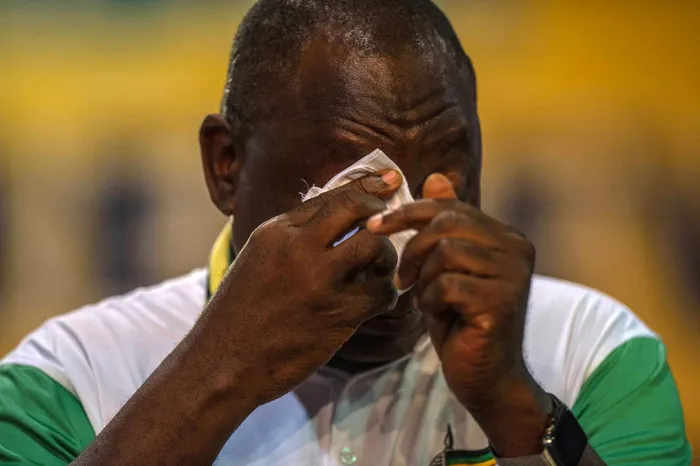
An emotional Cyril Ramaphosa following his election as President of the African National Congress (ANC) during the party's 54th National Conference on December 18, 2017 at the NASREC Expo Centre in Johannesburg. Ramaphosa came to office promising renewal, integrity and growth. What the country has received is drift, protection of the powerful, and measurable decline, says the writer.
Image: AFP
Prof. Sipho Seepe
The jury is in. The verdict is near-unanimous across former ANC insiders, critics, the public and parts of business: Cyril Ramaphosa’s time in office has been an unmitigated political, economic and social disaster.
Leading the criticism is former finance minister Trevor Manuel, one of the economic envoys appointed by Ramaphosa himself. Asked about Ramaphosa’s presidency, Manuel is blunt. “Part of the difficulty in South Africa is that you take on something when you’ve never run anything. Donald Trump has the same problem. Everything he’s touched has been a complete disaster… What is it that he [Ramaphosa] is doing? [He is] visionless. And he doesn’t take decisions.”
Political economist and author Moeletsi Mbeki is equally scalding. “The man has totally failed as a president; he can’t decide on anything…. He was never a leader – if you put him next to Nelson Mandela, Thabo Mbeki and even Jacob Zuma… He goes with the flow. He wakes up in the morning and says, ‘which way is the wind blowing’ and ‘I’m going to go that way’.”
In his article “The Non-existent President” (City Press, 13 February 2022), Mondli Makhanya argues that, thanks to BEE shares. Ramaphosa amassed wealth with minimal effort. All Ramaphosa had to do was “to lend his name and credibility to companies, conclude deals he didn’t negotiate for, and attend board meetings in which he did not speak much. What he did do very well, though, was invoice timeously and diligently for every little stitch of work he had supposedly done. Just like during his years in business, he didn’t really do much in the deputy presidency”.
Exaggerated expectations of economic recovery under Ramaphosa rested on the false premise that the country would be led by a genuine businessman. In truth, he was part of crony capitalists created by big business to serve as a buffer that would protect the interests of big capital against the impatiently restless masses. Beyond public relations exercises, his administration has delivered little of substance.
Far from kickstarting the economy, Ramaphosa did the opposite. Research associate at the Social Policy Initiative, Duma Gqubule sought to set the record straight. “Whichever way one slices the data, Cyril Ramaphosa’s presidency has been a disaster for the economy… There were eight out of 10 quarters of declining gross fixed capital formation (GFCF)… before the lockdown at the end of March 2020.” A promised R100-billion infrastructure fund remains empty. Despite investment summits that pledged R1.1 trillion, GFCF fell to 13.1% of GDP in 2021—the lowest since the Reserve Bank began tracking the figure in 1946—from 16.4% in 2017. (Business Day 7 Feb 2023).
Claims that blamed Covid-19 are a convenient alibi. The economic downturn began well before the lockdowns. Loadshedding, absent for years, returned in 2018 after Ramaphosa became president and inflicted nearly six years of damage. Investment had already collapsed.
In a later article, “Ramaphosa’s ‘wasted years’ worse than Zuma’s”, Jan 30, 2026, Gqubule argues, “Under Zuma, growth ran three times faster. In 2019, GDP crawled at just 0.3%, with three consecutive pre-pandemic quarterly declines. Meanwhile, 155 emerging and developing economies averaged 3.7% annual growth. Politically, the ANC lost 4.65 percentage points in 2019 and a further 17.32 points in 2024—the bulk of its post-2009 decline—despite Ramaphosa’s careful branding as the business-friendly reformer. Objectively, his presidency ranks as the worst since 1994.”
Job destruction has accelerated. Stats SA recorded 214 000 more economically inactive people in the third quarter of 2024 under the government of national unity. ArcelorMittal’s threatened closure alone risks 3 500 direct jobs and, according to the Steel and Engineering Industries Federation, up to 293 754 direct and indirect losses cascading through trade, transport and manufacturing.
Corruption perceptions have deteriorated. On 30 January 2024, Democratic Alliance leader John Steenhuisen noted that the Corruption Perceptions Index shows Ramaphosa’s administration “more corrupt than that of his predecessor,” having shielded cadres implicated at the State Capture Commission rather than delivering the clean-up he promised.
The Phala Phala scandal—centred on the theft of undeclared foreign currency stashed at Ramaphosa’s private farm—casts a long shadow on his presidency. The country has witnessed the corralling of law enforcement agencies in his protection.
The National Prosecuting Authority, the Public Protector, the police and the Reserve Bank responded with a collective “see no evil, hear no evil, speak no evil.” Processes were bent to shield the appointing authority. As journalist Adri Senekal de Wet observed, the tragic irony of Ramaphosa’s presidency is that the very state agencies meant to hold power accountable have been repurposed to protect him.
Internationally, Ramaphosa was damaged goods.
He was no longer the self-styled anti-corruption crusader, just another corrupt leader. The influential London-based Financial Times (Dec 10, 2022) led with a headline “Cyril Ramaphosa: the South African president clinging to power: A descent into legal scandal is not the arc envisaged for a leader who won early glory battling apartheid”.
Politically, Ramaphosa has taken the ANC from a comfortable 62% share of the vote to just over 40%. Under his leadership, the party moved from political hegemony to a position where it must beg support from opponents to govern.
Nothing repudiates the carefully cultivated narrative that Ramaphosa was more popular than the ANC than the image of Ramaphosa in an almost empty stadium during this year's Freedom Day celebration. The days of ANC mass rallies filled with enthusiastic supporters are gone. What remains is a party and a leadership struggling to command legitimacy.
The repudiation extends inside the ANC itself. Ramaphosa’s attempt to bolster his tattered image by hijacking the National Dialogue—an initiative of the so-called legacy foundations—backfired spectacularly.
Responding to Ramaphosa’s inane questions at the government’s jamboree: “Why do so many people live in abject poverty… Why, after decades of democracy, are the prospects for a white child so much better than those of a black child? …Why do clinics run out of medicine? Why do taps run dry?”, former minister Naledi Pandor was scathing. “There is nothing worse in an organisation, or in a country, than a leader who has no solution… The people are looking to us to solve it.”
The most abiding lesson of these years is that lies have short legs. Ramaphosa was always a Trojan Horse of white capital, deployed to weaken the ANC from within. The method was straightforward: identify a pseudo-activist among African people, dress him in revolutionary garb for credibility, co-opt and enrich him, then present him as a blessing for his people.
The strategy worked. It has since been applied to many former activists who became colonial administrators of global capitalism. Ramaphosa moved from experimental subject to active participant in the fiction. The creation was so carefully choreographed that both the ANC and large sections of the public believed it.
Ramaphosa is in many ways a victim of the propaganda that dressed him in borrowed robes. Under his leadership, the ANC has been irrevocably weakened. Socially, inequality, service delivery failures and institutional decay have deepened.
Economically, growth has stalled, investment has evaporated, and jobs have disappeared at an accelerating rate. The Phala Phala cloud remains, and the institutions meant to investigate it have been bent to protect the president rather than the public interest.
Ramaphosa came to office promising renewal, integrity and growth. What the country has received is drift, protection of the powerful, and measurable decline across every major indicator. The experiment has run its course. The results are clear.
* Professor Sipho P. Seepe is an Higher Education and Strategy Consultant.
** The views expressed do not necessarily reflect the views of IOL.