Africa's Migration Crisis: Why South Africa Shouldn't Bear the Burden Alone
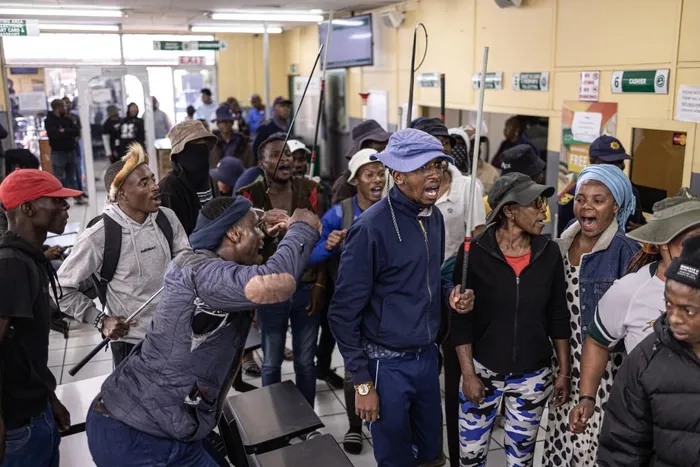
Protesters storm the Department of Home Affairs offices during a demonstration calling for the removal of undocumented immigrants in Alexandra township on July 30, 2026. Migration is not a South African crisis. It is a challenge for all states, says the writer.
Image: AFP
Bobby J. Moroe
There is an old African proverb that says: “When the roof leaks in one house, the rain wets the whole village.” Migration is that rain. It falls on every roof, on every border, on every city across this continent and across the world.
To stand and point at a single door, calling it one nation’s failure, is to miss the storm itself. South Africa has been made to stand at that door for far too long.
Let us be clear, but mostly frank - blaming South Africa for migration challenges is a deflection from real causes of migration.
Migration is not a South African crisis. It is a challenge for all states. From the Mediterranean to the US-Mexico border, from the Gulf to Europe, from Nairobi to Lagos to Johannesburg — every government is wrestling with the same questions: who comes in, how are they documented, and how do we protect both citizens and those who come in?
In Africa, South Africa hosts the highest number of migrants — both regular and irregular. And there is a reason for that.
For decades, beyond 1994, South Africa opened doors to the world. The country built an economy, a constitution, and institutions that, although imperfect, offer refuge, employment, schooling and hospitals.
People vote with their feet, and for many, South Africa is the destination.
If we are to speak honestly, we must ask: why is the outrage so loud in one place, and so quiet in others?
In parts of North Africa, the migration journey has produced horrors that should shame us all. Investigations by the IOM, the UN, and international media have documented African migrants being held in detention centres, sold in slave markets, beaten, and exploited. There have been mass expulsions of sub-Saharan Africans into the desert, without food or water.
In some Gulf countries, African migrant workers face the "kafala" system, passport confiscation, and conditions akin to modern servitude. This is not to justify acts of criminality and vigilantism in South Africa - the government has been unequivocal in condemning such acts and emphasised that law enforcement agencies are doing their work in apprehending perpetrators.
Where is Africa in that conversation? Where is the same thunder?
The silence is deafening. Yet when South Africans raise genuine concerns about crime and pressure on services, the continent erupts and calls it “Afrophobia” or "Xenophobia" - nomenclatures that have become synonymous only with South Africa. That is deflection.
South Africa cannot carry the weight of the whole continent’s push factors alone. It is the responsibility of all states in the world to do the work of discouraging irregular migration by creating conducive socio-economic environments at home in the form of jobs, security, governance and opportunities.
If we do not groom and grow prosperity where people are born, we will forever chase them at the borders.
At the same time, we must be honest about the challenges facing receiving nations like South Africa. The public clinics are full, The Schools are full, Housing lists are decades long, and resources are stretched to include foreigners.
South Africa is probably one of the only African countries that caters for migrants who don’t pay tax — treating them in public hospitals, educating their children, and offering them legal recourse.
I suspect few countries extend such courtesies to migrants like South Africa does. We do it because of who we are.
South Africans are raising genuine concerns about crime committed by undocumented migrants; they cannot be traced, and they put pressure on services and communities.
When South Africans raise these concerns, they are quickly called “xenophobic", yet the same phenomenon in some of our own countries is given different names: “security operations,” “urban renewal,” “illegal aliens.”, etc.
It is not disunity when South Africans raise concerns. It is democracy. It is a people asking their government to govern. No country in the world can allow illegal migration. The law must mean something. To suggest that South Africa alone should open its borders without rules is to ask for what no other nation would do.
In 2015, the African Union took a resolution to host a continent-wide conference on migration; to date, this has not taken place. This was an acknowledgement that this is not country-specific but a continental challenge.
The resolution was clear: migration must be managed jointly, with dignity and order. That conversation is not taking place enough. We are still stuck in cycles of blame. The bottlenecks are documentation, border management, data sharing, job creation, and law enforcement. These cannot be fixed by pointing at one country.
The rain is falling on all of us. So let us stop arguing about whose roof is leaking, and let us mend it together because migration is not South Africa’s problem alone; it is a global challenge. It demands a global — and African — answer.
* Moroe is the Acting High Commissioner of South Africa in Nigeria and Consul General in Lagos. He holds a PhD. in Political Science from the University of KwaZulu-Natal and writes in his capacity as a scholar at Nelson Mandela University in South Africa, where he serves as an adjunct professor.
** The views expressed do not necessarily reflect the views of IOL