Reclaiming Women's Month: Celebrating Resilience, Strength, Agency
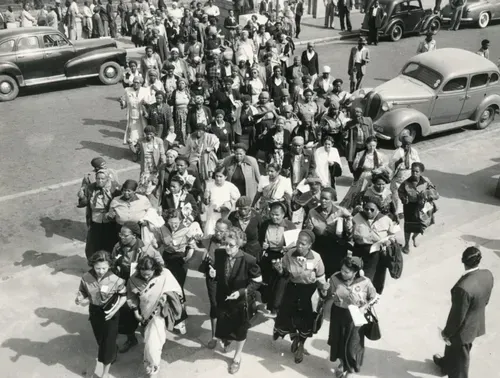
More than 20,000 women marched to the Union Buildings in Pretoria on August 9, 1956 to protest the apartheid regime's pass laws. When a month built to celebrate excellence slowly becomes a month built to highlight trauma, we lose the radical meaning of August 9, say the writers.
Image: Independent Media Archives
Dr Mpumi Zungu, Sibs Mthembu, Dr Zaino Petersen and Dr Whadi-ah Parker
Every August, South Africa turns all its attention to women. Billboards change colour. Government, NGOs and corporates roll out panel discussions, webinars and seminars. News bulletins fill with statistics. Without fail, and within the first week, the month narrows to a single theme, Gender-Based Violence and Femicide (GBVF).
As a principal investigator and investigators on the first National Gender-Based Violence study, and activists who were among those who marched to the Union Buildings on the 1st of August 2018, we do not doubt that every day in South Africa is a day for sustained attention to GBVF, and we support this focus.
South Africa's femicide and rape statistics are a national emergency, and no opinion piece arguing for a broader Women's Month focus should be read as arguing for less vigilance. But something has been lost in the process, and it's worth naming.
Women's Month was never meant to be a month-long vigil highlighting human rights violations, crimes and violence that are visited on women’s bodies each year. It was not meant to leave the same women re-traumatised and burnt-out before the 16 Days of Activism for No Violence against Women and Children.
August was meant to be a month-long celebration of defiance, strength, capability and victory of women in all their diversity.
August 9 Commemoration
On 9 August 1956, more than 20,000 women marched to the Union Buildings in Pretoria to protest the extension of pass laws to women. They were led by Lilian Ngoyi, Helen Joseph, Rahima Moosa and Sophia Williams-De Bruyn.
These women from different racial groups under apartheid law were united in a single act of civil disobedience. Many had walked for kilometres; some brought their children on their backs, not knowing what the consequences of that day would be.
They were not victims asking to be pitied; they were strategists, organisers and leaders of society executing one of the most disciplined mass actions. That is the memory August is supposed to hold, a memory of agency, not just anguish, pain and hopelessness.
Two Marches
Sixty-two years later, on the 1st of August 2018, another mass of women marched to the Union Buildings. The #TotalShutdown March was, by some counts, the largest coordinated protest by women in South Africa post-1994.
On this day, thousands of women, girls and gender-nonconforming people from all walks of life converged in all their diversity to march through the streets of Pretoria to the Union Buildings. It was organised as a direct response to a wave of femicide cases that had dominated headlines that year.
The two marches share a route, a destination and a refusal by women to be ignored. These marches were born of opposite motivations; the 1956 march was an assertion of power against the state before it could tighten its grip on their freedom of movement.
The 2018 march was a demand for protection after years of accumulating abuse and loss of women’s lives. It was a call to action to all state actors to protect women, girls, gender-nonconforming people and end GBVF in South Africa.
The Total Shutdown movement itself was born partly out of frustration that a society and government that commemorated August as "Women's Month" every year still failed to protect women from violence the rest of the time. This is a fair and pointed critique of empty symbolism.
But the answer to a month that celebrated women without acting was never supposed to be a month that mourns without celebrating either. We didn't fix the emptiness of the commemoration; we seem to have just swapped one incomplete story for another.
Both marches are proof of the same thing, that when South African women organise, the state moves. That is the through line August should be telling, not victimhood, but a six-decade record of women forcing change through collective, disciplined action.
Why It Matters?
It would be dishonest to pretend the pivot toward GBVF happened by accident or in bad faith. It happened because South African women kept dying, and civil society rightly refused to let a month meant to honour women pass in silence, while the violence against the same women being celebrated went unaddressed.
Unfortunately, somewhere along the way, urgency is becoming default programming, and the celebratory half of Women's Month is quietly disappearing from programming in many spaces. In recent years, we have seen increasing requests for GBV experts and activists to attend interviews, panels, and Women’s Month events that increasingly focus on GBVF.
The events and discourse didn't earn their place in August by displacing the march's legacy; no, they filled a vacuum left when we stopped actively curating the rest of the story of South African women.
The result is a strange inversion, where a month named for women's collective power and achievements is instead slowly becoming, in practice, a month largely defined by crisis discourse about women's collective vulnerability.
A Single Narrative
When a month built to celebrate excellence slowly becomes a month built to highlight trauma, we lose the radical meaning of 9 August. We collapse it to a generic "women's issues" month, erasing the political sharpness of what actually happened.
In that process, three things happen quietly:
1) Women's achievements go uncelebrated in the one window built for celebrating their defiance and victory;
2) Girls are forced to internalise a narrative of danger before they internalise a narrative of possibility and potential. A ten-year-old watching Women's Month content should also hear and see the stories of such as Caster Semenya's defiance, Thuli Madonsela's institutional courage, Miriam Makeba's global reach and role in fighting apartheid, Mandisa Maya’s rise to become South Africa's first female Chief Justice, UCT's Professor Liesl Zühlke’s journey to become the 2026 L'Oréal-UNESCO For Women in Science laureate for her work on rheumatic heart disease, Mary Vilakazi’s achievement to become the first woman CEO of FirstRand, Banyana Banyana’s success in the sport, Zozibini Tunzi becoming the first Black African woman in over five decades to be crowned Miss Universe in 2019 and many more such stories; and
3) GBV messaging itself becomes less effective through repetition without renewal. When the same crisis framing repeats every August and then gets repeated during 16 Days of Activism for No Violence against Women and Children with little new strategy behind it, the audience gets fatigued. Genuine urgency starts to sound like background noise.
Reclaiming Women's Month
This is not a call to abandon GBV conversations in August; that would be its own erasure. It's a call to stop reducing the month to one narrative and a set of “token” actions that create the impression of a whole-of-society response, when women still don't feel safe in their homes, workplaces, churches and communities.
We argue that repeating that women are unsafe and providing statistics each year to demonstrate harm isn't the same as making them safer.
Reclaiming the month means putting emphasis on celebrating women, highlighting their successes, defiance, strength, and capability while also holding every sector accountable for what it has done to address GBVF.
These conversations should not be separate; a woman cannot advance in the workplace, in politics, or in her own home while her safety remains provisional. This is not a new ask. Government, business, labour and civil society already committed to exactly this at the second Presidential Summit on GBVF in November 2022, held under the theme "Accountability, Acceleration and Amplification, NOW!".
The summit's own resolution was that progress against the National Strategic Plan on GBVF's six pillars must be tracked and reported on.
Reclaiming August means finally holding that commitment to account and treating "acceleration" and women's advancement as measurable targets, not just slogans. It would result in less public relations and talk shops that make no measurable dent; and more public accounting for sustained action accompanied by real celebration and recognition of unsung women (often volunteers and unpaid) who are the actual machinery behind the women’s movements and civil society activism.
That's what would be the difference between a month that talks about women and a month that makes institutions answer for them.
We honour the legacy that 9th August 1956 and 1st August 2018 represented by holding both truths at once: naming the violence women still face without letting it become the entire story, and giving equal, unapologetic space to the resilience, brilliance and leadership women in this country demonstrate every single day, not despite what August 1956 represented, but because of it.
* Zungu, Petersen and Parker are based at the Human Sciences Research Council (HRSC). Mthembu is a #TTS Activist. They write in their personal capacity. The views expressed do not necessarily reflect the views or policies of the HSRC.
** The views expressed do not necessarily reflect the views of IOL.