PAP Fiddles While Africa's Political, Economic Turmoil Mounts
PAN AFRICAN PARLIAMENT
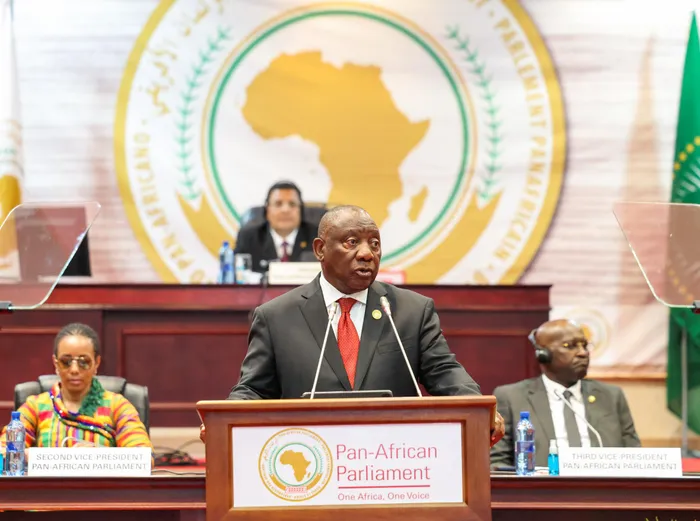
President Cyril Ramaphosa delivers the keynote address Opening of the First Ordinary Session of the Seventh Parliament of the Pan-African Parliament held at its headquarters in Midrand, Gauteng on July 27. The Session is held under the African Union's 2026 Theme: "Assuring Sustainable Water Availability and Safe Sanitation Systems to Achieve the Goals of Agenda 2063."
Image: GCIS
Kim Heller
When President Cyril Ramaphosa opened the First Ordinary Session of the Seventh Legislature of the Pan-African Parliament (PAP) in Midrand this week, he spoke of an institution that "carries the hopes and aspirations of more than 1.5 billion Africans for peace, progress and prosperity across our beloved continent."
He described it as "an enduring symbol of unity in diversity" and a vital democratic forum through which Africa's people, and not only its governments, can shape the continent's future. Lyrical words indeed.
Yet today the PAP remains one of the continent's greatest unfinished democratic projects. More than twenty years after its inauguration in Addis Ababa, it is still a parliament without legislative power. It debates. It scrutinises. It produces astute reports, model laws and carefully prepared resolutions.
It cannot, however, pass binding legislation. It cannot enforce implementation. Nor can it hold a single member state answerable for transgressing continental commitments.
Africa's continental Parliament remains largely consultative, while real power continues to lie with the Assembly of Heads of State and Government. This was never the original intention. The Pan-African Parliament, conceived under the Abuja Treaty, was expected to evolve into a fully-fledged legislative institution that would give ordinary Africans a direct voice in continental governance.
The 2014 Malabo Protocol reaffirmed this purpose. Twelve years later, the Protocol remains delayed as too few African states have ratified it. Sitting African Presidents have effectively muted this democratic continental voice.
The anti-colonial struggle was not merely about substituting foreign rulers with African governments. It was about deconstructing and decolonising power in a manner that served the people of the continent.
Political liberation without democratic participation is a poor win, and a betrayal of the promise of Pan-African democracy.
Former African Union Commission Chairperson Dr Nkosazana Dlamini-Zuma consistently argued that the Parliament should become a directly elected legislative body capable of passing laws that advance continental integration.
Her successor, Moussa Faki Mahamat, described its purely advisory status as a structural weakness that keeps it "away from the exigencies of an active and law-making institution." The Parliament's current President, Dr Fateh Boutbig of Algeria, has likewise called for the institution to become a genuine centre of continental governance rather than merely an observer of executive decisions.
There is a distinct democratic deficit in Africa where many of the most critical challenges transcend country borders. Climate change, migration, regional security, health, trade and resource sovereignty management require democratic continental institutions capable of developing common legal frameworks and holding governments accountable for implementing them.
An empowered Pan-African Parliament would strengthen both national and continental sovereignty in an increasingly competitive and multipolar global order, where Africa faces intensifying pressure over resources, influence and narrative control.
Despite institutional limitations, the Parliament has not been idle. It has supported the self-determination of the Sahrawi people, advocated for the rights of people with albinism, and advanced gender equality.
It has boosted election observation missions and supported the implementation of the African Charter on Democracy, Elections and Governance. Although its recommendations are not legally binding, the Pan-African Parliament has helped to shape continental and regional debates.
Its model laws on labour migration, democratic policing, gender equality, natural resource governance, public health and environmental management have provided African states with practical legislative templates rooted in African realities rather than externally imposed prescriptions.
This is important because it provides ready-made frameworks for national legislatures to adapt, thereby supporting the gradual harmonisation of laws across borders and reducing reliance on external models.
Institutionally, there are healthy signs of renewal. After years of internal political disputes which harmed its credibility, the election of a new Bureau under Dr Boutbig has restored stability and cohesion.
The Women's Caucus has evolved into an effective platform for promoting gender-responsive governance. Its sub-committees are active in addressing food security, public finance, infrastructure, human rights and conflict prevention.
The Parliament's work is more important now that the African Continental Free Trade Area (AfCFTA) is gaining momentum. Greater legislative standardisation and cohesion, common policies on labour mobility, environmental standards, infrastructure development and resource distribution are critical to the scope and success of the AfCFTA.
Economic integration ultimately requires legal integration. Ramaphosa acknowledged this in his opening address. He described the African Continental Free Trade Area as "the most powerful instrument we have to realise our cherished goal of African unity, prosperity and progress."
Speaking on the issue of migration, he argued that Africa must "create opportunity, silence conflict and strengthen inclusive institutions so that migration becomes a matter of choice rather than necessity."
Reflecting this year's African Union focus on water security and sanitation, he observed that shared rivers and aquifers require shared governance and called upon the Parliament to harmonise laws, supervise spending and bolster accountability. This cannot be achieved by a Parliament that is not empowered to legislate.
History preaches patience. The European Parliament also began as a consultative assembly before slowly acquiring legislative authority. Direct elections were only introduced in 1979, and it took decades to authorise its ability to make laws.
Closer to home, the East African Legislative Assembly exercises greater legislative and budgetary authority than the Pan-African Parliament. Supranational parliamentary governance is within reach.
Africa's Parliament needs to be transformed into a fully capacitated democratic legislature. Closing his address this week, Ramaphosa observed that the success of the Pan-African Parliament would not be measured by the debates it holds, but by the laws it helps shape, the commitments it helps implement and the difference it makes in the daily lives of Africa's people.
If the African Union genuinely believes that the Pan-African Parliament speaks for the people of Africa, then it must be entrusted with meaningful democratic power.
* Kim Heller is a political analyst and author of No White Lies: Black Politics and White Power in South Africa.
** The views expressed do not necessarily reflect the views of IOL or Independent Media.