World Bank Loans Undermining Democracy, Fiscal Sovereignty
ECONOMIC TRANSFORMATION
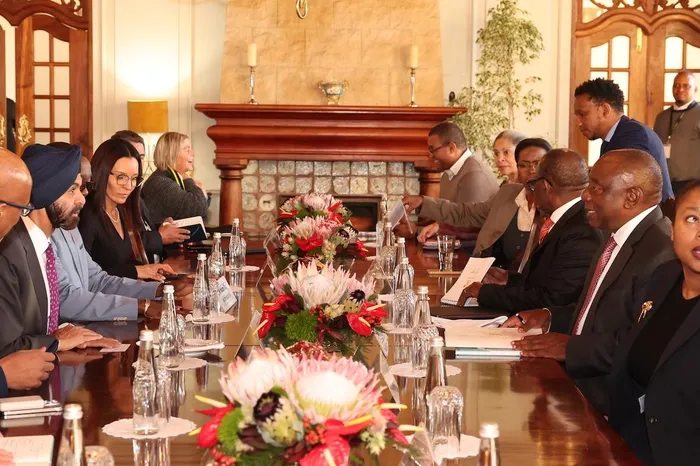
President Cyril Ramaphosa at a meeting with the World Bank Group, led by its President Mr Ajay Banga (left), at Mahlamba Ndlopfu in Pretoria on June 5. When governments make decisions that affect national fiscal sovereignty, they should not be able to bypass Parliament through administrative processes, say the writers.
Image: GCIS
Des Van Rooyen and Siyabonga Gama
The Umkhonto weSizwe (MK) Party rejects the recently concluded R25 billion World Bank Development Policy Loan. We do so not because we are opposed to development or investment, but because this particular financing arrangement is not neutral in its terms.
It comes with policy conditionalities—precise, pre-agreed reforms that lock South Africa into a direction of travel long after the debate in this House is over, and long after the officials who negotiated it have moved on.
This agreement is framed as a technical policy support measure. Yet the reality is that such loans function as political instruments. They tie South Africa’s fiscal and service-delivery choices to external policy prescriptions that are often regressive in effect: cutting the space for democratic decision-making, weakening public capacity, and advancing a privatisation agenda that transfers public obligations to private actors while leaving citizens to bear the risks.
At the heart of the MK Party’s objection is not the existence of foreign borrowing. South Africa may, at times, require financing to fund development. The question is who decides the terms, what those terms contain, and whether Parliament—through its constitutional oversight role—has meaningful authority before binding commitments are made.
Unfortunately, the country has fallen into a legislative and procedural gap. In recent years, National Treasury has secured large-scale commitments from multilateral institutions such as the World Bank and the African Development Bank.
But the pattern is troubling: significant long-term debt obligations are entered into without Parliament approving each agreement in advance, before the ink is dry and the policy conditionalities begin to shape domestic governance.
That gap is not a technical oversight; it is a constitutional weakness. It allows major policy decisions with fiscal consequences to be smuggled into the borrowing process rather than debated openly through democratic institutions.
MK Party believes that this must change. Borrowing that binds current and future generations should be subject to prior parliamentary approval, with full disclosure of the policy conditions before agreements are concluded.
When governments make decisions that affect national fiscal sovereignty, they should not be able to bypass Parliament through administrative processes. Democratic oversight must be frontloaded, not retroactively rationalised.
The World Bank loan—like similar arrangements elsewhere—does not merely “support efficiency.” It directs policy. It advances reforms that align with regressive IMF-style prescriptions and with the broader neo liberal privatisation logic that MK Party has already condemned in the context of Operation Vulindlela.
These are fundamental choices about the economy and about the role of the state in providing essential services. They should not be embedded through externally financed policy agreements that citizens do not meaningfully authorise.
The conditionalities attached to the loan reportedly relate to the privatisation of electricity, freight logistics, municipal infrastructure, and water and sanitation services. This is the central Operation Vulindlela copybook, whose negative effects will be felt in this country long after this hastily ill-conceived program by the prepaid GNU has been completed. The language used to sell these reforms is familiar: efficiency, investment, better service delivery, and improved performance.
But the outcomes of privatisation across sectors tell a different story. When essential services are opened to profit-driven models without robust safeguards, citizens face rising costs, uneven access, and deteriorating accountability. Investors may benefit from new revenue streams, but communities—especially the poor and working class—bear the burden when costs increase or when service providers fail to deliver.
Nowhere are these concerns more urgent than in local government. Municipalities already struggle with declining revenues, driven in part by the disruptions flowing from electricity privatisation and changes in how revenue is generated and collected. Extending the same privatisation approach to water and sanitation risks weakening another critical municipal revenue stream.
This matters because municipalities do not only deliver services; they also finance them through local billing systems and revenue flows. When those flows weaken, municipalities become more dependent on national transfers. The result is a predictable cycle: less municipal autonomy, less financial sustainability, and worsening service delivery.
First it was electricity; and now it is water and sanitation. Without a comprehensive replacement revenue framework, local government is placed in an impossible position. It is asked to take on greater responsibility while being stripped of the tools that fund service delivery. That is not reform; it is dismantling capacity and then blaming public institutions for the consequences of policy changes imposed from outside.
South Africa requires development finance that strengthens industrialisation, supports infrastructure investment, expands productive employment, and accelerates genuine economic transformation.
That is what “development” should mean in practice: building the productive base of the economy and improving the lives of people through effective public investment. Development should not be reduced to loans that finance IMF policy reform programmes while undermining the basic pillars of service delivery.
This is why the MK Party calls for immediate amendments to the Public Finance Management Act (PMFA) to close the current oversight loophole. We propose three clear actions:
(1) Parliament must approve major sovereign borrowing in advance of conclusion, particularly where loans contain policy conditionalities that affect domestic governance and essential services.
(2) Loan conditions must be fully disclosed publicly before agreements are finalised, so citizens and Members of Parliament can scrutinise what is being traded for financing—what reforms are demanded, what timelines apply, and what consequences follow if conditions are not met.
(3) Treasury must provide transparent accountability showing how externally supported programmes align with South Africa’s development priorities, including impacts on municipal financing, service delivery, and fiscal sustainability.
Our argument is straightforward: policy choices that shape the direction of the state must be determined by South Africans, through democratic institutions—not through negotiated commitments with international lenders that bypass transparent parliamentary scrutiny.
A country cannot call itself democratic while allowing core economic decisions to be made under the cover of debt instruments, proposed by neo liberal consultants who do not take into account the lived realities of its people or the character of the South African economy.
The MK Party rejects this World Bank loan because it represents precisely that danger: a transfer of sovereignty, not only in finances, but in policy. If government intends to borrow at this scale, it must do so in the open, with Parliament’s approval, and with citizens fully informed. That is how constitutional democracy protects both the present and the future.
South Africa’s development path is not a bargaining chip. It belongs to the people, and it must be determined through Parliament—not conditioned by external lenders.
* Van Rooyen is MKP's Member of the Standing Committee on Finance and Gama a member of the Portfolio Committee on Trade and Industry.
** The views expressed do not necessarily reflect the views of IOL or Independent Media.