High Court Ruling Shields A President Who Fears Accountability
PHALA PHALA SAGA
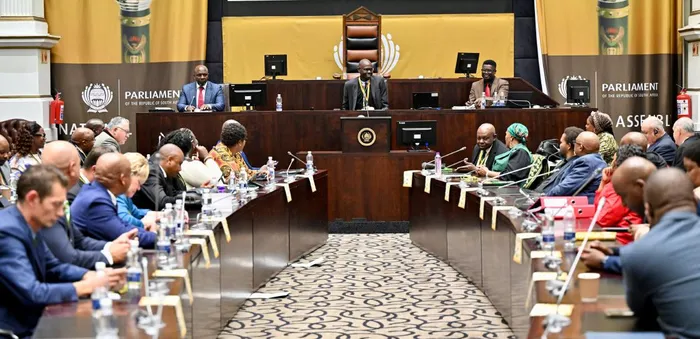
Parliament’s Impeachment Committee is forging ahead with its preparatory work despite a Western Cape High Court interdict that halted its Section 89 public hearings. The political optics generated by the Western Cape High Court’s judgment are deeply unedifying, says the writer.
Image: Phando Jikelo/RSA Parliament
Prof. Sipho Seepe
The Western Cape High Court’s decision to halt Parliament’s impeachment proceedings is merely the latest episode in the unrelenting crisis of leadership and trust that continues to engulf President Cyril Ramaphosa’s presidency.
At the heart of this crisis lies the constitutional demand for accountability—a demand Ramaphosa has perfected the art of evading at every turn.
The legal drama now playing out before the public centres on technical arguments over whether the independent parliamentary panel, chaired by former Chief Justice Sandile Ngcobo and composed of distinguished legal minds, applied the correct test when it concluded that Ramaphosa may well be guilty of a gross violation of the Constitution and anti-corruption statutes.
What remains etched in the public mind is the ignominious fall of a leader once hailed as the embodiment of integrity, only to squander that promise completely. It is the transmogrification of “Mr Clean” into a serial constitutional delinquent.
The political optics generated by the Western Cape High Court’s judgment are deeply unedifying. This is the same court that previously ruled against the former Public Protector when she sought to pursue precisely the kind of accountability process that Ramaphosa himself had once demanded.
In highlighting the apparent inconsistency, #CountryDuty, a civic movement that mobilises citizens around issues of accountability and justice, identified three clear grounds on which the ruling is appealable.
First, the judgment disregards the Constitutional Court’s earlier caution against courts freezing constitutionally mandated processes of public accountability pending review. Courts may intervene to halt such a process only when persuaded that the review is likely to succeed—not merely that it is arguable. The majority judgment fails to engage this critical threshold.
Second, the court invented an entirely new species of harm—“rule of law harm.” In plain language, this amounts to the claim that allowing a possibly unlawful process to proceed at all itself damages the rule of law.
Such a notion forms no part of the established four-part test for an interdict. As the ATM, MKP and EFF have correctly argued in agreement with #CountryDuty, if left unchallenged this innovation would freeze almost any government process facing any legal challenge, no matter how weak.
Third, having broken its own 2022 precedent—in which it refused to stop the impeachment process against then-Public Protector Busisiwe Mkhwebane despite a similarly unresolved legal challenge—the court did not explain this glaring inconsistency. The majority judgment is silent on the point.
In short, the inconsistency is stark: the Western Cape High Court once insisted that Parliament must generally be allowed to perform its constitutional duties without judicial interruption; in Ramaphosa’s case it interrupted those very duties.
The same court appears to have decided that reputational damage carries greater legal weight for the President than it did for the Public Protector.
It can of course be argued that each review application must stand on its own merits and that different facts can legitimately produce different outcomes. Yet the ruling inevitably raises the question of the threshold now being applied.
The seeming shift in judicial reasoning poses profound constitutional questions about the necessary and sufficient conditions that must be met before courts intervene in parliamentary affairs.
Those questions must be weighed against the Constitutional Court’s long-standing insistence that courts exercise exceptional restraint before interrupting constitutionally mandated parliamentary processes.
While the courts remain absorbed in legal technicalities and what many perceive as institutional shenanigans, the ordinary citizen—in whose interests the judiciary is supposed to act—remains thoroughly unimpressed.
The ruling arrives at a moment when public trust in the criminal justice system has reached rock bottom. The inaugural survey by Action Society, the Criminal Justice Trust Indicator (CJS-TI), reveals that trust in the judiciary stands at a mere 4 per cent.
Unlike other surveys, the CJS-TI measures the system’s performance as experienced by the public: perceived availability of justice, lived experience of justice outcomes, perceived impunity, and perceived systemic delay. The findings point to a near-total collapse of public confidence in South Africa’s criminal justice system.
This builds on earlier Afrobarometer data. In 2018, 32 per cent of South Africans suspected that judges were involved in corruption—more than double the 15 per cent recorded in 2002.
Politically, Ramaphosa is damaged goods. For a man who insists he is innocent and has nothing to hide, he has gone to extraordinary lengths to ensure he is never called to account. These are not the actions of a confident leader; they are the manoeuvres of a man on the ropes.
Successive polls show that he is dragging the ANC down with him—a prospect and a warning repeatedly voiced by his former comrade and predecessor, Thabo Mbeki.
Long before the Constitutional Court delivered its landmark judgment finding that Parliament had erred in halting the impeachment process, Mbeki had expressed his deep annoyance at the ANC’s decision to close ranks and squash the attempt to establish a multi-party committee to investigate Ramaphosa.
Mbeki wrote: “Are we [the ANC] saying that we suspect or know that he (Ramaphosa) has done something impeachable and therefore decided that we must protect our president at all costs by ensuring that no Multi-Party Committee is formed? … We acted as we did [as if] there was something to hide…. What message are we communicating to the masses of our people about the values and integrity of the ANC?”
Mbeki’s concern finds direct echo in the independent panel’s conclusion: “Viewed as a whole, the information presented to the Panel, prima facie, establishes that there was a deliberate intention not to investigate the commission of the crimes committed at Phala Phala openly.”
Mbeki has since sharpened his critique, pointing out that the Phala Phala scandal has nothing to do with the ANC’s political agenda. It is a private matter involving a member engaged in private business. Could it be that the ANC has entangled itself in the scandal because some of its members are Ramaphosa’s clandestine business partners and are therefore equally implicated in what appears to be fraud, money laundering and corruption?
The more extreme and frightening possibility is that many within the party sit in Ramaphosa’s financial pockets. In that case the ANC is led by pre-paid members whose only function is to do the bidding of their paymaster.
Matters grow still more complex when one recalls that the judiciary itself decided South Africans could not be entrusted with information about who funded Ramaphosa’s 2017 campaign for the ANC presidency.
This turn of events stands in stark contrast to the confidence Ramaphosa once projected.
Riding a wave of public approval, he declared: “In my own history where I am conflicted, I have [had] a sense of integrity to step out of the way to say I’m conflicted on this and I have ingrained that in the way I do things so that fingers should not be pointed at one about favouring oneself when you are conflicted.”
He was responding to questions about what he would do if implicated in the Zondo Commission report on state capture. He presented himself as a man of integrity prepared to come clean.
That assurance was music to the ears of his enthusiastic supporters in the mainstream media—hopeless groupies who once insisted he could do no wrong. We now know that keeping his word has never been Ramaphosa’s strongest trait.
Quite the opposite. And the ANC will pay the price. When Ramaphosa finally bows out as President, there will be precious little left of the party he once promised to renew.
* Professor Sipho P. Seepe is an Higher Education and Strategy Consultant.
** The views expressed do not necessarily reflect the views of IOL or Independent Media.