Will a United, Independent Judiciary Transform SA’s Legal System?
STATE OF JUSTICE
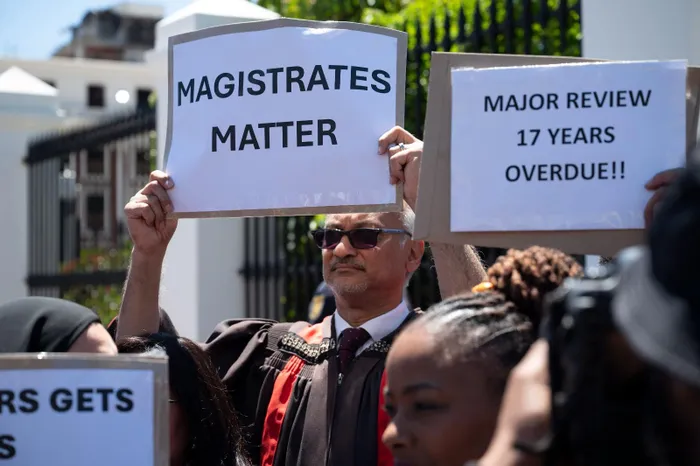
Western Cape magistrates marched to Parliament in Cape Town, to demand judicial reforms, improved salaries, and recognition as 'judges of the lower court'. Magistrates’ courts are the closest to the people. While bringing different levels of the judiciary together is a progressive move, that alone will not address any incompetencies and other challenges that the judiciary is wrestling with, says the writer.
Image: Armand Hough / Independent Newspapers Archives
Prof. Bheki Mngomezulu
The Judiciary Conference was held in Umhlanga in KwaZulu-Natal from July 13 to 16, 2026. The main objective of this conference was encapsulated in its theme: “Towards a single, institutionally independent, and accountable judiciary.”
The six main resolutions adopted on the last day built on those adopted at the Judges Conference held from December 4 to 7, 2023, in Sun City in the North-West province. Twenty years had passed since South Africa’s legal minds gathered in this manner to deliberate on various issues that concern their profession.
Unlike the 2023 conference, which primarily focused on the judges, the one for 2026 was broader in its focus – including the judiciary in its broader context. As indicated in both the theme outlined above and the resolutions discussed below, the 2026 conference took a deliberate decision to correct some of the wrongs of the past by calling for unity.
But while the intention of this conference looks genuine and justifiable, the question remains: to what extent will the proposed single independent judiciary address incompetencies and other ills associated with the judiciary?
For example, will allegations of corruption, delays in delivering judgements as was the case with the Phala Phala matter, and the delivery of questionable judgements suddenly end just because there will be a single and institutionally independent judiciary?
To answer this and other questions, it is important to trace the judiciary from the country’s constitution and cite a few examples that will illuminate certain submissions and propositions.
Firstly, South Africa has three arms of state. These are the executive, the legislature, and the judiciary. The last arm is independent and is tasked with interpreting the laws, ensuring justice, and upholding the constitution of the country. All the courts in the country – including the Constitutional Court – fall under this arm of the state, the judiciary.
Chapter 8 of the Constitution specifically focuses on courts and the administration of justice. Section 165 of the Constitution focuses on judicial authority. Section 165(1) states that the judicial authority of South Africa is vested in the courts. Section 165(2) expounds this point by stating that “the courts are independent and subject only to the Constitution and the law, which they must apply impartially and without fear, favour or prejudice.”
The discussion above makes it clear that since the Constitution was adopted in 1996, the judiciary had a very clear mandate on what to do and how. If that is the case, how did it happen that some judges failed to act independently, delivered questionable judgements, or delayed in delivering judgements long after the cases had been concluded?
This question implores us to have reservations that the resolutions of the 2026 Judiciary Conference will make any significant difference in how the judiciary conducts its business. What seems clear is that the problem is not a lack of clarity on what judges and magistrates must do. Instead, failure by some members of the judiciary to execute their mandate resides elsewhere.
From an administrative point of view, the proposed changes as per the conference resolutions do make sense. The call for a judiciary-led court administration and governance model proposed in resolution 1.1 would assist in bringing synergy within the judiciary.
The resolution on the need for a sustainable funding model to secure the judiciary’s financial independence and accountability for public funds is indeed fair. However, this alone will not suddenly result in the members of the judiciary refraining from the allegations enumerated above.
Resolution 2 focuses on the need for adequate remuneration, benefits, staffing, and other issues to make the job of the judiciary easier. The six sub-sections provide the necessary detail. Surely, this is a necessity. All employees need proper salaries. But good salaries and adequate tools of trade do not cure conscience (or lack thereof). Even after this resolution has been implemented, more work will still be necessary to redeem the image of the judiciary.
One of the critical resolutions is Resolution 3, which focuses on the code of judicial conduct and norms and standards. The proposed Judicial Conduct and Norms and Standards Review Committee is a noble idea. The detail provided in sub-sections 3.1-3.4 is explicit enough.
But while the code of judicial conduct is important, it remains unclear if, once finalised, it will be implemented and properly monitored.
The third resolution on judicial appointments, ethics and discipline is linked to resolution 3. Sub-section 4.1 exposes the disconnect in legislation which regulates judges and magistrates. The resolution proposes an amendment of legislation to bring all appointments and matters of discipline under one legislative regime.
Experience shows that having good legislation is not a panacea to addressing societal issues. In the same vein, it is not a solution to addressing issues affecting professionals – including those in the legal fraternity.
Magistrates’ courts are the closest to the people. Higher courts such as the High Courts, appeals courts, and the Constitutional Court are not easily accessible. While bringing different levels of the judiciary together is a progressive move, that alone will not address any incompetencies and other challenges that the judiciary is wrestling with.
Resolution 5 is progressive. It calls for the judiciary to be supported in information technology, digitisation and artificial intelligence (AI). This resolution speaks to the need to enable the judiciary to move with the times so that it could remain relevant. The call for “the modernisation of court” to enable the judiciary to provide service expeditiously is good. All the six sub-sections under this resolution are informative and sound.
But advancement in technology is not enough to address all the challenges faced by the judiciary.
Judicial wellness stipulated in resolution 6 will assist the judiciary in focusing on the work at hand. But such wellness alone is not an answer to all the challenges and allegations levelled against the judiciary.
Transformation of the judiciary is a necessity. However, individuals should be the first ones to transform.
* Prof. Bheki Mngomezulu is Director of the Centre for the Advancement of Non-Racialism and Democracy at Nelson Mandela University.
** The views expressed do not necessarily reflect the views of IOL or Independent Media.