UN's Structural Disconnect Sidelines Africa in Peacekeeping decisions
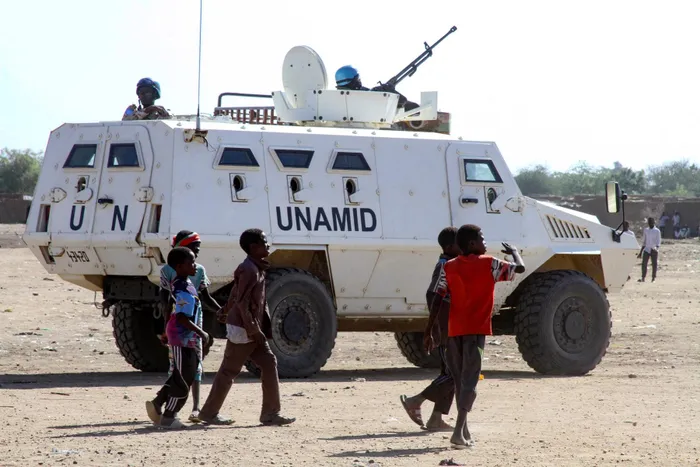
Sudanese children walk past an armoured vehicle of the United Nations and African Union peacekeeping mission (UNAMID) in Kalma Camp for internally displaced people in Nyala, the capital of South Darfur. The limited presence of practitioners from Africa was conspicuous throughout the week, even though Africa accounts for more than 40% of the world’s conflicts, says the writer.
Image: AFP
Emebet Getachew Abate, Sara Tadesse Gebremariam
The week of June 22–26, 2026, set a milestone in the United Nations’ institutional calendar: the first-ever UN Peacebuilding Week, convened in New York alongside the 20th anniversary of the UN peacebuilding architecture.
Under the theme “Partnerships for Innovation, Inclusion, and Impact,” more than 50 parallel sessions and side events were held across five days. At a moment when multilateralism is being tested, this gathering was not only symbolic but a reaffirmation that peace remains a collective interest and that the system built to sustain it still matters.
Four key themes emerged from the week’s thematic discussions:
Anchoring Peacebuilding in Prevention
The most important choice in designing Peacebuilding Week was to centre prevention not as a standalone theme but as the connective tissue binding the entire program. Anchoring peacebuilding in prevention carries normative weight, affirming that prevention is universal and that the UN system has moved, at least at the level of discourse, beyond treating peacebuilding as a post-conflict affair.
Evidence of buy-in for the prevention agenda is reflected in the formal submission of national prevention strategies to the UN Peacebuilding Commission by countries such as São Tomé and Príncipe, Mauritania, Angola, and Papua New Guinea, marking a significant transition from multilateral aspiration to national policy commitment.
Yet, such a strategy submitted to a multilateral body is merely a policy artefact; it is not, in itself, evidence of the operational capacity, funding, or political will required for implementation.
It is therefore crucial for prevention strategies to be grounded in existing local practices.
Yet these localised strategies often lack international support. One session organised by the Sigrid Kaag Foundation reinforced how peacebuilding and prevention plans that are not funded do not lead to change, and short-term project funding undermines the kind of sustained, locally led practices evident in places like Mauritania and Sudan.
Technology and AI
The sessions focused on technology were among the week’s most refreshing, and among the most unresolved. The conversation on peacebuilding through innovation, facilitated by the UN Global Compact, presented financing models for fragile contexts and explored the application of AI as a catalyst for peacebuilding.
AI offers real potential for peacebuilding, from Kenya’s early-warning architecture built around the Uwiano Platform for Peace to digital tools used to document atrocities and map community needs in Syria. Yet to be used responsibly in contexts such as mediation, negotiation, and early warning, AI tools need to be rooted in trust, data sovereignty, a do-no-harm approach, and human oversight.
One of the enduring challenges is the asymmetry in who is developing AI tools. AI systems are predominantly trained on European, North American, and English-language sources, leaving a data gap that initiatives like the Lacuna Fund are working to close.
A representative of Microsoft acknowledged that most AI labs do not bring local participants to the table during the design phase, only afterwards. Genuine co-design would distinguish this generation of peacebuilding technology from earlier waves of externally designed early-warning systems that lacked local ownership.
Fragmentation Despite Shared Purpose
One of the week’s most recurring themes was the need for a whole-of-society, whole-of-system approach to peacebuilding, yet there was little reflection on how existing mechanisms could be better harmonised and connected without reinventing the wheel.
For more than a decade, the same cluster of challenges- siloed approaches, connections between the local and the global, inclusion, financing, and partnerships- has dominated peacebuilding discourse.
Yet the question remains whether these are being confronted or have become permanent fixtures of the system. A session on inclusive dialogue and partnerships across peacebuilding hubs offered a pointed observation: The environment in New York is not a true ecosystem, but rather a hierarchical, highly political, and member-state-driven system.
Participants called for peacebuilding hubs to be connected, not duplicated, and warned against confusing ecosystems with echo chambers.
The Absence of African Frameworks
The limited presence of practitioners from Africa was conspicuous throughout the week, even though Africa accounts for more than 40% of the world’s conflicts.
UN Deputy Secretary-General Amina Mohammed reminded participants at a side event “not to lose sight of the people who are caught up in conflict while actors at the UN level sit 40,000 feet high.”
Moreover, none of the sessions was framed around African peacebuilding frameworks. The African Union’s Continental Structural Conflict Prevention Framework, including the Country Structural Vulnerability and Resilience Assessment (CSVRA) and the accompanying Country Structural Vulnerability Mitigation Strategies (CSVMS), had limited visibility.
The AU’s “Silencing the Guns” initiative did not feature in any of the discussions. This pointed to the structural disconnect between the UN and regional mechanisms.
This disconnect reflects a deeper asymmetry in whose frameworks are treated as the default reference point. AU instruments such as the CSVRA were developed to assert African ownership over how fragility and prevention are defined, yet sessions addressing Sudan, the Sahel, and the Horn of Africa drew almost exclusively on UN-generated typologies.
The practical consequence is that African institutions are required to translate their own frameworks into UN terminology to be legible in these spaces, rather than the reverse. Closing this gap requires UN conveners to actively build instruments from the AU and regional economic communities into session design from the outset.
The permanent mission of Kenya was a notable exception to the lack of African representation, co-sponsoring at least six side events with substantive participation. By contrast, the AU Observer Mission to the UN co-sponsored only two side events, and the regional economic communities were conspicuously absent.
Middle powers including Turkey, India, the United Arab Emirates, and Saudi Arabia were largely missing as conveners or substantive contributors. Nordic countries, EU member states, the UK, Germany, Switzerland, Canada, and the Republic of Korea demonstrated the strongest multilateral commitment, backed by sustained financial investment.
Holding the System Accountable
These four takeaways point to a system that has largely arrived at the right normative conclusions. Prevention is universal. Peace must be locally owned. Technology must be human-centred. Financing must be flexible and long-term. Few in the rooms would dispute any of these propositions.
Yet the distance between these norms and institutional habits remains a central fault line.
At a civil society dialogue convened by ACCORD, Vasu Gounden noted how almost none of the peacebuilding architecture that exists today predates 1990. The Peacebuilding Fund, mediation support structures, and peacekeeping operations were all built by a generation that decided it wanted a different world.
The young practitioners in the room at Peacebuilding Week are entering a far more difficult era: more transnational violence with the resurgence of proxy actors scrambling for ports, minerals and allegiance, more transactional approaches to peacemaking, and a multilateral order under greater strain.
The first UN Peacebuilding Week demonstrated that the system can still convene, still produce evidence, and still generate cross-sectoral exchange. The test for the years ahead is whether it can hold itself accountable to its own stated commitments with the same rigour it applies to the conflicts it studies.
It requires political commitment, coalition building, mutual accountability, and the capacity to sustain collective action over time. That scrutiny must be applied as readily to the architecture of the UN itself as to the fragile states it seeks to support.
* Emebet Getachew Abate is a gender, peace and security, and peacebuilding practitioner. Sara Tadesse Gebremariam is a peacebuilding and programme professional focused on Sudan and the Horn of Africa. This is an edited version of the article published at https://theglobalobservatory.org/
** The views expressed do not necessarily reflect the views of IOL or Independent Media.