PIC's Governance Crisis Underscores Urgent Need for Political Reform
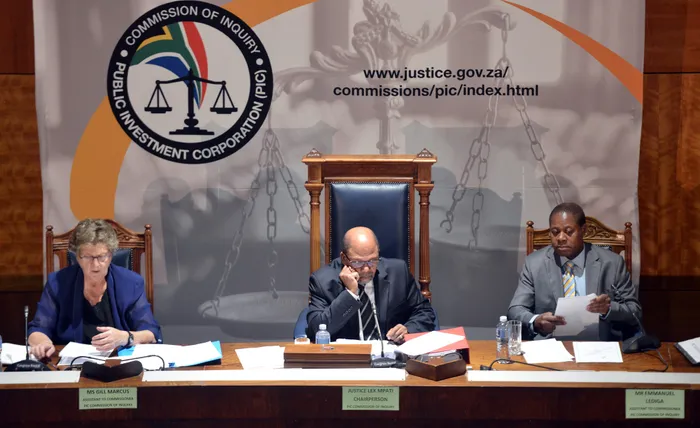
(From left) Gill Marcus, Justice Lex Mpati (Chairperson) and Emmanuel Lediga were appointed by President Cyril Ramaphosa in 2018 to probe allegations of impropriety within the Public Investment Corporation. Successive administrations have commissioned numerous reviews into the governance of State-Owned Companies. The country's challenge is therefore not a shortage of diagnostic reports. It is an implementation deficit, says the writer.
Image: Oupa Mokoena / Independent Newspapers
Zamikhaya Maseti
The administrative and executive turmoil that has engulfed the Public Investment Corporation (PIC) is both unfortunate and deeply concerning.
The precautionary suspension of its Chief Executive Officer, Patrick Dlamini, has once again exposed the fragility of governance within one of South Africa's most strategic public institutions. Yet to interpret the current developments merely as an isolated governance dispute would be to miss the larger political economy question confronting the democratic State.
The PIC is not simply another State-Owned Company. As the manager of approximately R3 trillion in assets, principally on behalf of the Government Employees Pension Fund, it occupies a unique position in South Africa's financial architecture.
It is the custodian of the retirement savings of millions of public servants and one of the largest institutional investors on the Johannesburg Stock Exchange. Its investment decisions influence infrastructure development, industrial financing, housing, private equity and the broader direction of capital formation within the economy.
Consequently, instability at the PIC reverberates far beyond its boardroom. It undermines confidence in the State's capacity to safeguard public wealth and weakens trust in institutions that should anchor long-term economic development.
The current crisis should therefore compel South Africans to revisit a much broader question. What is the strategic purpose of our State-Owned Companies within the democratic developmental state?
This question extends beyond the PIC to include Eskom, Transnet, Denel, the South African Post Office and the Development Finance Institutions (DFIs). More fundamentally, it invites us to ask whether the democratic state has developed a coherent understanding of what these institutions are meant to achieve within South Africa's political economy.
Ironically, the Apartheid State answered this question with remarkable clarity, albeit in pursuit of an immoral and exclusionary project. State-Owned Companies were deliberately positioned as instruments of economic transformation for White South Africans. Institutions such as the South African Railways, the Post Office, Eskom, ISCOR and SASOL formed part of a deliberate state-led strategy to address the socio-economic challenge of the poor whites.
Through public employment, industrial expansion, skills development and preferential access to economic opportunities, these institutions consolidated and expanded the White middle class while systematically excluding the majority of the Black people from meaningful economic participation.
The masses of the Black people were instead confined to providing cheap labour upon which that racial political economy was constructed.The democratic State inherited these institutions together with their considerable productive capacity. What it inherited less successfully was the strategic coherence with which they had previously been deployed.
Thirty years into democracy, millions of Black people remain trapped in structural poverty, unemployment and economic exclusion. This reality should force us to ask an uncomfortable question. Why has the democratic State been unable to utilise these same institutions with equal determination to dismantle poverty, create productive employment, drive inclusive industrial development and unapologetically address the problem of the poor blacks?
The answer cannot simply be reduced to corruption or poor administration, although both have undoubtedly contributed. The deeper challenge lies at the intersection of politics and economics. It is at this intersection that institutional mandates become blurred, political interests compete with developmental priorities and governance structures gradually lose their strategic direction.
The Judicial Commission of Inquiry into Allegations of State Capture, chaired by Chief Justice Raymond Zondo, exposed how this intersection became fertile ground for patronage and institutional capture.
Boards that were expected to provide strategic leadership increasingly became sites of factional contestation. Oversight weakened. Accountability deteriorated. Executive authority became vulnerable to political interference.
Institutions established to advance national development instead became preoccupied with internal instability and, in some instances, private enrichment. Yet South Africa cannot claim ignorance of these governance weaknesses.
Successive administrations have commissioned numerous reviews into the governance of State-Owned Companies. The country's challenge is therefore not a shortage of diagnostic reports. It is an implementation deficit.
President Cyril Ramaphosa should seize the present crisis at the Public Investment Corporation as the moment to fully implement the recommendations of the Presidential Review Committee on State-Owned Entities, which was appointed on 10 May 2010 and chaired by Riah Phiyega.
The Committee produced one of the most comprehensive blueprints for reforming South Africa's State-Owned Companies, addressing governance, shareholder oversight, funding models, board appointments and institutional accountability. Its recommendations remain as relevant today as they were when they were submitted.
There is a certain historical continuity that should not be overlooked. President Ramaphosa served as Deputy President when the Committee completed its work and received its report. The country therefore does not require yet another commission of inquiry or another diagnostic exercise.
The report already exists. It simply needs to be dusted off and implemented with political conviction.The recurring crises at the PIC, Eskom, Transnet, Denel and other State-Owned Companies demonstrate that replacing boards, dismissing executives or reshuffling leadership cannot, on their own, resolve systemic governance failures.
Such interventions may address immediate administrative challenges, but they do not remedy the structural weaknesses that continue to undermine these institutions' developmental capacity.
South Africa's State-Owned Companies must now be fundamentally repurposed into the true developmental arms of the democratic State. They should mobilise public capital, drive industrialisation, finance strategic infrastructure, support productive sectors of the economy, create sustainable employment and broaden economic participation.
This was the strategic vision that informed the work of the Presidential Review Committee, and it remains the unfinished business of democratic South Africa.
Nothing less will restore the developmental character of South Africa's State-Owned Companies. Nothing more is required than the political will to implement the reforms that government itself commissioned.
* Zamikhaya Maseti is a Political Economy Analyst.
** The views expressed do not necessarily reflect the views of IOL or Independent Media.