Building Economic Freedom: The SA, Namibia Partnership
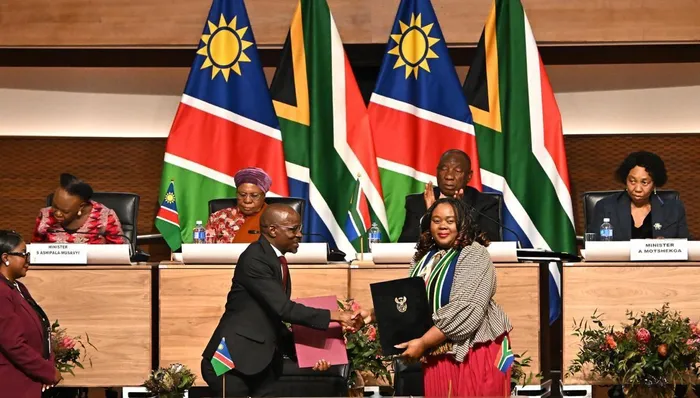
Namibian President Netumbo Nandi-Ndaitwah and President Cyril Ramaphosa witness the signing of seven agreements during the 4th session of the SA-Namibia B-National Commission held on July 17 in Pretoria.
Image: Presidency/X
Kim Heller
"Namibia is not merely our neighbour. Namibia is our sister nation," President Cyril Ramaphosa affirmed at the Fourth South Africa–Namibia Bi-National Commission (BNC), held in Pretoria last week. South Africa and Namibia share a history shaped by struggle, sacrifice and solidarity.
In 1967, Namibian liberation leader Andimba Toivo ya Toivo and thirty-six other Namibian activists were charged with terrorism in an apartheid South African court. Their "crime" was resisting South Africa's illegal occupation of Namibia and demanding their country's right to self-determination.
Standing in the dock, Toivo defended the rights of the Namibian people to govern themselves and determine their own future. He was sentenced to twenty years' imprisonment. He spent sixteen years on Robben Island alongside Nelson Mandela, Walter Sisulu, Govan Mbeki and other ANC leaders, forging bonds of solidarity that no prison walls could break.
The liberation struggles of Namibia and South Africa were never separate. They were chapters of a common African quest for freedom and dignity.
Today, more than three decades after the end of apartheid and the achievement of Namibian independence, both countries remain confronted by another formidable challenge: dismantling colonial economic structures that continue to shape patterns of wealth, production and trade.
Political freedom has not translated into genuine economic sovereignty. Across much of Africa, colonial patterns of extraction remain firmly intact. The continent exports its minerals, agricultural products and raw materials while importing manufactured goods produced elsewhere at far greater value.
African labour, resources and markets continue to enrich economies beyond the continent while industrial development at home remains constrained. The antidote lies not in isolated national strategies but in coordinated continental industrialisation, anchored in robust regional integration, and African ownership of production.
Against this backdrop, it is encouraging that at last week's Bi-National Commission, seven bilateral agreements and memoranda of understanding were signed, covering trade, transport, agriculture, education, skills development and other areas of cooperation.
Equally significant was the establishment of the Namibia–South Africa Business Council by the two countries' chambers of commerce. Together these developments suggest a growing determination to move beyond ceremonial diplomacy towards measurable economic delivery.
The foundations for deeper economic cooperation already exist. South Africa remains Namibia's largest trading partner, while Namibia is an increasingly important economic partner for South Africa. Bilateral trade has increased in recent years, with Namibia exporting billions of dollars' worth of goods, including minerals, fish, livestock products and other commodities.
The newly established Business Council has been tasked with advancing joint production in manufacturing, energy and logistics. If accompanied by political resolve, projects such as the Kudu Gas Project, the Trans-Kalahari Corridor and emerging green industrial corridors could significantly strengthen regional energy security, improve transport infrastructure and stimulate industrial investment across Southern Africa.
President Netumbo Nandi-Ndaitwah articulated this vision clearly. "What we want is balanced prosperity through value addition, industrialisation and stronger regional value chains," she said.
Her emphasis on expanding manufacturing capacity rather than simply increasing commodity exports reflects an understanding that sustainable development depends upon producing, processing and innovating within Africa rather than exporting the continent’s riches to build and sustain foreign empires.
She also welcomed the private sector's commitment to supporting investment, job creation and the opportunities presented by the African Continental Free Trade Area (AfCFTA).
Both governments reaffirmed their commitment to the AfCFTA and the African Union's Agenda 2063. Intra-SADC trade remains disappointingly weak despite decades of declarations, protocols and ambitious regional plans.
Most Southern African countries continue to trade far more extensively with foreign nations than with each other. This reinforces dependence on external markets and limits opportunities for regional industrial growth.
If expanding trade between South Africa and Namibia is coupled with greater manufacturing capacity, beneficiation and coordinated industrial planning, it could help reposition SADC as a genuine economic powerhouse rather than merely a supplier of raw materials.
President Nandi-Ndaitwah's proposal that the Southern African Customs Union should become an engine for regional industrialisation deserves serious consideration. Customs unions can be repurposed to build productive regional economies.
Namibia offers valuable lessons for the region. Under President Nandi-Ndaitwah's leadership, food self-sufficiency has been elevated to the centre of national development planning. Food production is rightly viewed as both a strategic national asset and a cornerstone of economic resilience.
While South Africa possesses considerable agricultural potential, it has yet to fully realise that potential or transform the sector in ways that meaningfully include Black farmers and rural communities.
Namibia's insistence on greater local participation and beneficiation within its emerging oil and gas industry is commendable. This determination to dismantle the colonial model of extraction and replace it with an African-centred development strategy offers an important example for South Africa and the wider SADC region.
Previous bilateral commissions have produced ambitious declarations that were followed by uneven implementation. Yet there is also reason for cautious optimism. The Fourth South Africa–Namibia Bi-National Commission focused on measurable outcomes, institutional cooperation and long-term economic planning.
If the political will demonstrated in Pretoria is sustained, the partnership between these sister nations could become a model for regional integration.
The liberation movements that defeated colonialism and apartheid transformed the political landscape of Southern Africa. The challenge confronting today's leaders is to complete that unfinished journey by transforming the economic landscape.
Winning that battle requires regional integration, industrialisation, beneficiation and the courage to place African development above inherited colonial patterns of dependency.
The same courage that won freedom must now be summoned to build economic freedom – to build prosperity, replace dependency with development, and secure genuine African economic sovereignty.
* Kim Heller is a political analyst and author of No White Lies: Black Politics and White Power in South Africa.
** The views expressed do not necessarily reflect the views of IOL or Independent Media.