Political Interference in the PIC Impeding Economic Transformation
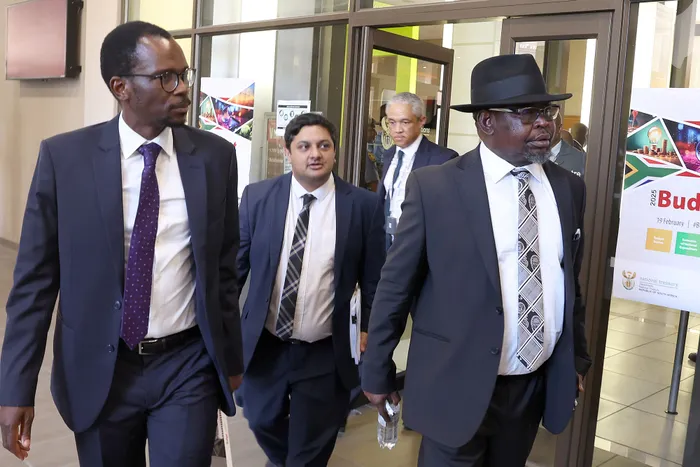
(From left) Deputy Ministers of Finance Dr David Masondo, Ashor Sarupen and Minister of Finance Enoch Godongwana at budget briefing in Cape Town. If political leaders allow the PIC to become another battlefield of ANC internal contestation, public confidence will keep collapsing, says the writer.
Image: Kopano Tlape / GCIS
Des Van Rooyen
The uMkhonto weSizwe Party (MK Party) regards the precautionary suspension of Patrick Dlamini, Chief Executive of the Public Investment Corporation (PIC), with caution—but not passivity. Strategic state institutions must be protected, and investigations must run their course in a manner that respects due process and the constitutional order.
At the same time, we must say clearly: where political meddling has allegedly distorted oversight, that wrongdoing must be condemned in the strongest terms.
The MK Party believes that the reported conduct—political interference allegedly brought about by the ANC Minister of Finance together with his ANC Deputy Minister of Finance, who also chairs the PIC Board—has serious implications for institutional stability and public trust.
A precautionary suspension is not a finding of guilt. However, it is a mechanism that tests the strength of governance systems and the integrity of investigations. The PIC is central to South Africa’s financial architecture and, critically, manages funds for government pensioners.
For that reason, any disruption at leadership level must be handled with transparency, consistency, and urgency—without political interference and without undermining credibility.
Recent developments have also attracted regulatory scrutiny, which only heightens the obligation on all political principals to restore confidence through credible governance.
But the MK Party’s concern goes beyond process: the country cannot be led to believe that financial oversight and strategic public institutions are subject to factional control by whoever holds the loudest political power in the moment.
We also reject the growing perception that there are competing centres of authority within the political leadership responsible for overseeing public financial and economic institutions. When leadership is divided through political rivalry, it weakens institutional stability, unsettles investors, and erodes public trust. In such moments, pensioners and the ordinary working class are the ones who pay the price—never the ministers, never the factions.
The MK Party therefore insists that three principles must guide what happens next:
1. The precautionary process must be completed swiftly, fairly, and transparently, so that the PIC is not left in prolonged uncertainty.
2. Governance must not be compromised by political or personal rivalries. Investigations must be independent and insulated from interference, and day-to-day authority must not be disrupted through political theatre; and
3. There must be accountability based on evidence—not opportunism. If allegations have been weaponised for political ends, those responsible must face the consequences, while verified wrongdoing is dealt with decisively.
South Africa has already paid a heavy price for episodes where public institutions were used as political instruments. That pattern must not be repeated.
The governance concerns surrounding the PIC fit a broader trend: inadequate institutional safeguards, weakened oversight discipline, and political interference disguised as governance action.
The MK Party will therefore continue to demand that stability, transparent governance, and accountable leadership protect the people’s assets. The suspension of Patrick Dlamini must become a turning point toward clean, evidence-based governance—free from ANC political meddling and factional control.
If political leaders allow the PIC to become another battlefield of ANC internal contestation, public confidence will keep collapsing. South Africa deserves better—and the MK Party will not be silent.
* Des Van Rooyen ( MP) is the MK Party Standing Committee on Finance lead at the National Assembly.
** The views expressed do not necessarily reflect the views of IOL or Independent Media.