MKP’s Reshaping of KZN Political Landscape Rattles Rival Parties
LOCAL GOVERNMENT ELECTIONS
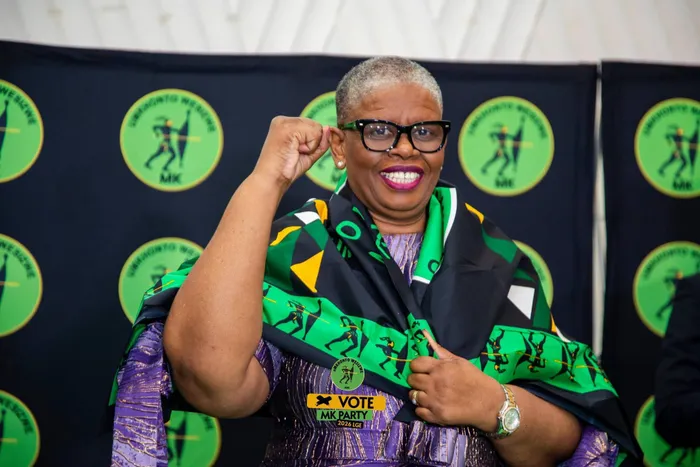
Former eThekwini mayor Zandile Gumede has defected from the ANC to the uMkhonto weSizwe Party (MKP) and has been appointed KwaZulu-Natal deputy convener. These defections are not mere footnotes; they signal a deeper structural decline for the ANC, says the writer.
Image: Facebook/MK Party
Prof. Sipho Seepe
The British philosopher and mathematician Bertrand Russell, regarded as one of the 20th century’s most influential intellectuals, famously remarked: “To understand the actual world as it is, not as we should wish it to be, is the beginning of wisdom.”
Political pundits who failed to heed Russell’s time-tested wisdom found themselves dumbfounded by the electoral performance of uMkhonto weSizwe Party (MKP) in the 2024 national and provincial elections.
MKP’s dramatic rise culminated in it securing approximately 45% of the vote in the province of KwaZulu-Natal (KZN). This strong showing came largely at the direct expense of the ANC, whose support in the province plummeted from its traditional dominant position to a mere 17%.
The once-ruling party, which long led government structures in KZN, has been reduced to a shadow of its former self. Despite MKP’s commanding share of the vote, it has been crowded out of meaningful participation in provincial government by a coalition of smaller parties that received far less voter support.
This exclusion is tantamount to undermining the voice of the majority that expressed itself clearly at the ballot box. This reality is not lost on the people of KZN who see it as a blatant disregard for their democratic and popular mandate.
Since then, the ANC has increasingly witnessed a significant defection of former leaders and influential cadres to the MKP. These defections are not mere footnotes; they signal a deeper structural decline for the ANC.
Key personalities who once anchored the party’s support in KZN have migrated, taking with them organisational experience, networks, and voter loyalty. This haemorrhage suggests that the ANC’s decline in the province is likely to continue. For now, the political calculus is in MKP’s favour.
The changes in favour of the MKP unfold against unrelenting attempts to mischaracterise its leader and the party as nothing more than a resurgence of ethnic mobilisation.
Berating these mischaracterisations, political economist Moeletsi Mbeki had this to say: “Zuma has support amongst the poor. We have always known this. Everybody has known except his enemies within the ANC... So [the poor] see him as one of them. He doesn’t come from the elite, like the Eastern Cape, like my brother and Mandela... He is just an ordinary person who was a migrant worker. That’s why they identify with him – there was bound to be a response when he got arrested.”
Mbeki continues. “How could he accuse Jacob Zuma of ethnic mobilisation when he has two men in his team from the Eastern Cape — Dali Mpofu and Mzwanele Manyi? I know Jacob Zuma. I was with him in exile.”
Simplistic ethnic reductionism that characterises many analyses of MKP has failed to dent the party’s popularity in the region. South Africa has witnessed its fair share of this political short-sightedness. Instead of confronting reality as Russell advised, there have been persistent attempts to manufacture a narrative that denies MKP’s legitimacy and staying power.
Prominent among these falsehoods was the relentless projection of Zuma as a political has-been whose influence had waned. This wishful thinking blinded many to the unstoppable force that MKP would become.
The investment in mischaracterisation of MKP is only matched by the simultaneous portrayal of Ramaphosa as the indispensable saviour of the nation. Contrary to the choreographed positive narrative of Ramaphosa, he has proven to be an unmitigated disaster. He has presided over the ANC’s historic decline. The party’s national vote share dropped dramatically, with MKP hiving off a massive chunk of its traditional base, especially in KZN.
Ramaphosa’s approach, including his initial framing of the 2021 unrest as ethnic mobilisation, alienated many in the province. His belated retraction came too late to stem the tide. Families still seeking justice for lives lost during that period found little comfort in ANC leadership, further tilting sentiment towards MKP.
The intense projection of Ramaphosa as South Africa’s knight in shining armour dissipated quickly amid persistent economic struggles, energy challenges, and governance failures. With the Phala Phala scandal playing itself out in the courts and parliament, the optics are not good for the ANC. Ramaphosa has lost all forms of credibility and believability.
The 2024 elections underscored that ordinary South Africans cannot be permanently fooled by propaganda and machinations. Ramaphosa and his sycophants fell victim to their own echo chamber.
Helen Zille, Federal Chair of the Democratic Alliance, admitted her underestimation of MKP: “I thought this party can't get anywhere... I’ve never been more wrong… those are the power of identity politics as people choose it for themselves. I mean that was a very powerful Zulu vote because they were saying... Don’t mess with the most senior Zulu person in politics today, because we all take it as an insult.”
Many have had to dust off and revise the premature political obituaries they wrote about Zuma. The inability to read unfolding political reality resurfaced dramatically in 2024. Seasoned politicians and commentators underestimated Zuma’s fortitude and strategic ingenuity.
As Jonny Steinberg observed in Business Day (22 March 2024), Zuma is “a crafty politician... in a league of his own.” Steinberg added that in 30 years of democracy, “the most talented political player to emerge by a country mile is Jacob Zuma. He alone has mined down to the tectonic plates deep under SA’s social formation and shifted them to produce a politics that brings him power. Nobody else has come anywhere close.”
The 2024 national and provincial elections delivered a decisive blow to that collective hallucination. Ordinary voters in KZN saw through the propaganda. With local government elections approaching, questions remain about whether MKP can sustain and expand its 2024 performance.
Given the defection of key ANC leaders and the palpable disillusionment on the ground, the trajectory strongly favours continued MKP gains. The crowding out of MKP from provincial power structures, despite its 45% mandate, has not diminished its appeal; if anything, it has highlighted the disconnect between the will of the voter and coalition outcomes, reinforcing perceptions of an establishment resistant to change.
The people of KZN recognise this dynamic and are unlikely to reward the parties that sidelined their majority choice.
The ANC’s precipitous decline of 17% of the share of the vote nationally, the loss of key leaders to its rival, and its seeming absence from meaningful contestation signal a profound realignment. As Russell reminded us, wisdom begins with seeing the world as it is.
In KZN today, that reality is one of MKP ascendancy and ANC retreat. The coming elections will likely confirm this shift, as voters continue to express their preference for a party that speaks to their lived experiences and refuses to be silenced by institutional gatekeeping.
The ordinary citizens of KwaZulu-Natal have made their voices heard. The political calculus has changed, and no amount of denial or coalition arithmetic can obscure the fundamental realignment underway. MKP’s moment is not a fleeting protest but a structural transformation in the province’s politics.
Despite its prominently reported internal challenges, the party remains central to KZN’s geopolitical imagination. This is a testament that its appeal is rooted in genuine grievances, identity, and leadership charisma.
* Professor Sipho P. Seepe is an Higher Education and Strategy Consultant.
** The views expressed do not necessarily reflect the views of IOL or Independent Media.