Afrikaner 'Refugees' Tarnishing Madiba's National Reconciliation Legacy
MANDELA MONTH
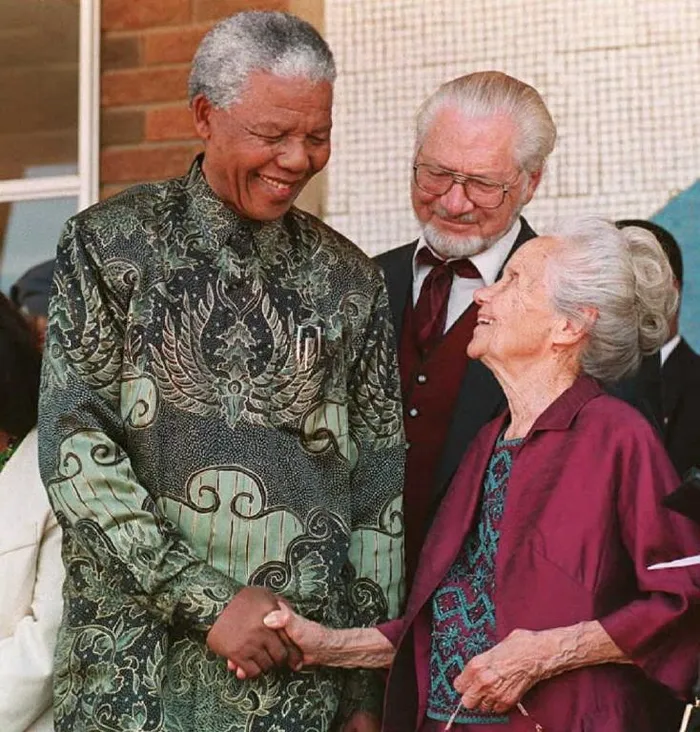
Then President Nelson Mandela with Betsie Verwoerd, the 94-year-old widow of late apartheid architect and prime minister Hendrick Verwoerd in Orania, a whites-only settlement, on August 15. Mandela said at the time that the purpose of his visit was "to unite South Africa where we cease to think in terms of colour."
Image: AFP
Prof. Bheki Mngomezulu
Yesterday, on July 18, 2026, the country and the global community celebrated Nelson Mandela’s birthday. Had he lived to this day, he would have turned 108 years old.
Mandela set the reconciliation tone when he pardoned his captors and persecutors. He even had tea with their widows – something that was frowned upon by some of his comrades in the ANC and the Tripartite Alliance. But because Mandela’s mind was on the bigger issue of rebuilding South Africa, he opted not to take revenge but to chart a way forward where all races could live harmoniously.
But while Mandela’s reconciliation spirit undoubtedly saved this country from a potential bloodbath and remains relevant even after his passing, recent events have made a mockery of his spirit of reconciliation. If anything, they are an antithesis of reconciliation.
The baseless claim that Afrikaners are being brutally murdered in South Africa under the watch of the post-apartheid government has reconfigured the political landscape both nationally and internationally.
US President Donald Trump consistently made false accusations against South Africa that the government was folding its arms while Afrikaners were being killed in numbers. President Cyril Ramaphosa’s visit to America and his attempt to explain this issue did not bear any positive results.
Ramaphosa’s promise to investigate the issue of white crosses allegedly resembling the graves of slain Afrikaners was totally wrong since there was nothing to investigate. All he needed to tell Trump was that this is not how we bury the dead in South Africa. Moreover, Afrikaners do not have secluded graves in post-apartheid South Africa.
What is interesting is what some of us had already anticipated. Over 7, 700 Afrikaners were offered refugee status in America. Trump had capped the figure at 17, 500. Now two things are happening.
Firstly, not all Afrikaners are cleared to stay in America. The now intense screening process identified those who have criminal records and those who do not meet the requirements for receiving documentation. They failed to prove that their lives are indeed in imminent danger. Noticeably, the letters declining their applications clearly stated that the refusal is unappealable. The hopes of these Afrikaners relocating to America have been dealt a serious blow.
Secondly, some of those Afrikaners who received refugee status are already coming back to South Africa. They cite various reasons. These include the high cost of living, threat to their lives – not clear who threatens them, distance between them and their relatives, and inability to adjust to a new life.
Two critical questions arise:
(i) Why did they not think about these situations before falling into Trump’s ploy?
(ii) If they felt that their language (Afrikaans) was under threat, how did they hope to preserve this language in a foreign country where there are no special schools for Afrikaners and where the lingua franca is English – both at school and in the community?
The return of these Afrikaners raises a new set of questions. If they left the country under the pretext that they were going to be killed, has that threat subsided? For those who sold their properties and resigned from their jobs, what are their expectations? Where will they stay and work? From a logical point of view, can you return to a country where you run the risk of being killed?
Another equally important question is the issue of South Africa’s immigration and emigration laws. Fortunately for these Afrikaners, immigration laws do not bar South African citizens from the country regardless of the time they spent abroad.
For those who renounced their South African citizenship, they can still return to South Africa. However, they will be treated as foreign nationals until they formally reinstate their South African citizenship.
Was this worth the trouble? Did these Afrikaners act rationally, or were they ill-advised and made wrong decisions? What advice can they give to their fellow Afrikaners who still plan to accept Trump’s offer to seek refuge in America? These are some of the most critical questions.
Another pertinent question becomes: how should the South African government, March and March, and the public perceive and treat these returnees? There are two possible answers.
Firstly, given the reasons they provided when they left the country, one view is that they should either be ostracised or be asked to retract the statements they made before they left – including the lies that their lives were in danger and that South Africa has become an uninhabitable country. This would deter them from falling into the same trap in future and to think rationally before making any reckless decision.
Secondly, in the spirit of reconciliation, and in honour of Mandela, these Afrikaners should be pardoned for their utterances and actions. In this regard, the country could adopt the view that to err is human. As Mandela taught us, no one is a saint. He once posited that “I am not a saint, unless you think of a saint as a sinner who keeps on trying.”
Deriving inspiration from these words, South Africans can pardon these Afrikaners who acted recklessly, engulfed by excitement to live abroad and failed to think rationally. The assumption is that they have learnt a lesson from their actions and will act differently next time.
Above all, there is a need to educate these Afrikaners about patriotism and politics in general.
Organisations like AfriForum and Solidarity have been vocal on what was generally dubbed as ‘the plight of the Afrikaners’ in South Africa. Now that things have turned out this way, what should they do?
The most obvious answer is that they must apologise to the nation for any unfounded utterances and claims they may have made to please and sustain Trump’s false statements. Members of these groups remain South African citizens. If they love this country, they should voluntarily apologise, pledge their allegiance to the country, and vow not to be misled or mislead the nation in future.
Mandela’s reconciliation legacy should not be used for political expediency!
* Prof. Bheki Mngomezulu is Director of the Centre for the Advancement of Non-Racialism and Democracy at Nelson Mandela University.
** The views expressed do not necessarily reflect the views of IOL or Independent Media.