Transnational Drug Cartels Threaten Africa's Security, Sovereignty
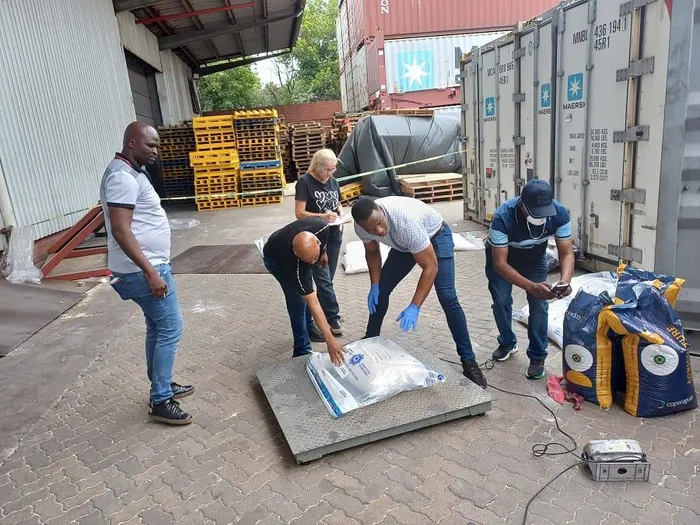
Police officers weigh pure cocaine seized at the Durban Harbour. Africa's ports should serve as gateways to prosperity. Not corridors for criminal empires, says the writer.
Image: SAPS
Kim Heller
Ninety kilograms of cocaine were seized at the Durban Harbour on 6 June 2026. This illicit cargo, hidden in excavators, was sent from Brazil's port of Santos. Just days later, a second consignment of drugs was intercepted at the same harbour.
The intricacy of the concealment procedures carried the hallmark of well-organised drug cartels anchored in Brazil, including groups such as the Primeiro Comando da Capital (PCC).
The PCC, one of the most notorious criminal enterprises in Latin America, and affiliated trafficking networks are not only embedded in the cocaine corridors of West Africa. Still, they are believed to be extending their reach across Southern and Eastern Africa.
With the Trump administration's heightened cross-border law enforcement against transnational cartels, there has been pressure on criminal networks to diversify their operating geographies and seek new transit corridors. They are acting with stealth and speed to identify and exploit new vulnerabilities.
Africa is an attractive new prospect. It sits astride some of the world’s busiest maritime trade routes. While maritime trade has expanded rapidly across Africa, enforcement capacity is uneven and underdeveloped. The Continent's weak logistics systems, institutional gaps, and poorly governed transport infrastructure make it an easy target for drug cartels.
South Africa's Durban Harbour is a real prize. It has strong commercial links with Brazil and is one of the Continent's most active maritime gateways. However, years of governance failures, infrastructure decay and operational inefficiencies have severely eroded the stability of South Africa's ports.
Transnet's prolonged operational and financial decline is now a real-time national security risk. A sovereign state that is unable to secure its own gateways is literally leaving its strategic gateways wide open to foreign criminal networks.
South Africa's ports, which should be critical engines of domestic and continental economic integration, could easily be subverted into opportunity zones for transnational drug cartels.
The recent interceptions of cocaine consignments in South Africa demonstrate a level of capacity and integrity within law enforcement and customs personnel. However, the structural vulnerabilities that enable trafficking should not be discounted. For as long as governance failures and infrastructural and political rot remain unaddressed, the threat of foreign criminal activity is dangerously high.
The challenge is continental. The United Nations Office on Drugs and Crime (UNODC) has monitored the Continent's growing importance within the sordid world of cocaine trafficking for over two decades, and according to the UNODC, cocaine seizures in the Continent increased more than 20-fold between 2015 and 2024.
West Africa has been identified as a long-standing and ever-ready corridor for cocaine headed to Europe. In addition, emerging markets and routes in Southern and Eastern Africa are being actively pursued.
Africa would do well to recognise, as the United States has, that organised crime and drug cartels pose a significant threat to security and sovereignty. Criminal syndicates operate across geographic borders with practised, almost predatory agility, making the most of poor enforcement systems and gaps. Africa needs to be highly vigilant.
The African Union Mechanism for Police Cooperation (AFRIPOL), a robust institutional foundation, could be better resourced and fully mandated to prioritise early-warning systems for maritime trafficking, joint risk-profiling protocols, and coordinated operations across member states. Because criminal networks always find the weakest link, collective standards across the Continent serve as a crucial mechanism of mutual defence.
If the threat of transnational drug cartels is not addressed, the consequences will be dire. Criminal networks will gain traction within strategic ports, high-value logistics chains, and public infrastructure.
Cocaine markets and routes will be entrenched, and other machinations of organised crime, including human trafficking, trade in illegal weapons and large-scale money laundering, could flourish. This will not only tear the moral, societal, and economic fabric of African countries apart but place security and sovereignty in peril.
The intervention of the African Union is paramount in addressing the issue of inadequate maritime security and the real threat of continental infiltration by organised foreign drug and criminal elements.
A continent-wide maritime security blueprint is necessary. This should incorporate state-of-the-art risk analysis, cargo profiling, and tracking, as well as coordinated surveillance of vulnerable shipping routes, if it is to provide a strong continental protective shield.
The African Integrated Maritime Strategy 2050 and the Lomé Charter on maritime security and development could be further empowered to enhance port governance, operational standards, and integrity.
Africa's ports can and must become gateways to industrialisation, continental integration, and shared prosperity under the AfCFTA — not gateways for criminal empires. This requires building institutions that are professional, accountable, and capable of protecting Africa's borders, ports, and economic future.
The development of capable, accountable institutions that exercise effective authority over territory and safeguard strategic infrastructure is central to the unfinished project of genuine liberation. South Africa could lead by example. There is a pressing need to develop and entrench professional, integrity-rich, and accountable management at Transnet's ports.
The repair and rejuvenation of South Africa's ports and Transnet is by no means simply a narrow commercial or a mere logistical project. It is a sovereignty and security imperative. Infrastructure and technology require upgrades to meet contemporary maritime security standards.
Large-scale, highly effective inspection equipment is a must-have, alongside risk-profiling systems and anomaly detection. Drone and underwater monitoring to boost harbour surveillance should be treated as minimum defensive requirements against predatory transnational actors who act with speed, sophistication, and agility. Drug cartels and their criminal networks operate with practised agility across borders.
All they require is a single entry point to contaminate an entire regional corridor. Secure ports, trusted customs systems, and resilient logistics networks across the Continent are non-negotiable foundations for Africa's security and economic integration.
The Continent cannot risk becoming the new primary operating environment for transnational criminal syndicates. Africa's ports should serve as gateways to prosperity. Not corridors for criminal empires.
* Kim Heller is a political analyst and author of No White Lies: Black Politics and White Power in South Africa.
** The views expressed do not necessarily reflect the views of IOL or Independent Media.