Immigrants’ Exodus Shines Light on SA’s Skills Deficit
CRACKDOWN ON ILLEGAL MIGRANTS
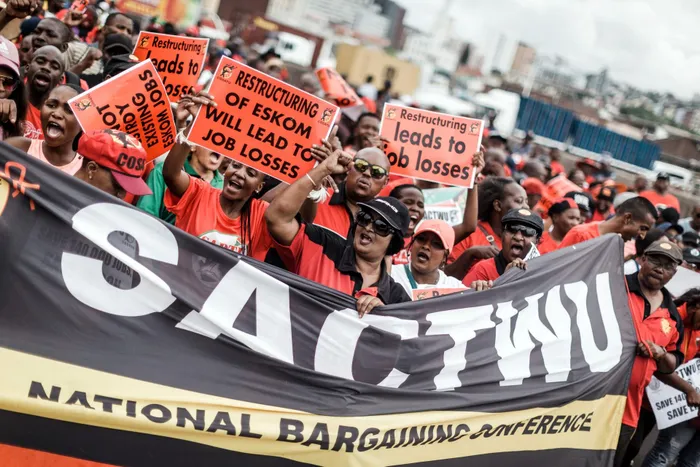
South African Clothing And Textile Workers Union (SACTWU) members protesting against job losses and deepening poverty in Durban on February 13, 2019. Thirty-two years after democracy, the country should not be discovering that its own citizens require training for jobs that have existed for decades, says the writer.
Image: AFP
Zamikhaya Maseti
The announcement by sections of the eThekwini business community that they will embark on a skills development programme for South Africans following the departure of foreign nationals should not be received as a moment deserving of celebration.
Rather, it should be understood as an unintended exposure of one of the South African economy's enduring Achilles' heels, namely, the persistence of a cheap labour regime that has survived the democratic transition despite three decades of public investment aimed at transforming the economy and broadening employment opportunities.
The significance of this intervention lies not in the skills programme itself, but in the uncomfortable question it compels the nation to confront.
Why, after thirty-two years of democracy, has the training of South African workers suddenly become an urgent priority? If South Africans can be trained today, why was this not undertaken systematically over the past three decades, while these sectors benefited from substantial government support and public resources?
This question cannot be answered through the narrow prism of immigration. It requires a political economy analysis rooted in South Africa's historical development and the enduring relationship between the State, capital, and labour.
Few scholars understood this relationship better than the renowned South African political economist Professor Harold Wolpe. In his seminal Cheap Labour Thesis, Wolpe demonstrated that apartheid was not merely a racial project, but an economic system deliberately designed to ensure a continuous supply of cheap Black labour to South African industry and mining.
The Bantustans performed a critical economic function by reproducing labour while transferring much of the social cost of sustaining workers away from employers. Capital accumulated wealth because wages remained artificially low while African families and impoverished rural communities absorbed the costs of social reproduction.
Wolpe's analysis was itself grounded in Karl Marx's Theory of Surplus Value. Marx argued that profit originates from the difference between the value created by labour and the wages paid to workers. The greater this difference, the greater the accumulation of capital.
The pursuit of profit, therefore, creates a permanent incentive to minimise labour costs while maximising productivity. It was precisely because of these contradictions that Marx concluded that the industrial working class would eventually become the gravediggers of capitalism, not because of moral outrage alone, but because the very logic of capitalist accumulation continually reproduces social and economic contradictions.
Democracy dismantled the legal architecture of apartheid. It did not, however, automatically dismantle every structural feature of the political economy that apartheid had created.
While the Bantustans disappeared from the constitutional landscape, the search for vulnerable and inexpensive labour has remained a persistent feature in certain sectors of the economy. The composition of that labour may have changed, but the economic logic identified by Wolpe continues to invite scrutiny.
The eThekwini announcement should therefore be interpreted within this broader historical context. It raises legitimate questions about whether certain sectors became overly dependent on vulnerable labour rather than investing consistently in the development of South African workers. If businesses now acknowledge that local workers can be trained, one must ask why that investment was not made long before the current circumstances.
The irony becomes even more striking when one considers the extensive support that democratic governments have provided to these sectors.
Since 1994, billions of rand have been directed towards industrialisation, tourism development, manufacturing competitiveness and enterprise development through clothing and textile support programmes, sectoral Master Plans, tourism recovery initiatives, Industrial Development Corporation financing, Skills Education and Training Authorities, the Department of Trade, Industry and Competition, provincial development agencies and numerous public-private partnerships.
The government has consistently identified tourism, hospitality, manufacturing, clothing, textiles, and agro-processing as strategic sectors capable of generating employment, industrial expansion, and inclusive economic growth.
The obvious question, therefore, follows. Have these substantial public investments produced the employment outcomes originally envisaged? Have firms that benefited from public incentives invested sufficiently in workplace training, apprenticeships, and the employment of South Africans? If not, what mechanisms of accountability exist to ensure that public resources achieve their developmental objectives?
These are not ideological questions. They are questions of public accountability.
The recent intervention by the March and March movement has, regardless of differing political opinions about the movement itself, forced both the State and the private sector to confront uncomfortable realities about labour market practices.
In doing so, it has shifted public attention beyond immigration towards the deeper structural question of how South Africa organises work, skills development and labour market participation.
Nor should the discussion be confined to eThekwini alone. Similar concerns have emerged across many urban centres and productive sectors. Agriculture, construction, hospitality, manufacturing, and portions of the textile industry have all periodically attracted scrutiny regarding labour practices and compliance with employment legislation.
These sectors have likewise benefited from extensive government support, ranging from infrastructure investment and export promotion to financing, tax incentives and enterprise development programmes. Public support carries corresponding public obligations.
This debate should therefore not become one that pits South Africans against foreign nationals. Such a simplistic narrative would obscure the real structural challenge. South Africa's Constitution guarantees the dignity of every human being, regardless of nationality.
Exploitation of labour cannot become acceptable simply because its victims are migrants, nor can unemployment among South Africans be ignored because businesses find vulnerable labour economically attractive.
The real issue is the organisation of labour markets, the enforcement of labour standards, and the responsibilities of capital within a constitutional democracy.
The government must now undertake a comprehensive evaluation of how public support has been utilised across strategic economic sectors. Every firm receiving public incentives should demonstrate measurable commitments to local employment, accredited workplace training, compliance with labour legislation, skills transfer, and sustainable economic development.
Where investigations establish abuse of labour legislation or misuse of public incentives, consequence management should include appropriate financial penalties, recovery of incentives where legally permissible, and stronger regulatory oversight.
This is precisely where the developmental State assumes its historical responsibility. A developmental State is not merely a distributor of incentives or subsidies. It possesses both the authority and the obligation to discipline capital in pursuit of national developmental objectives.
Public resources cannot become instruments for private accumulation divorced from broader social responsibilities. Capital that benefits from State support must simultaneously contribute towards employment creation, productivity growth, technological advancement, skills development, and social transformation.
Ultimately, the eThekwini initiative represents far more than a municipal skills programme. It has unintentionally illuminated one of the unfinished tasks of South Africa's democratic transition.
Thirty-two years after democracy, the country should not be discovering that its own citizens require training for jobs that have existed for decades. That investment should have been embedded within the democratic developmental project from the outset.
If there is one lesson emerging from this episode, it is that South Africa's economic transformation remains incomplete. The challenge before the nation is not merely to replace one labour force with another. It is to construct an economy whose competitiveness is founded upon productivity, innovation, skills, decent work, and human dignity rather than the perpetual search for the cheapest available labour.
That is the true mandate of a democratic developmental State and the unfinished promise of South Africa's constitutional order.
* Zamikhaya Maseti is a Political Economy Analyst.
** The views expressed do not necessarily reflect the views of IOL or Independent Media.