DA Turmoil Exposes the Party's Clean Governance Hypocrisy
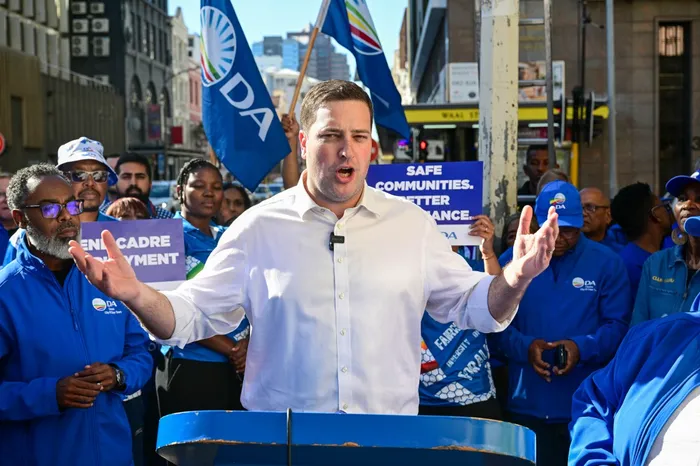
Democratic Alliance leader Geordin Hill-Lewis launching the party's local government elections campaign in Long Street, Cape Town on May 25.
Image: Henk Kruger / Independent Newspapers
Prof. Bheki Mngomezulu
Over the years, the Democratic Alliance (DA) has projected itself as a disciplined political party that does not air its dirty linen in public. It insisted that any internal squabbles are handled or resolved amicably through internal structures, thereby maintaining the integrity of the party.
Moreover, the DA has consistently boasted that, unlike other political parties such as its main competitor, the African National Congress (ANC), which has been leading the country since 1994, the DA has been leading when it comes to service delivery and good governance.
Citing audit outcomes and the reduced number of public protests in DA-controlled areas as proof of good governance, the DA maintained that it governs better where it has the mandate from the electorate.
ANC president Cyril Ramaphosa confirmed this claim when he addressed over 4000 ANC councillors. He conceded that the best performing municipalities were led by the DA, not the ANC. The DA justifiably and understandably welcomed these accolades.
The party has posited that its focus is on electing people with requisite skills and knowledge instead of being guided by variables such as gender and race. This created the impression that, unlike the ANC, which implements its cadre deployment policy, which results in incompetent cadres occupying critical positions, the DA is guided by and embraces meritocracy in deploying its members to lead.
While all these claims cannot be summarily dismissed, they should not be taken at face value. Instead, they should be subjected to scrutiny to verify their authenticity and truthfulness. Importantly, these claims should be interrogated to establish the extent to which they have been maintained since the historic 2024 general election.
Various developments challenge the currency of these claims that were once justifiable. A few of these developments are discussed below, albeit briefly.
Firstly, the recent audit outcome presented by the Auditor-General Tsakani Maluleke on June 24, 2026, about the state of South Africa’s municipalities during the 2024-2025 reporting period tacitly challenges the claim of the DA’s sustained good governance.
According to the report, Cape Town Metropolitan Municipality was one of the three metros that obtained an unqualified audit opinion. The other two were eThekwini and Johannesburg. The AG observed that Cape Town Metropolitan Municipality showed regression from the previous reporting period. This finding nullifies the DA’s claim of sustained good governance and deprives it of its bragging rights.
Secondly, recently demoted former DA leader and former Minister of Agriculture John Steenhuisen shocked many when he claimed that DA ministers, including Communications and Digital Technologies minister Solly Malatsi, were influenced by Tony Leon to hold meetings with Elon Musk’s Starlink representatives.
Moreover, speaking to News24, Steenhuisen accused Resolve Communications, which is Leon’s company, of being behind a campaign to discredit him. He found this behaviour ‘shocking’ since while he was minister, Resolve Communications used to approach him asking that he meet and assist its clients “with issues and problems or policy changes that they would like to see.” He found it strange that the company has turned against him.
When this news surfaced, Solly Msimanga, who is now the DA’s Federal Council Chairperson, promised that the party’s federal executive council would investigate this matter to establish its veracity. Apart from establishing the facts, Msimanga stated that the investigation would also aim to establish if this incident brought the party into disrepute.
An affidavit dated July 6, 2026, from a Tshwane staff member confirmed that indeed there was a meeting involving former Mayor Solly Msimanga, Tony Leon, and Chief of Staff Marietha Aucump. According to the affidavit, the meeting resulted in a directive to the staffer to facilitate work for Resolve Communications in Tshwane.
This is another incident that has the potential to tarnish the DA’s political reputation as a party that claims to embrace integrity. In the past, the DA has exploited factions within the ANC and used them to score political points by presenting itself as the opposite of the ANC regarding public image and internal unity. How the party will manage its own factional politics remains to be seen. Its faction resolution skills will be tested.
Another issue that has unwittingly dented the DA’s political image is its membership of the current multiparty coalition government. When the DA was the official opposition party, it had a clear identity. It was easy to blame the ANC for many things that went wrong in the country. This was justifiable because the ANC was the governing party from 1994 to May 2024.
Following the May 2024 general elections, which did not produce an outright winner, things have changed for both the ANC and the DA. As soon as the ANC realised that it failed to retain its majority in parliament, it invited other political parties to constitute government. One of those parties was the DA.
While the DA’s decision to join the multiparty coalition government was necessitated by the election results, it left the party suffering from an identity crisis. At times the DA behaves as though it is still the opposition party. In other instances, it remembers that it is now part of government. This confusion is not good for the party’s political identity.
2026 marks the second year since the formation of the multiparty coalition government. Many things have gone wrong in the country. Not even Ramaphosa’s “New Dawn” could help. The economy is not growing. Unemployment continues to rise. The crime rate is very high. The cost of living is also very high. Poverty continues to ravage the country. Inequality, which has been one of the characteristic features of South Africa, continues unabated.
With the Local Government Election (LGE) imminent, the DA would have used these realities to discredit the ANC. However, this option has fallen off the radar since the DA is now part of government. Criticising the ANC for failing to address the issues enumerated above would be tantamount to self-criticism.
Therefore, a public spat will disadvantage the DA in the upcoming LGE.
* Prof. Bheki Mngomezulu is Director of the Centre for the Advancement of Non-Racialism and Democracy at Nelson Mandela University.
** The views expressed do not necessarily reflect the views of IOL or Independent Media.