Funding Crisis Imperils AU's Somalia Peace Mission
HORN OF AFRICA
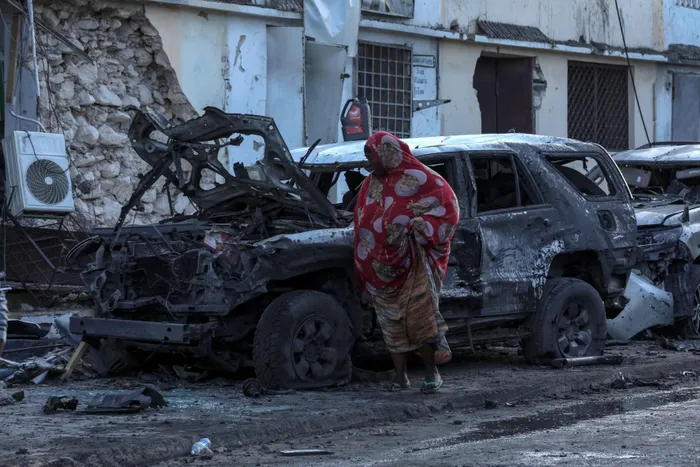
A woman walks past debris and destruction at a cafe in Mogadishu on July 15, 2024 following a car bomb blast. The Somali experience illustrates how security and stabilisation missions can arrest violence and insurgency in the short term but are no substitute for accountable, legitimate governance, says the writer.
Image: AFP
Kim Heller
Washington's decision to end its logistical support for the African Union Support and Stabilisation Mission (AUSSOM) in Somalia highlights how the foundations of the Continent's security and peacekeeping remain precariously dependent on the whims and will of foreign nations.
Africa is less central than it once was to America's foreign policy and counterterrorism strategy. Washington is fully entitled to reshape its foreign policy priorities as it navigates global power plays, domestic economic pressures, and shifting security calculations.
Rather than being disappointed or despondent about this withdrawal, Africa and the African Union must concentrate on building a security architecture grounded on continental funding and self-sufficiency rather than on the shaky foundation of indefinite foreign assistance. Africa's sovereignty cannot be achieved while the security of African nations remains outsourced.
Over the past two decades, Washington has funnelled close to U.S.$2 billion through the United Nations Support Office in Somalia (UNSOS) for fuel, transport, engineering support and medical evacuations.
The United States has also provided bilateral aid to countries that have deployed troops to the mission. However, it has been African soldiers, not American troops, who have been caught in the crossfire of battle and carnage.
Washington has justified its exit by noting that, despite two decades of significant funding, Somalia has failed to develop its security infrastructure or take ownership of key security functions.
A U.S. State Department spokesperson stated: "Somalia has been unable to independently sustain progress that AUSSOM and its predecessor missions have made to degrade and contain al-Shabaab or take ownership of most of its own security functions."
The decision pulls the plug on a long-standing logistical lifeline without a fully resourced African alternative in place. The rather abrupt withdrawal of U.S. support creates a dangerous void.
The African Union Commission has warned member states that the U.S. decision carries "significant implications for the logistical sustainment, operational posture and financing of the Mission."
The withdrawal of United States support for AUSSOM will severely hamper its operational capability, making it more challenging to protect territory and communities from insurgent attacks. Al-Shabaab has mastered the art of insurgency, and it is likely to take full advantage of this void.
International support over the last two decades helped Somalia drive al-Shabaab out of major urban centres, reduce piracy, and bolster some elements of Somalia's federal government.
However, it did not bring lasting peace. Poor governance, political fragmentation, economic exclusion and ethnic rivalries continue to drive instability. This renders victories over insurgent attacks not only inadequate but temporary.
The Somali experience illustrates how security and stabilisation missions can arrest violence and insurgency in the short term but are no substitute for accountable, legitimate governance and inclusive political and economic development.
The security model may have produced significant short-term security gains, but it also embedded structural dependency, keeping Somalia's security and sovereignty highly vulnerable.
The Institute for Security Studies has noted that this type of model is unstable, as security and peace initiatives can be entirely eroded or terminated by foreign policy shifts. If there is no capacity to fund and manage these programmes once foreign support has been withdrawn, peace is placed in peril.
With the longest coastline in Africa, Somalia is a geopolitical jewel in the lucrative global maritime trade. While sky-high levels of piracy declined due to vigilant maritime security and international cooperation, a security vacuum could see new waves of piracy.
The ramifications of this would be severe. Increased security expenses, costly diversions of sea routes around the Cape, and compromised supply chains could sink trade, offshore investment, and the fishing industry along this crucial sea corridor.
Maritime insecurity could potentially exacerbate arms, drug and human trafficking, with ripple effects across the Indian Ocean and Red Sea. A power vacuum rarely stays empty for long. It is filled by those with the resources and strategic interest to move quickly.
The departure of the United States could prompt countries such as China, the United Arab Emirates, Qatar, Saudi Arabia and Russia to seize the opportunity to expand their diplomatic, commercial and security influence in the region.
For decades, the AU has championed the principle of African solutions to African problems. However, there is currently no strong, sustainable African financial and institutional framework capable of supporting long-term peace operations without relying overwhelmingly on external donors.
While the AU's Peace Fund is an important milestone in the development towards greater self-reliance, it is currently not sufficiently capacitated to support or sustain complex, major continental stabilisation missions, despite private-sector pledges of millions of U.S. dollars.
If security autonomy is to be achieved, AU member states will need to move beyond rhetorical commitments and make concrete and consistent financial contributions to collective security programmes. Strong institutions, good governance, high levels of accountability and solid collaboration between national governments and regional organisations are also required.
America's departure at the end of December 2026 should provide Africa with an opportunity to navigate its own security pathway and free itself from endless cycles of external dependence.
The only sustainable solution is a security architecture conceptualised, funded, and directed by Africans themselves in Africa. However, for now, with the under-resourced AU Peace Fund and persistent conflict across the Continent, this is still a work in progress.
An underdeveloped security architecture, dependent on foreign support, is an existential threat to the Continent. Security is a sovereign responsibility, not a donor-funded project. Decisive action is needed and time is running out. The era of outsourcing Africa’s security must come to an end.
* Kim Heller is a political analyst and author of No White Lies: Black Politics and White Power in South Africa.
** The views expressed do not necessarily reflect the views of IOL or Independent Media.