SAPS Struggles with Resource Constraints Amid Rising Crime
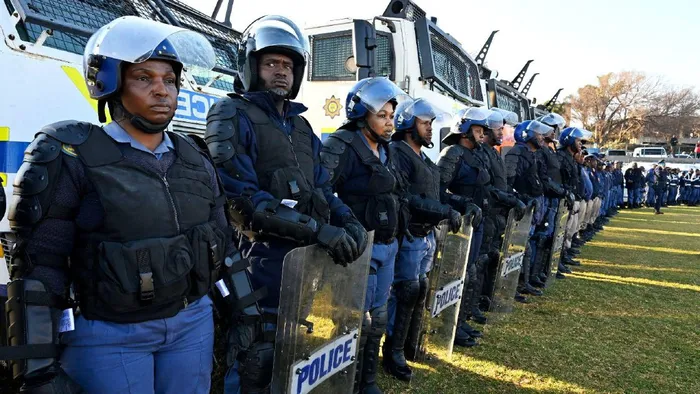
Members of the SA Police Service deployed in Gauteng province ahead of the June 30 anti-immigrants protest. It may be impossible to have more boots on the ground if the officers are not well compensated, says the writer.
Image: tumeleng English/ ANA Studio
Esewu Mxolisi Mathebula
The South African Police Service (SAPS) is responsible for ensuring that the citizens of South Africa are protected against harm and feel safe wherever they are, and this is a Constitutional mandate (Section 205(3) of the Constitution of the Republic of South Africa Act 108 of 1996).
The protection further extends to all people who live in South Africa. It is a fact that there is a plethora of both illegal (undocumented) and legal (documented) foreign nationals who live and work in South Africa, and the citizens of South Africa are compelled to share the limited resources such as medical services, work spaces, schools and more with them.
Furthermore, the police are to protect everyone equally while ensuring that those who are in the country illegally are arrested and deported back to their respective countries. However, the police have raised concerns over the years about inadequate resources, which are mainly due to budgetary constraints.
The shortage of resources was also mentioned by the outgoing Western Cape Provincial Commissioner, Lt Gen Patekile, who highlighted “severe staff shortage, budget cuts, and the poaching of trained police officers,” amongst other things. Lt Gen Patekile made a clarion call for the funding of the SAPS so that they can have more boots on the ground.
However, it may be impossible to have more boots on the ground if the officers are not well compensated, since private companies such as security companies, banks and insurance companies are poaching the officers since they offer better packages than their current employer.
It is known that the Western Cape has been grappling with gang-related violence, which can be associated with the lucrative illicit drug market over the years, and it perpetuates relentlessly. Therefore, more police officers are required to add to the approximately 19 000 SAPS officers that are currently available in the Western Cape. This is a number that has dwindled from around 21 000 officers that were available a decade ago, according to Lt Gen Patekile.
These officers are trying their level best to ensure that the people of the Western Cape are safe, but it is cumbersome under the circumstances. During a meeting of the Standing Committee on Appropriations on 12 May 2026, the leadership of the SAPS cited critical structural, operational and resource constraints. They even went further to be specific about the 42% staffing shortage, with only 45% of officers ready to perform their duties.
The leadership also mentioned that about 7, 500 police vehicles are unserviceable and a further deficit of R5.8 billion to cater for the modernisation of the Information and Communication Technology (ICT). The modernisation of the SAPS includes the complete rollout of the Integrated Case Docket Management System (ICDMS) to all police stations countrywide, which remains a challenge. It also includes the introduction of body cameras, which also remains a challenge.
It is not only the SAPS that is affected by a lack of resources, particularly human resources; the Independent Police Investigative Directorate (IPID) is also bleeding. They have a huge responsibility of investigating cases against members of the SAPS as per their mandate (IPID Act 1 of 2011).
However, their workload seems insurmountable considering the number of staff members at their disposal. There are about 400 staff members who must investigate approximately 19, 728 active cases. Failure to investigate these cases effectively against the SAPS could mean that victims may never see justice.
The SAPS is considering more collaborations with public and private partnerships in trying to improve effective service delivery. We saw the involvement of various security companies during the 30 June 2026 protest, and these companies are better resourced than the SAPS.
However, the allocation of an amount of R600 million to curb any eventuality during the protests against people who are illegal (undocumented foreign nationals) in South Africa is contrary to the outcry of lack of resources in the SAPS.
It is a fact that the money allocated to the SAPS for the protests against illegal immigrants that took place countrywide on 30 June 2026 would go a long way in addressing some of the challenges currently facing the SAPS. This includes, but is not limited to, staff shortages, training of detectives, sourcing of modern technological systems and more.
It is understood that this money is part of the emergency fund and was not necessarily budgeted for the SAPS Operations. However, there are various issues that could have been declared emergencies by the leadership of the SAPS long ago.
Unfortunately, the leadership of the SAPS raised their concerns to Parliament about staff shortage, inadequate resources, dilapidating infrastructure, and retention of members with scarce skills, amongst other things, with no luck. It is a fact that taxpayers who are adversely affected by crime are the same people who foot the bill for the June 30, 2026 police operation.
It is only fair that the police management must organise another media briefing just to give the nation feedback on how the money was spent (comprehensive breakdown). Moreover, the protests could have been avoided had the government shown an appetite in addressing the issues of undocumented foreign nationals decades ago.
Various organisations (including political parties) have been complaining about the porous borders over the years, but nothing much was done to address the situation; hence, undocumented nationals have easy access to the country.
The Border Management Agency (BMA) has not been able to tighten the ports of entry to a certain extent. The sad reality is that even the police officers who were deployed on 30 June 2026 did not have enough resources (most) to do their work. The visibility of the police on the ground without the necessary equipment is not a guarantee that they can prevent crime.
There are incidents in South Africa where police were pelted with stones by angry mobs in various communities; unfortunately, the SAPS leadership has not learnt much from history. Moreover, there is an avalanche of police officers who are leaving the SAPS due to several reasons, and the management is struggling to keep them because the skills retention policy failed to address most critical issues.
According to Chokoe (2022:271), a plethora of police officers resign from the SAPS due to the following reasons:
- Poor salaries
- Lack of promotions in the operational environment
- Poor work conditions
- No job satisfaction
- Low organisational motivation
- Unfair promotions
- Greener pastures
The above reasons can be mitigated provided there is a voracious appetite from both the leadership of the SAPS and Government to address the issues. Moreover, the appointment of SAPS leaders fit for purpose is a necessity. The Daily Sun Newspaper dated 22 June 2026 published a story about a Police Constable, Lindokuhle Ngcobo, who recently obtained a Doctorate (PhD) in Policy and Development Studies from the University of KwaZulu-Natal.
Surely, Constable (Dr) Ngcobo has other qualifications; however, he remains a Constable. Dr Ngcobo may not have a reason to stay longer in the employment of the SAPS; greener pastures are calling. There are many police officers like Dr Ngcobo in the SAPS who are overlooked for promotions while those less qualified are being elevated to higher ranks.
Should Dr Ngcobo get another opportunity elsewhere, he may not hesitate to leave the SAPS. Moreover, the allowances for scarce skills range between R1 000 and R1 500 per month, and that is before tax. The allowance is not enough to keep anyone with skills that are required elsewhere with better packages.
For instance, it costs approximately R1 million to train one Special Task Force Member, and these are some of the skills that private security companies require, and they pay them handsomely. Therefore, the SAPS is struggling to compete with the market.
The truth is that the SAPS will continue losing qualified and experienced members, especially the experienced detectives and Forensic Investigators, if they do not review their skills retention policy. However, R600 million was used for an operation that was generally peaceful. More money must be injected into the SAPS so that they can do their work diligently.
The recruitment of more police officers is appreciated; however, it may not be an immediate solution in the capacitation of the detectives, forensic investigators and more.
In addition, without the necessary tools of trade such as vehicles, complete riot control gear, bulletproof vests (serviceable) and more, even the recruits will be office-bound and thus defeating the purpose of visible policing and mobile crime prevention.
Therefore, more funds must be injected into the SAPS purse as a matter of urgency.
* Esewu Mxolisi Mathebula is an Independent Crime and Policing Analyst.
** The views expressed do not necessarily reflect the views of IOL.