Wrath Against African Migrants May Exact a Heavy Toll
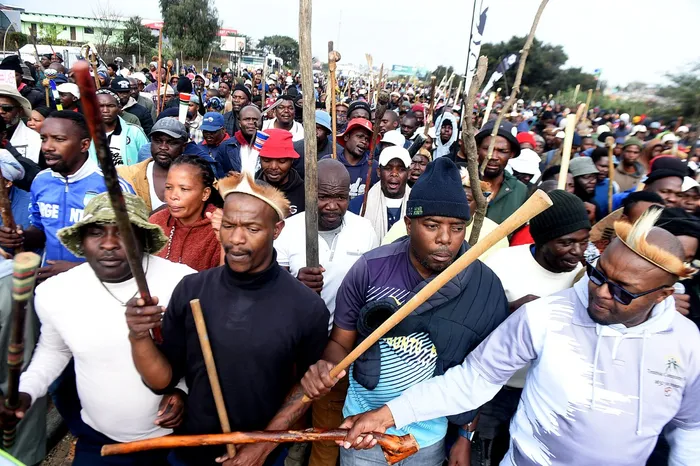
Protesters took to the streets in a national day of action on June 30 to demand the removal of undocumented migrants from South Africa.
Image: ITUMELENG ENGLISH Independent Newspapers
Kim Heller
June in South Africa is always bitterly cold. This winter carries a particularly ominous chill as anti-immigration groupings have issued an ultimatum: undocumented African nationals must leave the country by 30 June 2026, or face consequences.
The rage behind this deadline is fuelled by severely strained public services, fierce contestation for jobs, and persistent crime that has made daily life hazardous for millions of South Africans. Migrants have become easy scapegoats for an economic crisis that demands structural repair from the state.
The seemingly unstoppable gale of mass grievance now threatens serious economic and reputational damage to South Africa's standing in the region and on the continent.
Previous waves of attacks against migrants resulted in consumer boycotts and retaliation against South African companies, including MTN and Shoprite operations in several African countries. The Group Chair of MTN, a leading pan-African company, Mcebisi Jonas, has warned that South Africa cannot afford to alienate itself from the continent.
This week, the Thabo Mbeki Foundation held its National Democratic Revolution Seminar.
Dr Nkosazana Dlamini-Zuma, a former Chairperson of the African Union and South African Cabinet Minister, posed a crucial question: if every African migrant left tomorrow, would unemployment and poverty disappear?
Dlamini-Zuma was clear that we need to fix our own home and our own economy. Former President Thabo Mbeki made a disturbing claim. He asserted that there is a deliberate attempt to isolate South Africa from the rest of the continent. These protests are not organic, according to Mbeki.
The Southern African Development Community is a powerhouse with 16 member states, a population of over 380 million, and a total nominal GDP of close to $900 billion. South African financial, retail, mining, logistics, manufacturing, and telecommunications businesses have a powerful footprint in the region.
Hostility towards African nationals is costly, not only in human lives lost but also economically and diplomatically. Critical cross-border supply chains and investments may become collateral damage in this war of rage. Companies in retail, logistics and manufacturing which depend on regional integration for scale could be badly affected.
Continentally, the reputational and economic stakes are high. The continent accounts for approximately 30% of South Africa's export market, creating much-needed jobs and boosting industrial capacity. South Africa's share of the market could plummet if this climate of threats, hostility and violence continues. Africa remains South Africa's biggest tourism market.
South African Tourism has confirmed cancellations from several African countries following the recent protests and attacks. According to World Bank statistics, the African Continental Free Trade Area is expected to increase the continent's income by almost $450 billion by 2035. It is projected that between 30 million and 40 million people could be lifted out of extreme poverty through expanded intra-African trade.
With South Africa's developed manufacturing capacity, solid financial sector and logistics infrastructure, it is set to benefit from these impending socio-economic shifts. South Africa needs to ensure its continental commitments on trade protocols, investment frameworks, and managed mobility are honoured, not weakened, and that it does not suffer a significant and irretrievable structural loss of revenue and reputation across the region and the continent.
This would be detrimental, especially at a time when other economic players are working hard to augment their presence and leverage.
Foreign powers such as China, India, Türkiye and the United Arab Emirates are eagerly deepening their commercial and diplomatic penetration across the continent. South Africa's economic prowess is already under pressure as economies such as Morocco, Kenya and Rwanda are upping their game in key sectors, including services, finance and renewables.
South Africa can ill afford estrangement from critical regional and continental markets, or the loss of its economic standing or capacity to influence the course of continental integration.
After centuries of fragmentation and external dependency, current-day Africa needs to emerge as a united and robust economic frontier, under African stewardship and in service of African priorities. In this context, South Africa, Africa's most industrialised economy, needs to be a motor of continental growth rather than a vessel of instability.
Colonialism and apartheid exploited and systemically fractured Africa. Neighbouring countries were reduced to labour camps and markets serving white South African capital interests. The unfinished quest for African-based sovereign economies is a continental project. When South Africa attacks African migrants, it sabotages this decolonisation project.
South Africa has both the right and responsibility to manage its borders and deport those who are in the country illegally. However, it must reject political opportunism and violence. During this week's seminar, Dr Dlamini-Zuma spoke of how Rwanda is growing and flourishing because Africans come in and out. She argued that free movement is not necessarily a problem as long as it is managed properly.
When South Africa enables African nationals to be stalked in its streets, it weakens its foothold on the continent, morally, economically and diplomatically. An editorial in The Southern African Times on the eve of 30 June 2026 marches observed that "Today's deadline will pass. The violence it has catalysed will leave sediment in diplomatic relationships and investment perceptions that dissipates considerably more slowly than the marches themselves."
The editorial concludes that "Africa's integration story remains the most structurally compelling long-term investment narrative available to the patient allocator. It is, however, a narrative predicated on solidarity.
What South Africa's streets have looked like this June is the antithesis of that solidarity, and the continent, which cannot afford the sentiment, can still less afford the bill".Scapegoating is not an economic strategy. Dlamini-Zuma was right. We must fix our own house, and in the process, take care not to burn down the neighbourhood.
* Kim Heller is a political analyst and author of No White Lies: Black Politics and White Power in South Africa.
** The views expressed do not necessarily reflect the views of IOL or Independent Media.