The Tony Leon Saga: Uncomfortable Truths Behind the DA's Clean Governance Narrative
STATE CAPTURE
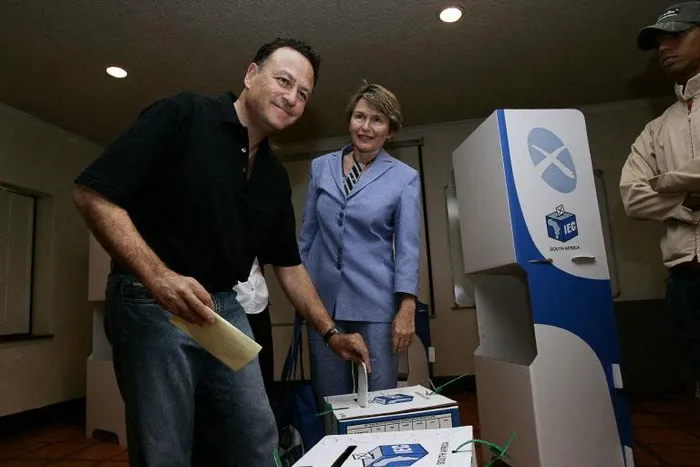
Then Democratic Alliance (DA) leader Tony Leon (left), observed by Helen Zille who succeeded him as party leader, casts his vote during the Local Government Elections on March 01, 2006 in Cape Town. The DA cannot have it both ways. It cannot condemn the capture of the state by one party while tolerating the capture of policy by its own elite networks, says the writer.
Image: AFP
Dr. Reneva Fourie
For years, the Democratic Alliance has presented itself as South Africa’s foremost champion of clean governance. Throughout the years of state capture under Jacob Zuma, the party positioned itself as the uncompromising defender of accountability, transparency and ethical governance.
Recent revelations by former DA leader John Steenhuisen about the conduct of another former leader, Tony Leon, and his public affairs firm, Resolve Communications, have exposed a staggering contradiction.
Resolve Communications is accused of arranging meetings between Elon Musk’s Starlink and DA ministers, including Communications Minister Solly Malatsi, to push for faster regulatory action on Starlink's operating licence.
If true, this is a clear case of gross policy interference. It would also demonstrate a complete disregard for government procurement processes, which are designed to ensure transparency and fairness in the tender system, by directing public resources to benefit powerful companies and connected individuals.
Leon has dismissed these claims as an insult, but the public has heard that defence before. The ANC used similar dismissals when confronted with evidence of state capture. The DA cannot have it both ways. It cannot condemn the capture of the state by one party while tolerating the capture of policy by its own elite networks.
One has to wonder how deep this practice runs within the DA. The Tony Leon scandal may be the most high-profile example, but it is far from the only one. Other scandals associated with the DA have been glossed over or dismissed as partisan attacks. Dion George, a minister who was actively cracking down on the captive lion breeding industry, was ousted and replaced with Willie Aucamp, a man linked to hunting and wildlife ranching interests.
George himself accused Steenhuisen of cadre deployment for commercial interests. He submitted an 85-page affidavit to the Public Protector levelling serious accusations. He alleged that Aucamp had failed to disclose his commercial interests, creating a clear conflict of interest.
He accused Aucamp’s team of withdrawing South Africa’s proposal to tighten regulations on abalone trade at the 2025 CITES conference. This is the behaviour of a party that seems to have abandoned its principles in favour of protecting specific business lobbies.
The same practice might apply to the DA’s position on transformation. The party has been vehemently opposed to Broad-Based Black Economic Empowerment. It has waged a sustained campaign to scrap B-BBEE criteria in state tenders.
Its most significant recent policy push is the Economic Inclusion for All Bill. That proposed legislation would fundamentally reshape the multi-billion-rand government tender system. It would remove set-asides and preferences for historically disadvantaged groups. This directly serves the interests of its wealthy backers.
The alignment of interests is impossible to ignore. The DA is not simply advocating for a different policy; it advocates a policy that directly benefits the wealthy. The DA has received millions from businesses and individuals.
A small group of wealthy individuals and their associated entities provide a significant portion of the DA's funding. Companies linked to Capitec co-founder Michiel le Roux, the Oppenheimer family and Martin Moshal are prominent donors. Since the Political Party Funding Act took effect, the DA has declared over 419 million rand in donations.
In its recent disclosure, it led disclosures with approximately R57 million. This concentration of financial support is a key factor in the discussion of influence. The DA's policy platform aligns closely with business interests. It advocates for free markets and deregulation.
The DA has also been waging a campaign to change South Africa's foreign policy. The party cannot claim to be a party of the people while crafting policy that so clearly benefits its donors. This is the very definition of elite capture. It is the capture of public policy by private interests.
The DA has spent years attacking the ANC for allowing itself to be captured by corrupt interests. Now it stands accused of the same offence. The difference is that the DA’s capture is not about cash in brown envelopes. It is about policy. It is about reshaping the entire procurement system to benefit a small group of wealthy donors.
That is a far more insidious form of corruption because it is legal. It is done in plain sight. And it is defended as principled policymaking.
The DA’s hypocrisy extends to its own administration of tenders, particularly in the Western Cape. A forensic report identified irregularities in a 1.2-billion-rand IT tender. It found conflicting pricing by the winner, questionable disqualifications of other bidders, and officials’ involvement in the process.
Additionally, Cape Town’s clean audit record is declining. The Auditor General identified ongoing weaknesses and compliance failures in supply chain management and procurement oversight. The DA-led administration proceeded despite some concerns from the State Information Technology Agency.
There is also the matter of Helen Zille.
In 2014, Zille helped her son Paul Maree secure tablets from the provincial education department. A complaint was lodged alleging that Zille had used her influence to kick-start her son’s business, Paper Video.
In December 2018, the Public Protector found that Zille had violated the Executive Ethics Code. She was found to have engaged in a conflict of interest. The investigation revealed that her involvement created an appearance of impropriety.
Zille strongly denied the findings. She labelled the report rubbish and took it on judicial review. Yet the finding stands. The DA cannot claim to be a party of integrity while its senior leaders are found to have violated ethics codes. The Zille nepotism scandal is not an isolated incident; it leads to another example.
There is also the Paul Scheepers contract. In 2010, under Zille's leadership, the Western Cape government used public funds to contract a private entity linked to Scheepers, a serving SAPS Crime Intelligence officer.
The contract was for debugging phones in the provincial executive environment. The initial procurement was conducted through a limited process, raising serious questions about transparency and the basis for the deviation from standard procedure.
South Africa has spent years confronting state capture through commissions of inquiry, criminal investigations and procurement reforms. Yet the country has devoted far less attention to what might be described as policy capture, where organised interests seek to shape regulations, legislation and executive decisions before contracts are ever awarded. This deserves far greater scrutiny.
Whether involving telecommunications, procurement reform, environmental regulation or other areas of public policy, government decisions should always be driven by constitutional principles and the public interest rather than privileged access.
These incidents expose a gap in South Africa’s political funding framework. While the Political Funding Act requires disclosure of significant donations, it says little about lobbying or organised political influence. The country has no comprehensive lobbying register requiring lobbyists to disclose clients, meetings with senior public officials or efforts to influence legislation and policy.
As a result, citizens may know who funds political parties but remain largely unaware of who seeks to influence government decisions afterwards. This lack of transparency creates fertile ground for undue policy influence.
The emerging Tony Leon scandal is a case of elite capture in action. It is the alleged capture of policy by a former leader who appears to have used his influence to benefit private clients.
The party cannot escape scrutiny by claiming it is above reproach. We count on the Public Protector to be meticulous in its investigation and to dig deeper. The public deserves to know the full extent of the DA’s hypocrisy.
* Dr Reneva Fourie is a policy analyst specialising in governance, development and security.
** The views expressed do not necessarily reflect the views of IOL or Independent Media.