Stalled National Dialogue and the Mitigation of Anti-Migrant Hostility
BEYOND THE PROTESTS
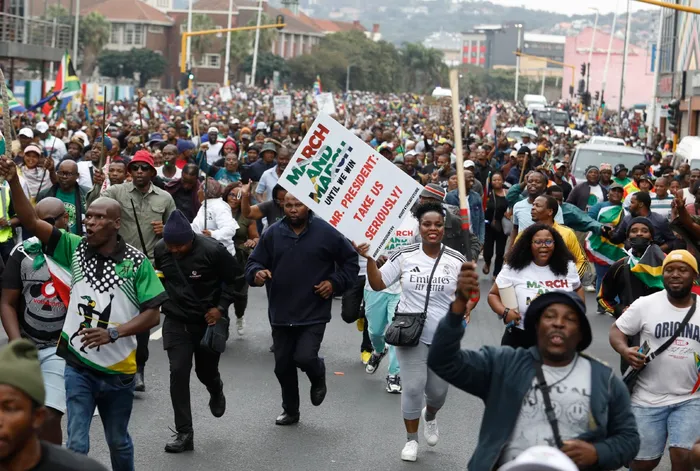
MARCH and March supporters converged in the streets of Durban on June 30 as part of their campaign demanding the repatriation of undocumented foreigners from the country. Illegal immigration is one component of a much larger structural contradiction confronting our political economy, says the writer.
Image: Doctor Ngcobo/Independent Media
Zamikhaya Maseti
The much-anticipated 30 June 2026 has now come and gone. For weeks, the nation lived under the shadow of uncertainty.
There were predictions of a national shutdown, fears of widespread violence, speculation of economic paralysis, and warnings that South Africa would once again relive the traumatic memories of July 2021. Markets became anxious, businesses activated contingency, and ordinary citizens wondered whether the democratic State retained sufficient capacity to preserve public order.
Across much of the country, thousands exercised their constitutional right to assemble and protest. The overwhelming majority of demonstrators marched peacefully. There were, however, isolated but deeply regrettable incidents of looting, intimidation, and attacks against foreign nationals in some localities.
The emergence of March and March as a movement represents something far more significant than a campaign about illegal immigration. It represents the reassertion of organised civil society into the centre of democratic politics.
Whether one agrees with every demand advanced by the movement is ultimately secondary. The more profound observation is that citizens organised themselves outside formal political Parties and succeeded in compelling the national conversation to revolve around questions of immigration, border management, State capacity, and public security.
Antonio Gramsci reminded us that political leadership is never exercised solely through the institutions of the State. It is also contested within civil society, where ideas compete for legitimacy and where consent is constructed.
This Movement has demonstrated this phenomenon precisely. It has sought to establish ideological influence by persuading society that illegal immigration constitutes one of the defining questions confronting democratic South Africa. That is an exercise in political hegemony, whether one celebrates it or opposes it.
One may therefore argue that before the marches reached the streets, they had already achieved a political victory. They succeeded in shifting the national agenda.
Indeed, the Government of National Unity found itself compelled to respond. Extraordinary financial resources were redirected towards policing. Intelligence coordination was intensified.
Politics often teaches us that governments seldom move simply because policy papers recommend action. More often, governments move because organised society alters the political balance of pressure.
The Movement appears to have achieved precisely that. It cajoled the State into treating immigration enforcement and public order as matters demanding immediate political attention.
Yet we must resist the temptation of simplistic explanations.
South Africa's crisis cannot honestly be reduced to immigration alone. Illegal immigration is one component of a much larger structural contradiction confronting our political economy. Persistent unemployment, particularly among the youth, stagnant economic growth, weak border administration, corruption, organised crime, failing municipalities, and declining institutional capacity have together created conditions in which immigration has become the visible face of much deeper frustrations.
This distinction is critical.
It is possible simultaneously to affirm the sovereign right of the South African State to regulate immigration in accordance with the Constitution while rejecting xenophobia, vigilantism and collective punishment. A capable constitutional State neither abandons border enforcement nor abandons human dignity. It protects both.
Perhaps the most important lesson emerging from the events surrounding 30 June is that many of the questions raised by this Movement were precisely the questions that ought to have found expression within the much-anticipated National Dialogue.
Regrettably, that process stalled before it could fulfil its intended purpose. South Africa was presented with an opportunity to convene a genuine national conversation on some of the most pressing challenges confronting the Republic. That opportunity remains unrealised.
The National Dialogue was never intended to become another ceremonial gathering or a public relations exercise. At its best, it was conceived as a platform through which government, political Parties, organised labour, business, academia, faith-based organisations, and civil society could collectively confront the structural contradictions that continue to define our democratic transition. It should have provided the country with an opportunity to move beyond partisan contestation and engage honestly with the realities facing millions of South Africans.
Among those realities is the question of migration and the effective management of South Africa's borders. The Movement has compelled the nation to confront concerns regarding porous land borders, the integrity of our ports of entry, weaknesses in immigration administration, and the capacity of the State to regulate migration in a manner that is both constitutional and effective.
These are not questions that should be monopolised by any single movement or political formation. They are matters of national policy and national security that deserve sober, evidence-based deliberation. Equally, migration cannot be discussed in isolation from the broader political economy.
High unemployment, particularly among the youth, the persistence of organised crime, sluggish economic growth, pressure on public services, and declining confidence in State institutions are interconnected challenges. To isolate one from the other is to misunderstand the complexity of the South African condition.
The National Dialogue should therefore provide the intellectual and political space to examine these questions in their totality rather than through the narrow prism of political expediency.
It is for this reason that the events of 30 June should not mark the end of a national conversation but rather the beginning of one. We should call, as a matter of democratic principle and constitutional responsibility, for the resuscitation of the National Dialogue.
Not because the Movement has demanded it, nor because the government has found itself under pressure, but because the Republic requires an inclusive national platform capable of producing durable policy consensus on issues that profoundly affect our collective future.
When that Dialogue is convened, migration, border management, unemployment, crime, economic growth, and State capacity must occupy its centre. These are not peripheral questions. They are among the defining public policy challenges of our generation.
They demand neither populist slogans nor ideological rigidity. They demand courageous leadership, rigorous evidence, constitutional fidelity, and a shared commitment to building a capable developmental State that commands the confidence of its people.
The passing of 30 June should therefore not be understood as the conclusion of a political episode. It should instead mark the beginning of a national conversation that South Africa has postponed for far too long.
That conversation must move beyond slogans. It must interrogate labour market dynamics, regional economic integration within the Southern African Development Community, border governance, asylum policy, organised crime, economic growth, and the developmental obligations of the democratic State.
The true measure of 30 June will not be whether the country avoided catastrophe on a single day. Its historical significance will be determined by whether the government converts this moment into lasting institutional reform.
If that occurs, 30 June 2026 may one day be remembered not as the day South Africa feared instability, but as the day the Republic was compelled to confront difficult questions it could no longer postpone.
That would constitute not the triumph of one movement over another, nor the victory of one ideology over another, but the strengthening of South Africa's constitutional democracy through the renewal of State capacity, democratic accountability and public confidence.
As we move beyond 30 June, let us, as South Africans, commit ourselves to dialogue, and to dialogue again, until we find one another. It is through honest engagement, mutual respect, and a shared commitment to the future of our Republic that we can forge a common understanding of the challenges before us and build a durable national consensus worthy of our constitutional democracy.
The issues that we shall be dialoguing about as South Africans cannot remain confined within our national borders. They must also reverberate within the chambers of the African Union, for they do not confront South Africa alone. The governance of migration, border management, regional economic integration, transnational organised crime, and the movement of people are challenges shared by many African States.
They therefore demand not only national responses but also Continental cooperation, collective leadership and a renewed commitment to the aspirations of Agenda 2063.
* Zamikhaya Maseti is a political economy analyst.
** The views expressed do not necessarily reflect the views of IOL or Independent Media.