Charting a Path to Independence and Accountability for the Judiciary
STATE OF JUSTICE
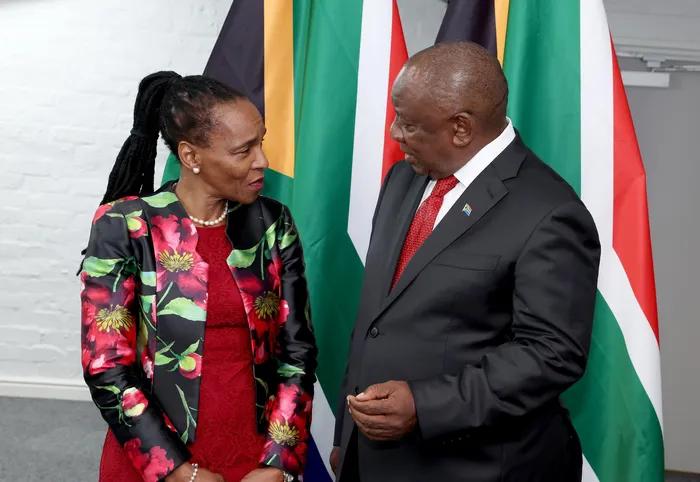
Chief Justice Mandisa Maya and President Cyril Ramaphosa in discussion at the Conference of International Association of Women Judges in Cape Town on April 9, 2025. The upcoming Judiciary Conference will enable much-needed introspection and institutional resetting, says the writer.
Image: GCIS
Dr. Reneva Fourie
As we mark 30 years of the democratic Constitution's existence, our Judiciary is facing severe strain.
While it continues to play an essential role as the guardian of the Constitution and the rule of law, recent allegations of judicial impropriety, institutional challenges and heightened public scrutiny have reinforced the need to strengthen both its governance structures and public legitimacy.
The Judiciary Conference, to be convened in Durban from 13 to 17 July 2026 under the theme “Towards a single, institutionally independent, and accountable Judiciary”, will enable much-needed introspection and institutional resetting.
Judicial independence and accountability constitute complementary key constitutional principles. People trust the courts when judges act fairly and when there are ways to address misconduct. Section 165 of the Constitution says courts are independent and must follow the Constitution and the law.
It also directs government bodies to protect the courts’ independence, fairness, dignity, transparency and effectiveness. These provisions necessitate systems to ensure that judicial independence is protected and accountability is enforced in practice.
The testimonies before the Madlanga Commission and other allegations of judicial impropriety have intensified pressure on the judiciary. Most concerns involve interference, personal misconduct, delays and conflicts of interest rather than explicit financial corruption.
In 2008, Constitutional Court judges accused Judge President John Hlophe of attempting to influence two judges in litigation involving Jacob Zuma. He was suspended, impeached by Parliament in 2024 and removed from office. Judge Nkola Motata was similarly impeached in 2024 following his drunk-driving conviction and dishonest defence at trial.
But, more recently, the Judicial Service Commission found suspended Gauteng High Court Judge Tintswalo “Nana” Makhubele guilty of gross misconduct for retaining her PRASA leadership role after her judicial appointment and facilitating an irregular R56 million settlement linked to state capture.
Suspended Judge Portia Dipuo Phahlane also faces 19 corruption and money-laundering charges involving alleged bribes exceeding R2 million connected to an International Pentecost Holiness Church leadership dispute. There are also documented incidents of corruption in the lower or magistrate courts. These incidents highlight the need to strengthen accountability mechanisms.
One of the most significant constitutional reforms still required is the establishment of a single judiciary. The establishment of a single judiciary should be understood as the completion of an important aspect of South Africa's constitutional transformation rather than simply an administrative restructuring exercise.
Integrating magistrates’ courts and superior courts under the institutional leadership of the Chief Justice should strengthen judicial independence, promote consistent governance and accountability, improve strategic planning and enable more effective administration across the justice system.
A single judiciary would facilitate more consistent ethical standards, integrated disciplinary processes and stronger institutional oversight under judicial leadership while fully respecting constitutional guarantees of judicial independence.
It would also remove longstanding perceptions of executive influence over aspects of court administration that should properly fall within judicial authority.
The practical benefits extend beyond institutional independence. These reforms are particularly important because magistrates’ courts represent the primary point of contact between the justice system and the general public. They adjudicate the overwhelming majority of criminal and civil matters, thereby shaping public perceptions of the courts’ effectiveness.
South Africa continues to experience significant case backlogs, outstanding judgments, infrastructure constraints and uneven performance across parts of the court system. Delays in the finalisation of cases undermine access to justice, increase litigation costs, weaken public confidence and adversely affect victims, accused persons, litigants and the broader economy.
Strengthening institutional governance through a unified judiciary would support more effective case management, better deployment of judicial resources and greater consistency in court administration.
A unified institutional framework would also facilitate more consistent standards, enhanced judicial education, greater use of technology and more coherent leadership throughout the court system.
However, the Judiciary continues to operate within an increasingly polarised political environment, in which judicial decisions are frequently subjected to intense public and political criticism, including regarding the separation of powers. In recent years, judgments concerning matters such as Nkandla and Phala Phala have, at times, entered areas traditionally reserved for Parliament or the Executive.
These concerns reflect a broader debate on how courts should enforce constitutional obligations while respecting the legitimate institutional roles of other branches of government.
Maintaining a balance between constitutional adjudication and respect for institutional boundaries is important. Judicial decisions should always remain open to robust legal scrutiny and principled public debate.
However, sustained attempts to undermine the legitimacy of the courts whenever judgments prove politically inconvenient risk weakening one of the central institutions safeguarding constitutional democracy.
The conference provides an opportunity to reaffirm the constitutional legacy established by South Africa's founding Constitutional Court. Arthur Chaskalson, Pius Langa, Johann Kriegler, Tholie Madala and Yvonne Mokgoro, together with the late Justice Minister Dullah Omar, played a defining role in dismantling apartheid legislation and developing constitutional jurisprudence founded on equality, dignity, accountability and the rule of law.
Their work established judicial independence as one of the cornerstones of South Africa's constitutional democracy. Preserving and strengthening that legacy remains an ongoing constitutional responsibility.
Realising the constitutional vision of a unified judiciary will require legislative support, adequate financial resources, and continued collaboration among the Judiciary, the Executive, and Parliament. The phased transfer of administrative functions to the Office of the Chief Justice, anticipated to begin this year, represents an important step in that process.
Although institutional restructuring alone will not resolve every challenge facing the justice system, it provides the governance framework necessary to improve efficiency, strengthen accountability and reinforce judicial independence.
The 2026 Judiciary Conference in Durban is an opportunity for the judiciary to take ownership of its future, move beyond past scandals and finally realise the Constitution's promise of a cohesive, self-governing judiciary. Through institutional review, the binding effect of court orders, judicial restraint, and accountability mechanisms, the judiciary serves as the ultimate arbiter of constitutional boundaries and defender of fairness.
By embracing the theme of a single, independent and accountable judiciary, the conference can chart a course towards an institution that is effective in its work and worthy of the public's trust. It represents the continued realisation of the constitutional promise of accessible, impartial and effective justice for all South Africans.
* Dr Reneva Fourie is a policy analyst specialising in governance, development and security.
** The views expressed do not necessarily reflect the views of IOL or Independent Media.