Navigating Coalition Politics: The Balance of Power in South Africa
CABINET RESHUFFLE
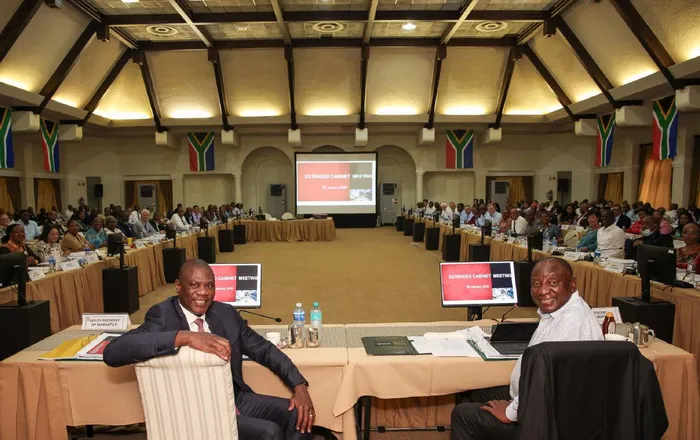
President Cyril Ramaphosa (right) and his Deputy Paul Mashatile at the Cabinet Lekgotla held in the Sefako Makgatho Presidential Guesthouse, Pretoria on January 28, 2026. If South Africa permits Cabinet to become a battleground for internal party contests, it risks creating multiple centres of executive authority, says the writer.
Image: GCIS
Zamikhaya Maseti
The unfolding debate around the Democratic Alliance's request that President Cyril Ramaphosa reshuffle ministers allocated to the party within the Government of National Unity presents South Africans with an important constitutional and political question.
At first glance, the matter may appear to be a routine internal adjustment within a coalition arrangement. Yet beneath the surface lies a much deeper issue concerning the constitutional authority of the President, the nature of executive power, and the future stability of coalition governance in South Africa.
The issue is not whether political parties are entitled to express preferences regarding who represents them in government. They certainly are. Political parties are voluntary associations with leadership structures, policies and electoral mandates.
They have every right to determine who among their members is best suited to advance their political programme. The question is whether those preferences should be elevated to the status of instructions directed at the President, whose powers are explicitly defined and protected by the Constitution.
The Constitution is remarkably clear on this matter. Section 91(2) states that the President appoints the Deputy President and Ministers, assigns their powers and functions, and may dismiss them. The language is deliberate and unambiguous. It does not provide that political parties appoint ministers.
It does not state that coalition partners dismiss ministers. Nor does it create any category of ringfenced ministerial positions belonging to particular parties. The constitutional authority resides in the Office of the President.
This constitutional arrangement was not accidental. The architects of South Africa's democratic order understood that executive authority must be vested somewhere. They recognised that a government cannot function effectively if competing centres of authority simultaneously claim the right to appoint and remove members of the executive.
Accountability requires clarity. If ministers perform poorly, the public knows who appointed them. If the Cabinet succeeds or fails, the President must ultimately account to Parliament and the nation.
It is therefore important to distinguish between political negotiation and constitutional authority. Coalition governments around the world are often built on agreements that allocate ministerial portfolios among participating parties.
Such arrangements are not unusual. They are part of the political reality of multiparty governance. South Africa's Government of National Unity emerged from precisely such a context following the 2024 elections.
However, political agreements do not supersede constitutional provisions. They may guide conduct, influence decisions and shape expectations, but they cannot transfer powers that the Constitution has vested elsewhere.
The President may choose to consult coalition partners before making appointments. He may even decide to accommodate their recommendations. Yet the decision remains constitutionally his. Consultation is not subordination. Cooperation is not a surrender of authority.
The recent developments within the Democratic Alliance must therefore be viewed through this lens. The party's new leadership is entitled to review its strategic direction and determine who it believes should represent it in government.
That is a legitimate political exercise. Nevertheless, when such decisions are presented publicly as instructions to the President, a constitutional line begins to blur.
This is not a criticism directed exclusively at the Democratic Alliance. Indeed, it would be intellectually dishonest to pretend that other political parties have not entertained similar impulses. Throughout democratic history, parties have often sought to maximise their influence over executive appointments. The temptation is understandable.
Cabinet positions confer power, visibility and access to State institutions. Political organisations naturally seek to ensure that individuals occupying those positions remain aligned with the prevailing leadership of the party.
The danger arises when this temptation evolves into a precedent.
Today, it may be the Democratic Alliance seeking the replacement of one of its ministers. Tomorrow, another coalition partner may insist on the removal of a minister who has fallen out of favour with an internal faction.
The following year, a different party may demand the dismissal of a minister not because of poor performance, but because of disagreements arising from a leadership contest. Gradually, the Cabinet ceases to function as a national executive and instead becomes an arena for settling party-political disputes.
Such a development would be profoundly damaging to constitutional governance.
Ministers occupy a unique position in South Africa's democratic system. While they may originate from political parties, their constitutional responsibilities extend far beyond party structures. Upon appointment, they assume obligations to the Republic as a whole. They swear allegiance to the Constitution, not to factional interests. They become accountable to Parliament and ultimately to the South African people.
For this reason, the Constitution does not recognise ANC ministers, DA ministers, IFP ministers or PA ministers. It recognises Ministers of the Republic of South Africa. Their political identities may remain intact, but their constitutional responsibilities transcend party boundaries.
This principle becomes even more important within the context of coalition governance. Coalition governments are inherently fragile arrangements. They require compromise, discipline and mutual respect for institutional boundaries. Once parties begin treating ministerial positions as private organisational property, the cohesion of the executive becomes increasingly difficult to maintain.
South Africa's constitutional democracy is still relatively young in historical terms. The Government of National Unity itself is an experiment born out of electoral realities. The country is learning how to navigate coalition politics at a national level. It is therefore essential that political actors exercise restraint and avoid practices that may weaken constitutional institutions in pursuit of short-term political objectives.
The Presidency occupies a particularly important place within this architecture. It serves as the focal point of executive authority and national coordination. While Presidents are inevitably political actors, the institution itself must remain larger than party calculations. Any practice that gradually reduces the President to a mere administrator of decisions taken elsewhere risks undermining both the letter and spirit of the Constitution.
This does not mean that Presidents should govern in isolation. On the contrary, consultation remains essential. Political parties within a coalition have legitimate interests that deserve consideration. Dialogue and consensus-building are indispensable components of democratic governance. Yet consultation must not be confused with constitutional compulsion.
There is a broader lesson here for all political parties represented in government. The temptation to use Cabinet positions as instruments of internal political management should be resisted. Leadership contests, succession debates and factional disagreements are inevitable features of democratic politics. They should be resolved within party structures and through democratic processes, not through pressure placed upon constitutional institutions.
South Africa has already witnessed the corrosive effects of excessive political interference in State institutions. One of the enduring lessons of the State Capture era is that institutional integrity matters. Once constitutional boundaries are weakened for temporary political convenience, restoring them becomes significantly more difficult.
The issue before the country is therefore larger than any individual minister, any particular party or any current political disagreement. It concerns the preservation of constitutional norms that safeguard democratic governance.
Whether one supports or opposes the Democratic Alliance's position is ultimately secondary. What matters is that all political actors recognise the distinction between recommendation and instruction, between political preference and constitutional authority.
The Constitution settled this matter nearly three decades ago. Political parties may recommend candidates, express dissatisfaction with ministers and lobby for change. They may negotiate vigorously and advocate forcefully for their preferred outcomes. Such activities are entirely legitimate within a democracy.
What they cannot do is assume powers that the Constitution has vested elsewhere.
The President may listen. The President may consult. The President may agree or disagree. But the authority to appoint, dismiss and reshuffle ministers remains constitutionally vested in the Presidency. That principle must be defended consistently, irrespective of which party seeks to challenge it today or may seek to challenge it tomorrow.
If South Africa permits Cabinet to become a battleground for internal party contests, it risks creating multiple centres of executive authority. And where authority becomes fragmented, accountability inevitably follows. The Constitution wisely sought to avoid such an outcome. Political parties would do well to heed that wisdom.
The Government of National Unity can only endure if all its participants recognise that coalition agreements may facilitate governance, but they cannot rewrite constitutional principles.
The temptation to convert Cabinet portfolios into party assets must be resisted. Ministers serve at the pleasure of the President and in the service of the Republic. They are not political trophies to be exchanged whenever internal party winds change direction.
In defending this principle, South Africans are not defending a particular President, political party or minister. They are defending the constitutional order itself. And in a constitutional democracy, that must always remain the higher obligation.
* Zamikhaya Maseti is a political economy analyst.
** The views expressed do not necessarily reflect the views of IOL or Independent Media.