Graft Kingpin Matlala’s Plea Deal Puts The NPA’s Credibility On Trial
ORGANISED CRIME
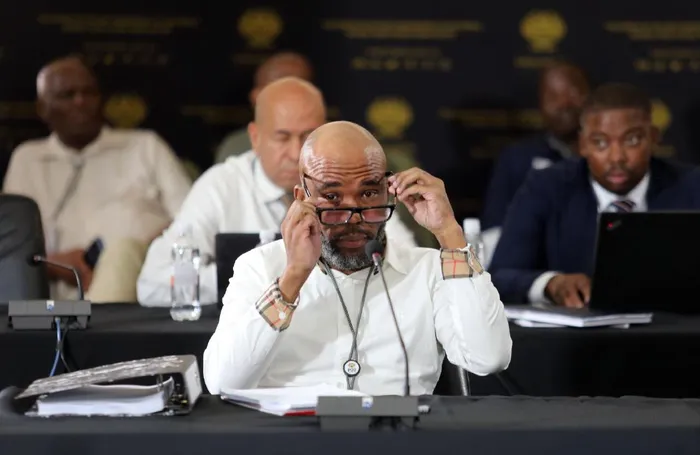
Vusimuzi “Cat” Matlala appeared before Parliament's Ad Hoc Committee probing corruption and political interference in the SA Police Service held at the Kgosi Mampuru Prison in Pretoria on November 27, 2025. The Matlala plea agreement is an important litmus test of whether plea bargaining can serve as an effective instrument against sophisticated criminal enterprises while maintaining public confidence in the justice system, says the writer.
Image: OUPA MOKOENA/Independent Newspapers
Dr. Reneva Fourie
The plea deal entered by alleged underworld figure Vusimuzi "Cat" Matlala in the R228 million South African Police Service tender corruption case is a major test of whether plea bargaining can advance justice in a high-profile corruption matter.
Against the backdrop of ongoing disputes involving SAPS and IDAC, the swift conclusion of the plea agreement is likely to invite public speculation about its timing and purpose.
Matlala appeared briefly in the Pretoria Magistrate's Court on Thursday, 25 June, where details of the plea agreement emerged. In terms of the arrangement, he will become a state witness and cooperate with prosecutors while having pleaded guilty to all seven charges against him, including fraud, corruption and money laundering linked to the controversial Medicare24 tender.
The State and Matlala have agreed to request that the court depart from prescribed minimum sentencing provisions and allow all sentences to run concurrently. The proposed sentence amounts to 15 years of direct imprisonment, with seven years suspended. The final decision rests with the court, and sentencing will only be concluded on 1 July should the magistrate accept the agreement.
According to the prosecution, Matlala has already prepared a statement that allegedly identifies several high-profile individuals connected to the Medicare24 matter and other related criminal activities. His case has been separated from the broader corruption proceedings and will continue independently in the regional court.
The development comes at a pivotal moment as the Madlanga Commission continues to expose allegations of an entrenched nexus between politically connected business figures, organised criminal syndicates and elements within the state.
Testimony emerging before the Commission has painted a disturbing picture of how public institutions and procurement systems may have been exploited to serve private and criminal interests at enormous cost to taxpayers and the rule of law. As a result, any plea agreement involving an alleged central figure in a major corruption and organised crime scandal is certain to attract intense public scrutiny.
The legitimacy of this plea agreement rests entirely on what Matlala is prepared to reveal and what the State is ultimately able to prove. Yet the public has been given little basis on which to judge either. The contents of his disclosure remain confidential, and the scope of his cooperation is still unknown. In the absence of transparency, uncertainty fills the void.
For a society that has endured decades of corruption scandals, failed prosecutions and unfulfilled promises of accountability, public confidence cannot be secured through assurances alone. It must be earned through results, transparency and equal justice before the law.
The National Prosecuting Authority faces a particularly difficult environment. For many years, it has struggled to secure successful prosecutions in complex, politically sensitive and high-profile corruption matters. Several major investigations have resulted in lengthy delays, withdrawn charges or failed prosecutions. In that context, the plea bargain may reflect a strategic decision by prosecutors to secure evidence that would otherwise be difficult to obtain.
It may also reflect concerns about the risks associated with pursuing a lengthy trial against a defendant with extensive knowledge of criminal networks and potentially significant legal resources.
Although informal plea negotiations existed for decades under the Criminal Procedure Act of 1977, formal recognition did not arrive until the introduction of section 105A in 2001. The provision allows prosecutors and legally represented accused persons to negotiate plea and sentence agreements before trial.
Courts must independently determine whether such agreements are just, lawful and in the interests of justice and may reject them if necessary. Plea bargaining emerged as a practical response to court backlogs, limited resources and large numbers of awaiting trial prisoners. It remains an important tool for resolving complex cases efficiently within an overburdened criminal justice system.
Nevertheless, plea bargaining remains controversial. Critics argue that it can create perceptions that wealthy, influential or well-connected defendants receive favourable treatment. Concerns have also been raised about limited public visibility into negotiations that can significantly affect outcomes in serious criminal cases. These concerns become especially acute when matters involve corruption, organised crime or public officials.
While less common in high-profile cases, South Africa has had a few plea bargains since the democratic transition. In 2005, Mark Thatcher pleaded guilty to contravening anti-mercenary legislation in connection with the attempted coup in Equatorial Guinea. He received a substantial fine and a suspended sentence.
Other notable examples include matters involving Roger Kebble as well as criminal proceedings connected to Glenn Agliotti and former national police commissioner Jackie Selebi. Each case generated debate about accountability, prosecutorial strategy and public confidence in the justice system.
Matlala's agreement will ultimately be judged by its results. If his cooperation leads to credible evidence, successful prosecutions and the dismantling of organised criminal networks, many South Africans may view the reduced sentence as a necessary compromise in pursuit of a larger objective. If no significant arrests or convictions follow, criticism of the agreement is likely to intensify.
The question of Matlala's safety is also unavoidable. Individuals who cooperate with authorities in organised crime and corruption investigations often face substantial risks. South Africa's Office for Witness Protection, established under the Witness Protection Act of 1998, exists specifically to protect vulnerable witnesses whose testimony is considered important to criminal proceedings.
The programme has achieved successes but also faces significant challenges. Resource limitations, difficulties faced by witnesses after leaving protection programmes, and persistent threats from criminal organisations have long raised concerns.
There have been instances in which witnesses and whistleblowers connected to corruption investigations have faced intimidation, violence or even death. Ensuring the safety of a witness whose evidence could implicate powerful figures will therefore require exceptional vigilance.
The Matlala plea agreement is an important litmus test of whether plea bargaining can serve as an effective instrument against sophisticated criminal enterprises while maintaining public confidence in the justice system.
South Africans will be watching closely to see whether the promised disclosures translate into meaningful prosecutions, whether powerful individuals are held accountable and whether the agreement ultimately strengthens the rule of law. The credibility of both the prosecution and the broader fight against organised corruption depends on how future action unfolds.
* Dr Reneva Fourie is a policy analyst specialising in governance, development and security.
** The views expressed do not necessarily reflect the views of IOL or Independent Media.