Zimbabwe's Constitutional Amendments Ignite More Political Strife
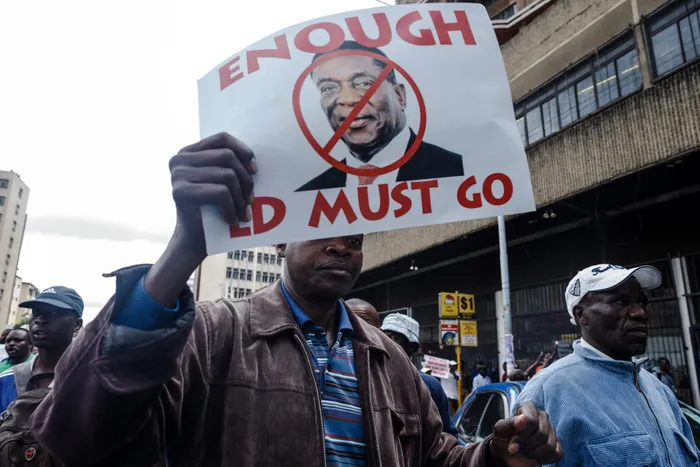
A pro-democracy activist holds a placard demanding the resignation of Zimbabwean President Emmerson Mnangagwa during a demonstration against the country’s worsening economic situation held in Harare on November 29, 2018.
Image: AFP
Kim Heller
Zimbabwe was once a liberatory light across Africa.
The country's political independence in 1980 was celebrated across the Continent as a long-awaited triumph against colonial domination and white minority rule.
With its expanses of productive land, developed infrastructure, and robust educational system, hopes were high that a democratic Zimbabwe would function as a strong cornerstone of post-colonial Africa — a lighthouse of sovereign, people-centred governance. However, this dream has dimmed over the decades.
On 18 June 2026, Zimbabwe's National Assembly, which is dominated by the ruling Zanu-PF party, passed Constitutional Amendment Bill No. 3. The consequences are weighty. If passed, Presidential and parliamentary terms could be extended from five to seven years, and the 2028 election could be delayed until 2030.
Most alarmingly, if the Bill becomes law, the election of the President by the citizens of Zimbabwe will be replaced with the election of the President by a joint sitting of Parliament. President Mnangagwa could remain in office until at least 2030, even though his second and final term should conclude in 2028.
The Bill has now moved to the Senate and is currently being debated. The Bill requires a two-thirds majority endorsement in the Senate. If achieved, the Bill will be sent to President Emmerson Mnangagwa for formal approval and then gazetted as a Parliamentary Act. The government is arguing that there is no need for a referendum.
When a country's constitution is weaponised to serve elite politicians rather than the common people, democracy enters a danger zone. In 2017, President Mnangagwa boldly declared that the people's voice "is the voice of God". In a rather ungodly move, the President is now denigrating the will of citizens and undercutting their participation in democracy.
When a country's President is selected by a Parliament dominated by his own party, ordinary people become little more than passive spectators in a democracy not of their making.
The President's men justify the amendments as essential for the successful implementation of Vision 2030, the government's economic transformation blueprint. However, detractors view the move as a purposeful erosion of democratic accountability.
There is profound sorrow in liberation struggles that bravely removed colonial regimes, but keep ordinary citizens disconnected from real power. Even if the Courts determine that the proposed amendments are legal, this does not mean that they are politically legitimate.
Shifting state power from a foreign elite to a local elite is no real win for democracy or sovereignty. When citizens are restricted from electing their own leaders, government credibility erodes.
Zimbabwe's situation is not unique. Across the globe, constitutions have been weaponised to benefit political elites. In Uganda, several constitutional amendments have enabled President Yoweri Museveni to stay in power for four decades.
In Rwanda, revisions to the constitution have assisted Paul Kagame's lengthy Presidency. In Guinea, Togo, Chad and Cameroon, leaders have used constitutional mechanisms and institutional capture to ensure the monopoly and longevity of power.
In Egypt, President Abdel Fattah el-Sisi has stayed in power due to constitutional tinkering in 2019. In 2018, the removal of the two-term Presidential limit in China was justified as a measure to ensure the country's renewal and security. This has extended the lifespan of Xi Jinping's Presidency.
In Russia, amendments to the constitution were trumpeted as vital for stability. This has allowed President Vladimir Putin to stay in power until 2036. In Nicaragua, President Daniel Ortega repealed term limits. He cited the need to defend revolutionary gains.
While in some instances, short-term emergency-driven constitutional amendments may be crucial, in many cases, they are simply driven by power-hungry leaders and represent a repugnant disintegration of people's power.
Interim constitutional deviations in a crisis may be justified if a country's sovereignty is in peril or if citizens' rights are being threatened. However, when leaders repeatedly stray from their country's constitution to extend personal rule, this should raise alarm bells.
Zimbabwean political analyst Brian Raftopoulos describes Zimbabwe's democratic crisis as far more serious than a mere electoral matter. He argues that Zimbabwe is caught up in a deep constitutional crisis, marked by a lack of accountability and rising state illegitimacy.
Amid the labyrinth of constitutional configurations and piecemeal schemes, ordinary Zimbabwean citizens battle real-life economic crises, joblessness and inadequate public services.
Zimbabwe, the once-celebrated breadbasket of Africa, is now a place where poverty itself is too often the only daily bread for millions of people. Increasingly, citizens are becoming less intoxicated by the heady nostalgia of a yesteryear liberation as they battle daily hardships.
The sacrifices of liberation movements must never be used to justify keeping political elites in office. Liberation credentials may have carried significant importance in the early post-independence honeymoon period, but they are now depleted by decades of disappointment.
Post-independence African governments that have chosen constitutional manipulation over winning democratic consent have shattered dreams of popular sovereignty. In a sad twist of fate, the preservation of post-colonial elites appears to be trumping the will and well-being of the people. Authoritative power with no expiry date is a sorry legacy for former liberation leaders, who have become little more than gluttonous elites.
When a country's constitution is amended to shield leaders from public dissatisfaction and potentially unfavourable electoral outcomes, former liberation movements and leaders may prevail. However, they will forever lose their ethical distinction and political currency.
If the people's voice is the voice of God, as Mnangagwa once invoked, these constitutional amendments appear rather unholy. There is no constitutional amendment that can shield a government that has lost popular credibility and consent, even if it may be judged legally acceptable.
* Kim Heller is a political analyst and author of No White Lies: Black Politics and White Power in South Africa.
** The views expressed do not necessarily reflect the views of IOL or Independent Media.