Betrayal of the Freedom Charter’s Vision for Economic Transformation
BUILDING DEMOCRACY
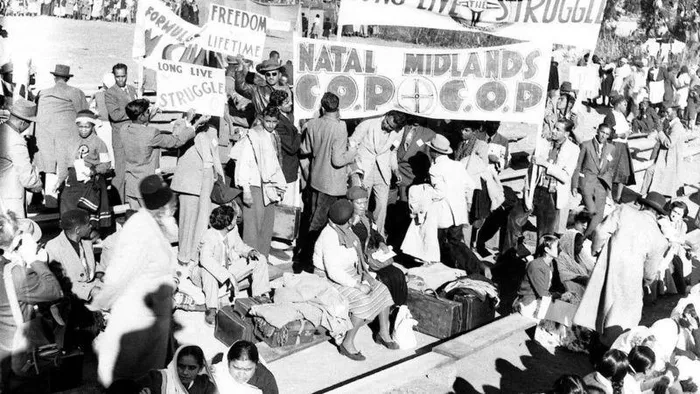
Delegates from Natal at the historic Congress of the People held in Kliptown where the Freedom Charter was adopted on June 26, 1955. Political liberation did not fundamentally alter the distribution of economic power, says the writer.
Image: Independent Media Archives
Dr. Reneva Fourie
This year marks the 71st anniversary of the adoption of the Freedom Charter at Kliptown on 26 June, 1955.
The Freedom Charter was the lodestar of the liberation struggle, the rallying point around which millions of South Africans united in pursuit of a democratic future. It sought to better transform economic power, social relations and ownership patterns in a society then shaped by colonialism and apartheid.
In the 1950s, few could have predicted precisely what a free South Africa would look like. What existed was a collective expression of hope and determination to overthrow apartheid and build a society founded on equality, dignity and justice. More than three decades into democracy, South Africa has achieved many of the Charter's political objectives.
Yet its deeper economic aspirations remain only partially fulfilled, and many of the principles that gave life to the Freedom Charter have been betrayed – eroded by corruption, weakened institutions and the growing dominance of private interests over collective development.
The most significant achievement has been the establishment of an integrated, non-racial democracy. The apartheid state has been dismantled and replaced by a constitutional order founded on universal suffrage, equality before the law and the protection of fundamental rights.
Millions of South Africans who were once denied citizenship now have the opportunity to participate fully in governance. Many of the Freedom Charter’s principles would later find expression in the Constitution and the Bill of Rights. Freedom of expression, freedom of association, and equal political rights are entrenched constitutional guarantees.
South Africa has also made important progress in rolling out basic services. Millions of households have gained access to electricity, water, sanitation, housing, healthcare and education. Social grants have become an indispensable source of support for vulnerable households, helping mitigate the worst effects of poverty.
Women enjoy greater legal protections and opportunities than at any point in the country's history, despite pervasive gender-based violence. And institutions to protect rights and promote accountability have been established.
These gains are significant. However, the Freedom Charter envisioned far more than the extension of rights. It sought the democratisation of economic power and the creation of a society in which wealth, opportunity and development would be shared broadly.
The Freedom Charter declared that the people shall share in the country's wealth. More than three decades after liberation, South Africa remains one of the most unequal societies in the world.
Wealth, productive assets, including the land, and economic opportunities remain concentrated, while millions continue to experience poverty, unemployment and insecurity. Political liberation removed the legal foundations of apartheid, but it did not fundamentally alter the distribution of economic power.
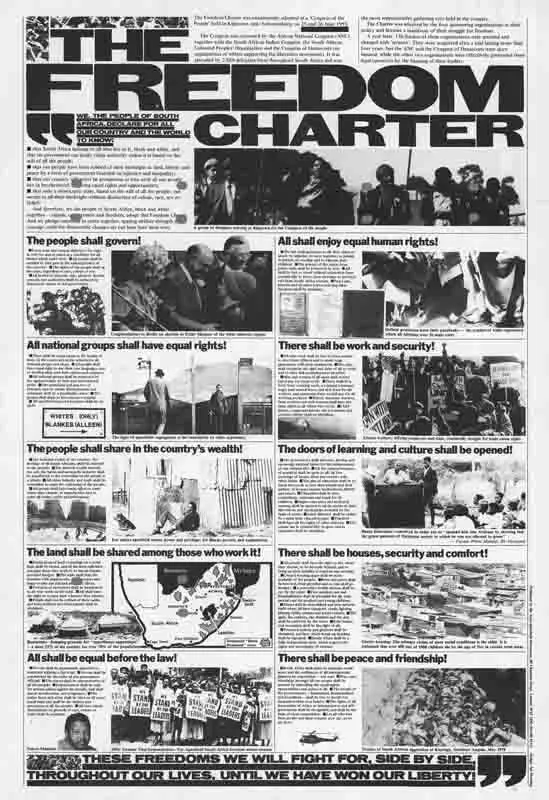
Clauses of the Freedom Charter adopted at the Congress of the People in Kliptown on June 26. 1955.
Image: Independent Media Archives
Part of the explanation lies in corruption and institutional degeneration. The Charter and the emancipatory vision it articulates across every clause – whether land reform, equality before the law, access to work, opening the doors of learning and culture, or the right to houses, security and comfort – have, in the process of implementation, been systematically subverted and instrumentalised by an inexorable logic of greed.
Corruption is currently being exposed as a ravaging force within the security cluster. We witness similar rot within the social cluster. Even some of our organs of people’s power, be they Business Forums or Ward Committees, have been captured and repurposed for predatory, illegitimate ends.
However, corruption alone does not explain the scale of the challenge. The deeper problem lies in the structure of the economy itself. One of the defining features of the post-apartheid economy has been the growing influence of financialisation. Increasingly, economic activity has been driven by financial markets.
Capital has often flowed into speculative investments that yield short-term returns rather than into sectors that create employment and expand productive capacity. The result is an economy capable of generating considerable wealth while simultaneously excluding large sections of the population from its benefits.
Government support for privatisation and the commercialisation of public assets, and the failure to curb private monopolies, have been particularly significant. The Freedom Charter recognised that strategic sectors are essential for mass-based prosperity through industrialisation, manufacturing growth, technological advancement and value-added production.
When private capital monopolises key sectors, barriers to entry rise and economic growth is constrained. Selling or outsourcing public assets also reduces the state’s capacity to drive industrialisation, infrastructure development, wider economic transformation and inclusive growth.
Similarly, the application of austerity measures in a society characterised by deep inequality and mass unemployment can undermine long-term development. Fiscal discipline has its place. Yet when expenditure reductions constrain investment in education, healthcare, and social and economic infrastructure, they can entrench rather than overcome structural inequality. In societies marked by historical exclusion, public investment is often a prerequisite for development.
The international economic environment has further complicated these challenges. Political independence did not free developing countries from global structures of economic power. Many remain integrated into an international system characterised by unequal exchange, financial dependence and asymmetrical power relations.
Within this framework, institutions associated with the Bretton Woods system have frequently promoted policies centred on fiscal restraint, market liberalisation, privatisation and financial openness.
The cumulative effect of these dynamics has been the persistence of an economic order in which political democracy coexists with concentrated wealth, unequal ownership and widespread economic insecurity.
The promise that the people shall govern has largely been realised. The promise that the people shall share in the country's wealth is far from being realised.
This is no longer the time merely to commemorate the heroes of 1955 or to celebrate the achievements of the liberation struggle. The most meaningful way to honour the generation that adopted the Freedom Charter is to confront honestly the challenges facing the country and to commit ourselves to fixing them.
The November local government elections present an important opportunity for citizens to make their voices heard, and it is encouraging to note the surge in youth voter registration. Now this needs to be translated into action at the polling stations. Active participation is needed for democracy to flourish.
Voting remains one of the most powerful instruments available to citizens to ensure accountability, influence policy, and shape the future of their communities. South Africans should approach the ballot box with the same seriousness and sense of responsibility that characterised the historic 1994 elections.
Seventy-one years after its adoption, the Freedom Charter remains both a record of extraordinary achievement and a reminder of unfinished work. Its vision of a non-racial, non-sexist and prosperous democracy continues to challenge South Africans to build a society that eradicates poverty, unemployment, inequality, crime and corruption.
The best way to celebrate that vision is to enable its realisation.
* Dr Reneva Fourie is a policy analyst specialising in governance, development and security.
** The views expressed do not necessarily reflect the views of IOL or Independent Media.