Resolving the Immigration Crisis Demands Pragmatic Leadership
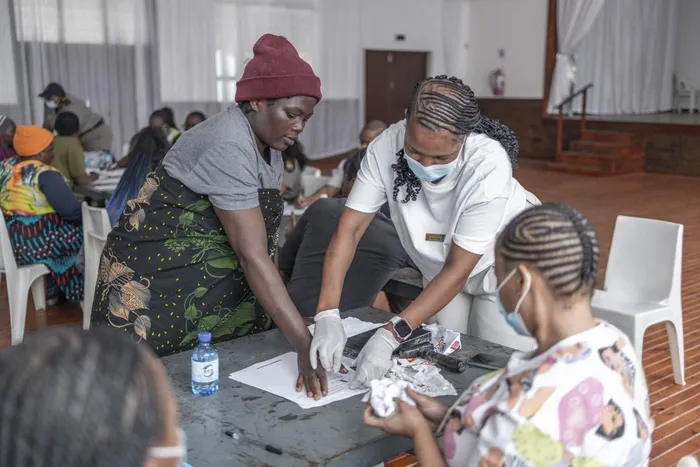
Immigration officials from the Department of Home Affairs take finger prints in order to verify documents of foreign nationals in Durban on June 12. Maintaining sovereignty in immigration policy while managing relations within the continent and the SADC region demands pragmatic leadership, says the writer.
Image: AFP
Prof. Sipho Seepe
While on the 2019 election campaign trail, a buoyant President Cyril Ramaphosa told an excitedly obsequious crowd: "Everybody just arrives in our townships and rural areas and sets up businesses without licenses and permits. We are going to bring this to an end. And those who are operating illegally, wherever they come from, must now know".
At the time of making this promise, those eating out of his hands believed him. They also believed that he understood their plight. This was one of the many of President Ramaphosa’s election promises that could not be sustained beyond the election season. By now, many South Africans have come to accept that with Ramaphosa, it is all talk and zero delivery.
Since the formation of March and the March movement, a citizen-led grassroots organisation focused on stricter immigration enforcement and citizen-focused advocacy, founded in March 2025 by Jacinta Ngobese-Zuma, there have been concerted efforts by privileged and highly placed voices to delegitimise its concerns.
There is nothing revolutionary about that. The March and March movement has been accused of ethnic mobilisation and xenophobia, even though its core grievances resonate widely across South Africa’s diverse communities. Such knee-jerk dismissals often stem from a failure—or unwillingness—to engage with the lived realities of ordinary citizens.
The planned June 30 immigration protests linked to the March and March movement have since generated significant national hype precisely because they tap into deep-seated frustrations that have been building for years.
Had President Ramaphosa delivered on his 2019 election promise to crack down on unlicensed businesses and illegal operations in townships and rural areas, the momentum behind March and the March movement might never have materialised, or at least would not have gained such traction. Instead, unfulfilled promises have left many South Africans feeling abandoned, contributing to a sense of betrayal that has fuelled public mobilisation.
These protests are politically inconvenient for the ANC and Ramaphosa on multiple fronts. Internally, with local government elections looming, they threaten further electoral setbacks following the party’s decline in 2024.
Externally, scenes of immigrants fleeing violence damage South Africa’s carefully cultivated continental and international image, prompting responses such as repatriation efforts by countries like Nigeria and Ghana.
Complex Realities and Emerging Insights
South African conversations reveal a nuanced understanding that transcends simplistic labels. Participants widely acknowledge migration as a global phenomenon driven by conflict, persecution, economic hardship, corruption, and lack of opportunity in countries across the region and continent.
Unresolved conflicts in places like South Sudan, the DRC, Somalia, Sudan, Ethiopia, Nigeria, and others account for the bulk of displacement, while South Africa’s progressive policies have made it a magnet for both genuine refugees and economic migrants.
Yet, there is broad recognition that illegal and undocumented migration places real pressure on housing, services, infrastructure, and jobs in a country already grappling with high unemployment.
This competition in a resource-scarce environment naturally breeds resentment, especially when integration is weak. Security risks that include smuggling, trafficking, crime, and exploitation compound the strain. Many note that not all foreign nationals targeted in violence are undocumented, and that xenophobic attacks solve nothing.
The root issues lie in economic decline, failing municipalities, and governance failures rather than the mere presence of migrants. Under Ramaphosa’s eight wasted years, for instance, the GDP growth averaged 0.6 %. This growth is three times slower than under his predecessor.
A recurring and powerful insight is that the anger expressed by marchers is not baseless xenophobia but a rational response to daily struggles: competing for scarce opportunities in informal settlements and townships, facing rising crime (sometimes linked to undocumented foreigners), and watching overstretched services while elites in secure suburbs lecture about Pan-Africanism.
As Penuel Mlotshwa, a South African podcaster, speaker, and author, passionately argues, empathy requires placing oneself in the shoes of the aggrieved rather than resorting to moralising or deflection. The government bears primary responsibility for weak border controls, corruption in immigration administration, and inconsistent enforcement.
Balance of Forces and the Sovereignty Challenge
The debates highlight a profound crisis of confidence in the state. Frustrations are directed not only at undocumented migrants but also at exploitative employers, criminal syndicates involved in trafficking and illegal mining, and corrupt officials. Migration has become a lens for broader grievances about inequality, institutional failure, and governance.
In many social media platforms, South Africans have since called for a balanced approach. In doing so, they have rejected false dichotomies between human rights and the rule of law. They have correctly argued that a sustainable approach requires:
- Strengthening border management and immigration enforcement (more inspectors, deportations, technology, and courts).
- Distinguishing clearly between refugees, asylum seekers, legal migrants, and undocumented persons.
- Enforcing labour laws and promoting better-managed legal pathways.
- Addressing root causes in origin countries through regional cooperation.
- Protecting human dignity while upholding national sovereignty.
This balance of forces—between civic mobilisation from below, government accountability, and continental relations—poses a key challenge. South Africa has historically benefited from regional migrant labour, particularly in mining and economic development from neighbours like Lesotho, Malawi, Mozambique, and Zimbabwe. Acknowledging these contributions does not preclude addressing today’s realities of uncontrolled irregular flows.
Maintaining sovereignty in immigration policy while managing relations within the continent and the SADC region demands pragmatic leadership. Overly permissive policies strain domestic capacity; blanket accusations of xenophobia stifle honest debate.
The future of South Africa is intertwined with the region’s stability—yet this interdependence cannot come at the expense of citizens’ legitimate concerns about security, opportunity, and belonging.
Ultimately, the hype around the June 30 protests reflects a society grappling with the democratic era’s complex tensions: migration, economic hardship, national identity, and state capacity. There is consensus that violence against any foreign nationals is unacceptable.
The path forward lies in moving beyond polarisation to evidence-based solutions that defend both human dignity and the rule of law—prioritising effective governance, integration, and regional collaboration. Only then can South Africa reconcile its progressive ideals with the practical imperatives of sovereignty and citizen welfare.
Those quick to moralise from positions of convenience and privilege could learn a lot from the rich insights emerging from South African conversations. This will enable them to present a more focused, balanced, and forward-looking approach to a multi-layered immigration challenge.
* Professor Sipho P. Seepe is a Higher Education and Strategy Consultant.
** The views expressed do not necessarily reflect the views of IOL or Independent Media.