Ramaphosa's Political Legacy at Stake as Legal Battles Intensify
PHALA PHALA LITIGATION
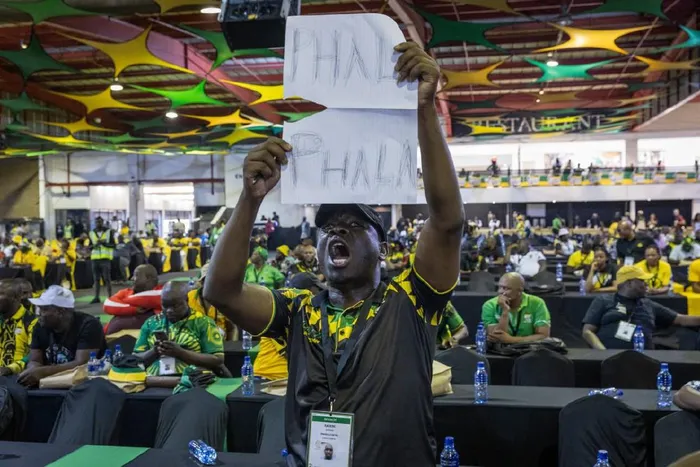
A DELEGATE holds a sign reading ‘Phala Phala’, referring to a theft that happened at President Cyril Ramaphosa’s farm with the same name, during the 55th National Conference of the ANC at NASREC in Johannesburg on December 16, 2022. President Cyril Ramaphosa’s Stalingrad tactics do not augur well for his political legacy. Importantly, he is delaying the inevitable, says the writer.
Image: AFP
Prof. Bheki Mngomezulu
The Phala Phala saga is like a chronic disease. Like a cat, it has nine lives. When one thinks that it is over, it resurrects and creates even more confusion. Intriguingly, the protagonist in this narrative is the president of the country.
According to chapter 5, section 83 of the constitution of South Africa, the sitting president has three clearly defined roles: (a) is the Head of State and head of the national executive; (b) must uphold, defend and respect the constitution as the supreme law of the Republic; and (c) promotes the unity of the nation and that which will advance the Republic.
If these are the expected functions of the president, to what extent has the Phala Phala matter assisted Ramaphosa in abiding by these prescripts? For example, have his actions since the Phala Phala saga surfaced assisted him in upholding the requirements of his office? If not, what kind of legacy will he bequeath to his successors? Importantly, what picture does this incident paint about South Africa as a country?
On June 1, 2022, Arthur Fraser, who was the former State Security Agency Director-General, formally reported the Phala Phala matter. When he filed his criminal affidavit at the Rosebank Police Station in Johannesburg, Fraser accused Ramaphosa of several misdeeds. This included bribery, concealing a crime, money laundering, and kidnapping.
Since then, the Phala Phala matter has been taking twists and turns. Firstly, President Ramaphosa realised that this was a very serious issue with several ramifications. The fact that the incident happened in February 2020 but was kept under the carpet raised red flags. What happened between that time and June 2022 compounded the already complex matter.
Ramaphosa should be commended for penning his resignation letter in 2022. This was a very pragmatic and proactive decision, which would have united the nation as contemplated in the section of the constitution cited above.
However, the ANC misled him by persuading him to rescind his resignation letter. At the time, the party enjoyed the majority in parliament. It planned to use its majority to defend the president, thereby sowing divisions in the country and in the ANC. This was one of the many factors that resulted in the ANC obtaining 40.18% of the votes in the 2024 general election.
The appointment of the three-member Section 89 independent panel led by former Chief Justice Sandile Ngcobo was the correct approach. Its mandate was to establish if Ramaphosa had a case to answer to. Indeed, the report confirmed that Ramaphosa may have a case to answer for.
Instead of implementing the recommendation of the panel report, the ANC used its majority to dismiss it. At that time, it appeared as though the Phala Phala matter was over.
However, the decision by the EFF and the ATM to take the matter up through legal channels brought it to life. Intriguingly, the Constitutional Court delayed in delivering judgment on this matter. Its decision left a cloud hanging over Ramaphosa. It also left the complainants guessing what the outcome would be.
It was only on May 8, 2026, that the Constitutional Court made its ruling. At the centre of this much-anticipated judgement was that the Speaker of the National Assembly should put together an impeachment committee to consider former Chief Justice Ngcobo’s report – something that should have happened in 2022 already. The only thing that would halt this process would be a successful court decision on the stay of the impeachment process. Once again, the Phala Phala matter came alive.
Accordingly, the Speaker of the National Assembly announced that a 31-member committee would be constituted. Although the ANC would enjoy the majority of nine members compared to the DA’s 5, the MKP’s 3, and the EFF’s 2, while other smaller parties had one member each, collectively, the ANC did not have the majority. Noticeably, the ANC was the last party to submit the names of its representatives.
The election of Makashule Gana from Rise Mzansi to chair this impeachment committee left many people talking. But this meant that the process would begin in earnest.
As this process unfolded, Ramaphosa approached the Western Cape High Court to apply for a stay of the impeachment process. While his decision was not in contravention of the constitution since he exercised his democratic right, it surely did not unite the nation.
A few questions arise.
Firstly, if the president believed in 2022 that the Phala Phala matter was indefensible, leading to his resignation, why did he deem it necessary to halt this impeachment process?
Secondly, if indeed he had nothing to hide and believed that he was innocent, why did he apply for a stay of the impeachment process instead of appearing before the committee to state his case?
Thirdly, does the president believe that what he is doing is right, or is he taking orders from the ANC, as was the case in 2022? Fourthly, have Ramaphosa and the ANC learned anything from the 2022 decision, which tarnished the image of the party? Fifthly and lastly, did Ramaphosa try to juxtapose morality with legality to see that what is legally correct could be morally wrong?
These questions invoke other discussions. When former President Jacob Zuma moved from one court to another, he was accused of implementing Stalingrad tactics while avoiding the inevitable. Now that Ramaphosa is doing the same, should the same argument be resurrected to blame him for using Stalingrad tactics?
Leaders like EFF’s Julius Malema have already made public statements that Ramaphosa will not escape the Phala Phala saga. If that is the case, is Ramaphosa delaying the inevitable? If the latter is the case, would it not be better for him to either resign voluntarily or appear before the impeachment committee than stall the parliamentary process? Which of these options would save his legacy?
In conclusion, Ramaphosa’s Stalingrad tactics do not augur well for his political legacy. Importantly, he is delaying the inevitable.
* Prof. Bheki Mngomezulu is Director of the Centre for the Advancement of Non-Racialism and Democracy at Nelson Mandela University.
** The views expressed do not necessarily reflect the views of IOL or Independent Media.