SA, China Relations: Balancing Investment, Job Creation and Worker Rights
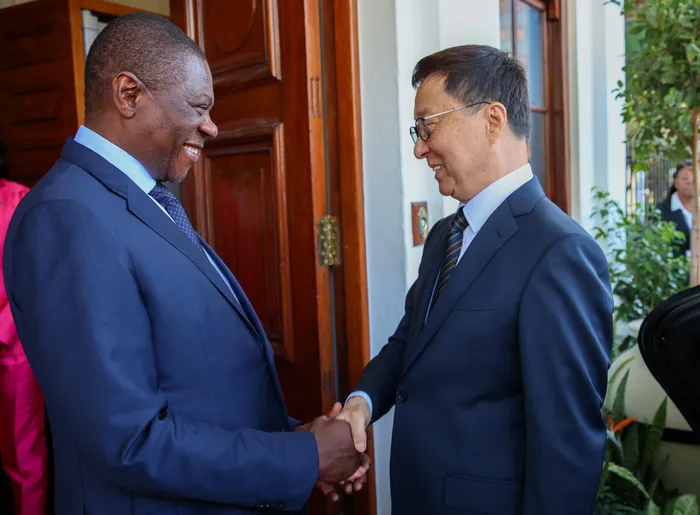
South Africa's Deputy President Paul Mashatile and the People’s Republic of China Vice President Han Zheng, at Tuynhuys, Cape Town on March 26. The two leaders co-chaired the 9th South Africa-China Bi-National Commission (BNC). The emerging dispute between BAIC and NUMSA should be approached not as a contest between Chinese investment and South African workers, says the writer.
Image: GCIS
Zamikhaya Maseti
The looming labour dispute between BAIC, the Chinese automotive manufacturer, and the National Union of Metalworkers of South Africa (NUMSA) is undoubtedly unsettling.
It comes at a time when South Africa's economy is struggling to attain higher levels of growth, investment and employment creation. Yet the significance of this dispute extends beyond the immediate disagreement over wages. It raises fundamental questions about the nature of industrialisation, labour relations and economic development in a democratic South Africa.
The automotive sector occupies a strategic position within the South African economy. It is one of the country's most important manufacturing industries, contributing significantly to national output, exports and employment. More importantly, it remains one of the few sectors that have consistently attracted large-scale foreign direct investment despite prevailing economic headwinds.
For the Eastern Cape, the automotive industry is not merely an important economic sector. It is the backbone of the provincial economy and has established itself as South Africa's automotive hub that generates thousands of direct jobs and indirectly through component manufacturing, logistics, transportation, engineering services, warehousing and retail activities.
The economic multiplier effects of the automotive sector cannot be overstated. Small businesses, transport operators, engineering firms, training institutions and local communities all derive economic benefits from the continued expansion of the industry.
In many respects, the fortunes of large parts of the Eastern Cape remain closely linked to the health and sustainability of the automotive sector. It is estimated that the automotive industry contributes approximately 30% towards the Eastern Cape's economy. Any instability within the sector, therefore, carries consequences that extend far beyond individual firms and workers.
It is therefore understandable why concerns are emerging regarding the wage dispute between BAIC and NUMSA.
According to reports, NUMSA is demanding that workers employed by BAIC be remunerated in accordance with prevailing industry standards. The union argues that workers should receive approximately R825 per hour, while the company is reportedly offering wages that fall significantly below the rates generally associated with the sector.
Whether the final negotiated figure ultimately differs from what is currently being reported is not the central issue. The principle that lies at the heart of the dispute is whether workers performing similar work within the same industry should be subjected to substantially different labour standards.
South Africa's democratic order was founded upon the recognition of human dignity, social justice and fair labour practices. The labour rights enshrined in the Constitution were not accidental. They emerged from decades of struggle against a system that deliberately relied upon the exploitation of cheap Black labour.
The democratic breakthrough of 1994 sought to dismantle this legacy and replace it with a developmental framework in which economic growth and social justice would reinforce one another.
It is therefore understandable why NUMSA would resist any arrangement that appears to institutionalise lower labour standards within a strategic sector of the economy. Workers cannot be expected to celebrate foreign investment if that investment is perceived to be built upon conditions that undermine hard-won labour rights and established industry norms.
However, the matter is not entirely one-sided.
South Africa finds itself in an increasingly competitive global environment. Countries across the world are aggressively competing for industrial investment. Automotive manufacturers today have multiple options regarding where to establish production facilities.
Decisions are influenced by labour costs, infrastructure quality, policy certainty, logistics efficiency and market access. Investors constantly assess these variables when determining where to allocate capital.
The arrival of BAIC in the Coega Special Economic Zone represented a significant vote of confidence in South Africa and in the Eastern Cape. It strengthened economic cooperation between South Africa and China while reinforcing the province's position as an emerging automotive manufacturing centre. Such investments should not be dismissed lightly in the face of unemployment and sluggish economic growth.
This reality imposes responsibilities on all parties.
BAIC must appreciate that South Africa's attractiveness as an investment destination does not derive solely from labour costs. The country offers a relatively sophisticated industrial base, a skilled workforce, established supply chains and access to regional and continental markets. These advantages are inseparable from the labour protections and social stability that have evolved within the democratic era.
Equally, organised labour must continue to pursue its objectives with a strategic appreciation of the broader economic environment. The objective of trade unionism has never been simply to win wage increases in isolation from economic realities.
The challenge before BAIC and NUMSA is therefore not to secure a narrow victory over the other. Rather, it is to arrive at a settlement that balances competitiveness with fairness, investment with dignity, productivity with social justice and profitability with human development.
History demonstrates that prolonged industrial conflict rarely produces lasting winners. Ultimately, adversarial outcomes weaken the very sectors upon which both labour and capital depend.
What is required at this juncture is constructive engagement anchored in mutual respect and recognition of shared interests. South Africa requires investment. It equally requires decent work. These objectives are not mutually exclusive.
The Eastern Cape has invested considerable effort over many years to position itself as the automotive capital of South Africa. Government, labour and business have collectively contributed to building an industrial ecosystem capable of competing internationally. That achievement should not be placed at risk by an avoidable breakdown in labour relations.
The emerging dispute between BAIC and NUMSA should therefore be approached not as a contest between Chinese investment and South African workers. Such a characterisation would be simplistic and ultimately misleading. The real issue is whether South Africa can continue attracting investment while maintaining the labour standards that define its democratic character.
The answer must surely be yes.
There is, however, a broader international dimension that cannot be ignored. South Africa and China are strategic partners within BRICS, a formation that was conceived not merely as an economic bloc but as a platform for promoting a more equitable and balanced global economic order.
The spirit that underpins BRICS is one of mutual benefit, shared development and cooperation among nations of the Global South. It follows, therefore, that tensions of this nature should not be allowed to fester unnecessarily. Economic diplomacy and constructive engagement must prevail over confrontation.
BRICS must increasingly evolve into a multilateral platform through which member States, investors, workers and governments can collectively address emerging economic contradictions. The partnership cannot be reduced to trade balances, investment flows and diplomatic communiqués.
It must also concern itself with the quality of development that it seeks to advance. A developmental partnership worthy of the name must recognise that labour rights, human dignity and economic growth are mutually reinforcing rather than mutually exclusive objectives.
Ultimately, the future growth and credibility of BRICS will depend not only on the volume of investments it attracts but also on the social outcomes it produces. The bloc cannot grow based on cheap labour, depressed wages and unequal labour standards.
Such a path would merely reproduce the very inequalities that the Global South has historically struggled against. The challenge before BRICS is to demonstrate that another model of development is possible, one that balances profitability with fairness, investment with social justice and economic expansion with human dignity.
That is the larger lesson that should emerge from the current dispute between BAIC and NUMSA.
* Zamikhaya Maseti is a political economy analyst.
** The views expressed do not necessarily reflect the views of IOL or Independent Media.