The Denuding Forest: A Tribute to Abdullah Ibrahim
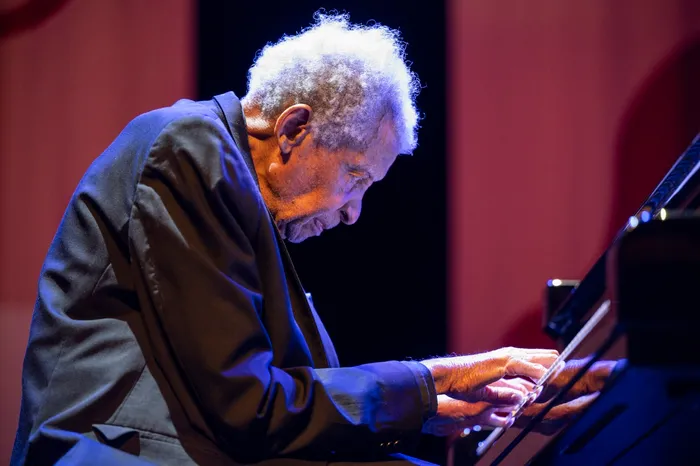
South African jazz legend Abdullah Ibrahim performing at the Cape Town International Jazz Festival on March 27. I can still hear his live performance of ‘Thula Dubula’ in that rasping voice of his, the dialectic between the harshness of the lyrics and the gentleness of the music creating an inner tension and beauty, says the writer.
Image: Armand Hough/Independent Media
Dr. Barry Gilder
There is a metaphor – a very visceral image – that has haunted me as the years of our liberation struggle recede. It is of a large dense forest, populated by towering yellowwoods, their tops disappearing into the heavens. Each tree represents one of the giants of our struggle against apartheid.
And each time one of those giants passes on – Mandela, Sisulu, Slovo, Hani and so many others – in my mind I see and hear a giant yellowwood crashing to the ground and dissolving into the soil, leaving another treeless spot on the forest carpet.
And in that forest, there is one special glade, where the trees have been falling too fast in recent years – Keorapetse Kgositsile, Nadine Gordimer, James Matthews, Dennis Brutus, Mazisi Kunene, Don Mattera, Miriam Makeba, Hugh Masekela, Jonas Gwangwa, Ray Phiri, Johnny Clegg.
And now, the crack and crash of the Abdullah Ibrahim yellowwood resound in my mind’s ear.
My path crossed with many of these fallen yellowwoods – in the NUSAS arts festival at Wits in 1973, in the concert halls and meeting halls and conference centres in London, Amsterdam, Gaborone, and even in Kinaxixi Square in Luanda, where I did one performance with Bra Jonas and the newly formed Amandla Cultural Ensemble, before proceeding to Moscow and a long non-musical trajectory.
I know my path crossed many times with this last yellowwood to fall, as ‘Bra Dollar’ and as ‘Abdullah’, but only one adheres to memory – the Culture and Resistance Conference and Festival in Gaborone in July 1982.
This conference was unprecedented. Close to a thousand artists and activists from inside South Africa and from all the corners of exile gathered in Gaborone for five days of a rich programme of talks, workshops, performances, exhibitions, and, of course, informal discussions and arguments at the University of Botswana campus and other venues. This was the first significant opportunity in decades for South Africa-based and exiled South African artists to engage with each other.
The better-known attendees included Abdullah Ibrahim, Hugh Masekela, Jonas Gwangwa, Wilson ‘Kingforce’ Silgee, Nadine Gordimer, Mongane Serote, Keorapetse Kgositsile, Thami Mnyele, James Matthews, Richard Rive, Malcolm Purkey, Alf Kumalo, David Goldblatt, Gavin Jantjes and many others.
My enduring memory of Abdullah is of the concert on one evening of the festival. I recall him at a grand piano to the left of the stage (although the ‘grandness’ of the piano might be more imagination than memory). In particular, I can still hear his live performance of ‘Thula Dubula’ in that rasping voice of his, the dialectic between the harshness of the lyrics and the gentleness of the music creating an inner tension and beauty.
The thing is, I don’t know how I can recall watching his performance from the audience, as, in their wisdom, the organisers had billed me to go on stage to sing after Abdullah – perhaps the most stressful example of ‘a hard act to follow’ – so I should have been in the wings. I think he wished me luck as he came off and I went on, and halfway into my first song, one of my guitar strings snapped, and I had to chat up the audience while I changed and tuned it.
When I was doing research for my book Songs and Secrets, our National Archives kindly gave me copies of DVDs donated by the Dutch anti-apartheid movement, featuring various cultural events that had taken place during the exile years. Among them was a documentary of the Gaborone conference that included an interview with Abdullah in which he said: ‘We don’t think of ourselves as being in exile. This is a strategic retreat.
I know Abdullah also attended the Culture in Another South Africa (CASA) conference in Amsterdam in December 1987. I was there, but have no clear recall of his presence and performance. It was another historic event, attended inter alia by him, Basil ‘Mannenberg’ Coetzee, Jonas Gwangwa and Dudu Pukwana; the ANC’s cultural ensemble, ‘Amandla!’; writers Nadine Gordimer, Lewis Nkosi, Cosmo Pieterse, Breyten Breytenbach, Baleka Kgositsile (née Mbete), Keorapetse Kgositsile, John Matshikiza, Mandla Langa and Njabulo Ndebele.
Back to the present. Last night, my subconscious made an intervention. I dreamt I was in a house I didn’t know. I was told that in a closed room in the basement was a dying Abdullah Ibrahim. I went down, knocked gently on the door and pushed it open. A young woman was sitting on a bed to the left, watching over a very weakened Abdullah lying on a bed to the right. I sat next to him and greeted him. He smiled wanly. I asked: ‘Do you remember me, Abdullah?’ He said: ‘Of course I do, Barry.’ I wished him hamba kahle. I woke up.
A few years ago, I was in the Orbit jazz club in Braamfontein. I was sitting and chatting with the late Myesha Jenkins and Khosi Xaba. Myesha told me she was putting together a book of jazz poetry and asked me to contribute. I said I didn’t have anything I’d written that would suit. She and Khosi said, ‘Well, then write something, Barry. And I did. It was published in To Breathe into Another Voice in 2018 by Real African Publishers.
Here’s the poem:
The Sounds of Exile
When the frontier
Slashes like a blade
Across the wrist
Of the soul
(As some
Would call it
Others
A Stygian hole
Out of which
No light escapes)
When, indeed,
The sight of light
Escaping through the crevices
Of mountain peaks
In the early morning
And the smell of wild
Lavender bushes
And the sound
Of goats bleating
Around the village
Or the roar
Of traffic
The weeping of saxophones
In the city
Behind
Have gone from the senses
And remain only
As the clattering
Of an old newsreel
In your distant mind
In a distant city
Then stop
Pause
Listen
Hold your palms up
To the only wind
That blows home
For now
From the dark clubs
And lamplit stages
Of London
Amsterdam
Stockholm
New York
Brussels
Moscow
Berlin
Harare
Gaborone
For peace sake
Hear the breeze
Blowing from the rumbling drums
Of Julian Bahula
The trembling strings
Of Lucky Ranku
Gusting us home
From Amsterdam
In the May of 1976
Come
Let us go to Gaborone
In that July
Of 1982
Surround ourselves
With the fecund minds
The limber fingers
And lithe lips
Of Wilson 'Kingforce' Siljee
Denis Mpale
Jonas Gwangwa
Hugh Masekela
And with Abdullah Ibrahim
who said
We don't think
Of ourselves as being
In exile
This is a strategic
Retreat
And sang
Thula
Dubula
No need to say much more
It's all been said
And tried before
It's all over now
But the dying
And come
Once more
Down the Gaborone road
To the Woodpecker
On the banks of
The Molopo River
As we look across the frontier
To home
With the sounds of
Bra Hugh and
Bra Jonas
And Steve Dyer
Blowing behind us
While the stones-throw enemy
Listens
Now
On the wind of jazz
See the light
Defying gravity
Escape
From the dark hole
* Dr Barry Gilder is an Editor at Amazwi Creatives, the author of three published books and an executive member of the National Writers’ Association of South Africa (NWASA)
** The views expressed do not necessarily reflect the views of IOL or Independent Media.