Pope Leo's Vision for AI: Bridging Humanity and the Global South
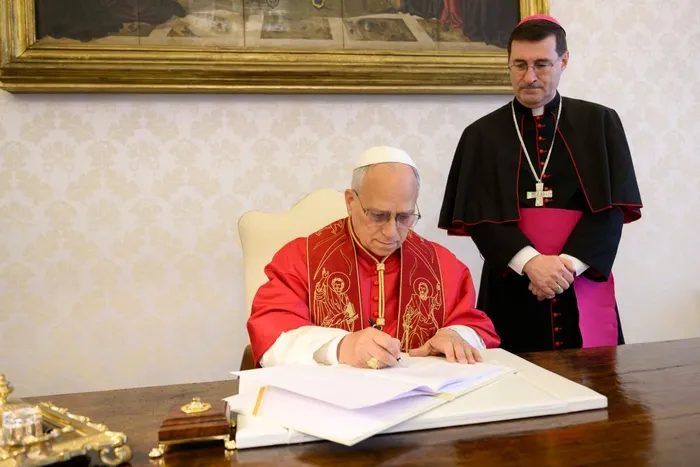
Pope Leo XIV signing his first Encyclical Letter “Magnifica Humanitas” which focused on the rise of artificial intelligence.
Image: Vatican Media/AFP
Ashraf Patel
Pope Leo's Encyclical - Magnificus Humanitas, released in late May, is a milestone world-changing document. In a world riven by multiple wars, narrow nationalism, breakdown of international law, polarisation, it has been welcomed for its progressiveness and rooted in values of humanity and tackling the polycrisis- the social-economic and environmental justice and perils of AI.
At 240 pages, it is a well-researched document and one for the ages- one rooted in ecumenical principles of egalitarian and values-based approach to managing technology for Humanity. Key elements include:
"On safeguarding the human person in the time of artificial intelligence, to articulate the church's position on a wide range of contemporary crises, including war, modern slavery, wealth inequality, the erosion of democracy and the devaluing of human capacities.
"To disarm does not mean rejecting technology, but preventing it from dominating humanity,"
According to Catholic media commentator Justi Mc Lelland,
" In the encyclical, Leo said AI must be freed from an 'armed' logic of competition driven by the pursuit of geopolitical and commercial dominance. Technology is never neutral, because it takes on the characteristics of those who devise, finance, regulate and use it." AI developers, therefore, "bear a particular ethical and spiritual responsibility, for every design choice reflects a vision of humanity. "One of Leo's most robust criticisms of AI aims at the concentration of power among a technocratic class of AI developers. To make his case, Leo invokes the principle of subsidiarity, which holds that social and political decisions should be made at the most local level possible. The Pope insisted that, within the development of AI systems, "the possibility of openly discussing the ethical frameworks involved and subjecting them to shared standards of social justice." ( Justin McLelland, June 2025)
Global South and North on AI
The Vatican's egalitarian approach to AI is in sharp contrast to that of Big Tech titan Elon Musk, who is set to become the world’s first trillionaire this Friday with yet another IPO listing. So how does the Pope's Encyclical compare to diverse responses from global civilisational powers?
Noting Big Techoligarchs have come to dominate the full value chain and their ideological online hate politics are polarising politics, their data extractivism and monetisation and extraction of labour in the digital economy in the Global South, have seen their wealth reach stratospheric levels.
Deregulation and Disruption
The Trump administration's deregulation agenda has been a mega boon for AI tech oligarchs who have lobbied for low guardrails, testing and safety standards. From low privacy to data extraction and energy-guzzling cloud data centres spread across outlying states and the Global South, they seek low compliance for their data-profit maximisation model. Google, OpenAI, et al. also seek unbridled access to AI testing to test data sets, and this means abuse of copyright and the livelihoods of creators of content globally.
The Great American AI Act 2026 - the long-awaited bill from Reps. Obernolte and Trahan, released in a “discussion draft” last week, is the most serious AI safety bill yet. But the AI safety community is divided over the big question: is it good enough?
In their analysis of Trump's new Great AI Act, Anton Leicht and Dean Ball make the case for betting on human agency as AI disrupts the labour market:
“The role of humans in future economies is not something we simply discover as it occurs. How we distribute tasks between humans and machines is largely downstream of a web of complicated economic incentives and technical features…and when policy makers ask ‘what will happen,’ they fail to see that they’re among the central live players in this question.” The attitude we suggest you take on this issue is uncomfortable … it asks you to bet on humans to figure out what to do, but not to idly sit back and watch it play out. Instead, we ask governments to take their thumb off the scale wherever they currently hinder human experimentation,
In the USA, free speech and corporate monopoly stand in stark contrast to the Global consensus on the need to regulate Generative AI. Here, Big Tech's business model controls the full value chain, where hate speech fueled on X and Meta has caused havoc in societies, is seen as a ‘First Amendment right’. The outsourcing of AI backend development to digital sweatshops in the global South ( Kenya, Philippines) is one of extractivism and exploitation. Energy-guzzling data centres are unsustainable, pushing up electricity utility costs and contributing to the current cost-of-living crisis.
In this regard, the US model of free market deregulation and AI as a national security pillar is the hallmark of the US model. The age-old US ‘cowboy capitalism’ approach to markets and dominance is on full display. This is in contrast to the vision and values of Pope Leo's Encyclical and the broader aspirations of the Global South and the UN.
EU‘s AI Act
The European Union’s EU AI Act is rooted in its traditions of both human rights and social market regulation. The AI Act sets out risk-based rules for AI developers and deployers regarding specific uses of AI. The AI Act is part of a wider package of policy measures to support the development of trustworthy AI, which also includes the AI Continent Action Plan, the AI Innovation Package and the launch of AI Factories. Together, these measures guarantee safety, fundamental rights and human-centric AI, and strengthen uptake, investment and innovation in AI across the EU.
China, BRICS, the Global South and AI Development
BRICS nations and China are leading on innovative approaches to Tech and AI for national development and co-creating new models for the global south. A cursory analysis of BRICS AI and China’s Global Civilisational Initiative, Global Governance Initiative, and its AI Governance Action Plan
Artificial intelligence (AI) is a new frontier in human development. It is a key driving force of the ongoing scientific and technological revolution as well as industrial transformation, and an international public good that benefits humanity. AI presents unprecedented development opportunities, and it also brings unprecedented risks and challenges. In the AI era, only through global solidarity can we fully unleash the potential of AI while ensuring its safety, reliability, controllability, and fairness, and ultimately deliver on the commitments outlined in the United Nations Pact for the Future and its annex: the Global Digital Compact (China Global AI Action Plan 2025)
The Chinese AI Governance plan is rooted in the need for industrial development and a responsible Governance framework within the state-regulatory matrix. In many ways, it has remarkable alignment with Pope Leo’s AI Encyclical and bodes well for the future of global AI and the UN GDC.
As global geopolitics deepen, the Pope's Encyclical has a remarkable resonance and alignment with the UN’s Global Digital Compact GDC, which is a pillar of the UN Pact of the Future that seeks to address the multiple crises facing the world. Key challenges ranging from the climate crisis, AI and information integrity to addressing poverty and inequality and conflicts are addressed. Here, the role of technology and AI should be a force for Good Humanitas - and not the current US-led Orwellian dangerous order of war, chaos and conflict.
* Ashraf Patel is a Senior Research Associate at the Institute for Global Dialogue, UNISA.
** The views expressed do not necessarily reflect the views of The African.