FIFA Cannot Claim Neutrality in the Face of Anti-Immigration Rhetoric
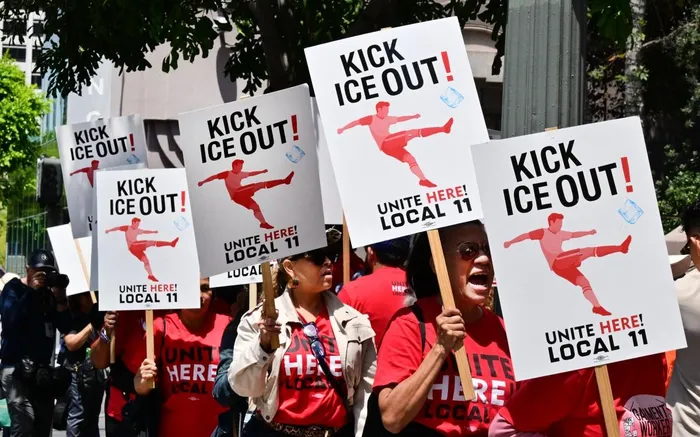
SOFI stadium workers protest outside FIFA World Cup 26 Los Angeles Office calling for ICE to be banned from the World Cup on May 1, 2026.
Image: AFP
Richard Santos
The images of the Senegalese national team being searched by US border agents on an airport tarmac, on the eve of the 2026 World Cup, represent more than just an embarrassing episode. They constitute a powerful metaphor for the historical times we are living in.
Just days earlier, Iraqi striker Aymen Hussein was subjected to hours of interrogation in Chicago. Then, Somali referee Omar Abdulkadir Artan, voted the best African referee of 2025 and selected by FIFA to officiate at the World Cup, was denied entry to the United States despite possessing proper documentation and accreditation for the event.
Taken in isolation, these facts could be presented as mere administrative procedures or bureaucratic excesses. Observed together, however, they reveal something deeper: the persistence of an international order that continues to classify people, nationalities, and territories according to political, racial, and geopolitical hierarchies.
It is often said that sport brings people together. But, in moments like this, it also exposes the invisible structures that organise the contemporary world system. Airports become laboratories of power, where nationality, origin, skin colour, and geographic location continue to operate as markers of suspicion.
In my studies on communication, colonialism, and race, I have argued that Western modernity has never completely abandoned its founding hierarchies. They have merely assumed new forms. In *Minority Majority *, I sought to demonstrate how numerically majority groups can be converted into politically subordinated subjects through institutional devices of power. In *Whiteness and Television*, I analysed how media narratives produce symbolic centralities and peripheries.
Finally, in *Media, Colonialism, and Cultural Imperialism*, I discussed how the production of the global imaginary continues to be traversed by asymmetrical relations between centre and periphery.
What we are observing now is the international translation of these same mechanisms.
When an African delegation is spectacularly searched on an airport tarmac, while representatives of the central powers circulate under the automatic presumption of legitimacy, we are not dealing with a simple security procedure. We are witnessing the updating of a colonial grammar.
Proponents of these measures will argue that it is merely a matter of the strict application of immigration protocols. This is precisely how contemporary mechanisms of exclusion work.
The discourse of security transforms geographical, racial, and cultural differences into potential threats. The result is the normalisation of practices that would hardly be accepted if applied equally to delegations from the Global North.
This isn't just about Senegal, Somalia, or Iraq. It's about the message being sent to the world: some bodies are welcome; others must constantly prove their innocence.
In Brutalism, Achille Mbembe offers a particularly useful interpretative key to understanding this phenomenon. According to the Cameroonian philosopher, the contemporary border has ceased to exist merely as a territorial boundary between states. It has become incorporated into certain subjects.
Thus emerge the so-called "border bodies" or "transborder bodies": individuals who carry with them the very condition of being suspects, permanently subjected to surveillance, control, and the need to demonstrate that they legitimately belong to the spaces they occupy.
It's not just people crossing borders. It's people onto whom the border is projected.
The search of the Senegalese delegation, the detention of an Iraqi athlete, and the ban on entry for a Somali referee reveal exactly this mechanism. The American border is not just in airports. It has been inscribed on certain bodies, especially those originating from Africa, the Arab world, and the so-called Global South.
In this sense, the episode goes far beyond the sporting world. It expresses a broader political rationale, characteristic of the contemporary period. Amid the relative decline of American hegemony and the emergence of new global disputes over markets, technology, influence, and strategic resources, there is a growing recourse to policies of control, securitisation, and closure.
The recent strengthening of ultranationalist, xenophobic, and anti-immigration rhetoric in the United States is not an isolated phenomenon. It is a manifestation of a hegemonic crisis. When powers perceive the erosion of their leadership capacity, they often respond by expanding surveillance mechanisms, constructing internal and external enemies, and symbolically reaffirming borders.
It is in this environment that racism finds new forms of legitimation.
It no longer necessarily presents itself through the biological languages that marked the 19th and 20th centuries. It reorganises itself through bureaucracy, the management of migratory flows, monitoring systems, and security policies. The language changes, but the hierarchy remains.
The World Cup should represent a celebration of human diversity. However, being held under these conditions, it risks becoming a global showcase for practices incompatible with the values of equality, coexistence, and cultural exchange that football itself claims to represent.
Therefore, I consider it legitimate to question not only the stance of the American authorities but also the complacency of international sports institutions. FIFA cannot claim neutrality in the face of practices that directly affect athletes, referees, and delegations. In situations like this, neutrality often functions as accommodation.
I confess that I'm following this World Cup with growing unease. Each new episode reinforces the perception that the choice of the United States as the main host of the tournament was, at the very least, controversial. More than that, it may have been a political and ethical mistake.
I don't hide my desire for Brazil to return home as quickly as possible. Personally, I believe that we shouldn't have even normalised holding an event that presents itself as a universal celebration while subjecting certain people to constraints incompatible with the spirit of sportsmanship.
The central question, after all, is not who will lift the trophy. The question is what kind of world are we legitimising when we accept as normal scenes that reproduce old colonial hierarchies under new bureaucratic justifications.
Football does not exist outside of politics. It never has. And when an African team is treated as a suspect even before stepping onto the field, the match has already begun long before the initial whistle.
* Richard Santos is a writer, researcher, professor, and extension worker at the Federal University of Southern Bahia (UFSB). This article was originally published at https://www.brasildefato.com.br/
** The views expressed do not necessarily reflect the views of IOL or Independent Media.