Navigating Geopolitical Loyalties for Common Prosperity
SA-KENYA RELATIONS
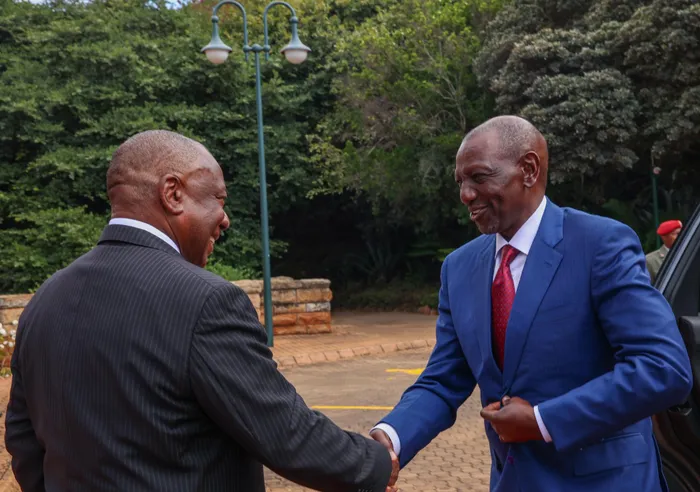
President Ramaphosa welcoming Kenya's President William Ruto to the Union Buildings in Pretoria on June 4. South Africa and Kenya have the economic muscle and diplomatic weight to show that Africa can build partnerships strong enough to overcome divisive geopolitical pressures, says the writer.
Image: GCIS
Kim Heller
By all accounts, President William Ruto's recent state visit to South Africa was a resounding success. The optics were good, as two major African economies officially pledged to drive joint prosperity at a time when the continent is in dire need of deeper economic integration.
South Africa, the continent's most industrialised economy, and Kenya, East Africa's commercial and logistical hub, are both countries with massive economic and political muscle. With a GDP of close to $480 billion, South Africa has substantial economic weight.
So too does Kenya, with a GDP of approximately $147 billion. Stronger cohesion and collaboration between Southern Africa and East Africa would have a positive impact on the continent as a whole, especially if truly integrated and sustainable value chains in key industries are activated.
South Africa's President, Cyril Ramaphosa, reiterated the importance of strengthening regional value chains, boosting industrialisation and continental integration. The President of Kenya, William Ruto, spoke of the need for Africa to move from an acquiescent spectator in world affairs to a major player.
There was a buzz of enthusiasm as trade agreements in education, skills development, and maritime affairs were signed, and as the talk steered towards amplifying the African Continental Free Trade Area (AfCFTA) possibilities.
This is a vital imperative as intra-African trade is paltry, hampering Africa's sovereignty and collective bargaining power within the global economy. There was a spirit of alignment and solidarity at the state visit grounded on a shared understanding that Africa's prosperity rests on greater economic integration.
The foundations for greater economic partnership are already in place. In 2025, trade between South Africa and Kenya was close to $680 million. South African businesses have invested over $2 billion in Kenya, while Kenyan businesses have invested almost $283 million in South Africa. Kenya is a major trading partner for South Africa outside of the Southern African Development Community.
During this historic state visit, agreements were signed on education, skills development and maritime affairs. This level of collaboration is desirable. Heightened continental cooperation and integration offer protection against global economic fluctuations, foreign pressure, and manipulation. The viability of the African Continental Free Trade Area (AfCFTA) depends on regional and continental partnerships.
Integrated pharmaceutical production could reduce Africa's reliance on imported medicines, while collaborative agro-processing industries could strengthen food security, industrial development and job creation.
The risk is that geopolitical differences, rather than common economic interests, could be the defining feature of South Africa-Kenya relations. The countries' vastly different foreign policy trajectories could become a source of tension in the highly competitive global matrix.
Under President Ruto's administration, Kenya has greatly strengthened its relations with the United States and key European powers. Kenya is the first non-NATO ally of the United States in sub-Saharan Africa. Kenya's ready involvement in the Haiti security mission points to its allegiance to the United States.
Its growing engagement with European countries, most notably France, signals how Ruto prizes and prioritises partnerships with Western powers. On the other hand, South Africa, through its BRICS membership, has positioned itself as a strong proponent of a multipolar global order in which the voice and agency of the Global South are elevated.
Divergent geopolitical orientations do not have to be obstacles to African unity and cooperation. African unity does not demand ideological congruence in foreign policy. Rather, it requires a shared commitment to sovereignty, development, and collective prosperity.
However, when geopolitical leanings and loyalties undermine trust and unity, regional and continental relations can fracture. This can structurally undermine industrial and trade policies, as well as joint infrastructure development and security partnerships between African nations.
History shows that foreign powers have tended to exploit regional and continental divisions to advance their geopolitical and economic interests. A key challenge for African nations is to avoid becoming embroiled in the rivalry between competing global players. International partnerships that do not bolster African development place it in peril, and the continent cannot afford this.
Both South Africa and Kenya are economically fragile. South Africa continues to grapple with sluggish economic growth, severe youth unemployment, and growing public discontent. Kenya's debt burden, high living costs and a highly politicised and disgruntled youth weigh heavily on its prospects for economic recovery. These conditions make both countries susceptible to prioritising short-term economic gains over longer-term developmental imperatives and continental priorities.
Both Ramaphosa and Ruto emphasised partnership and shared purpose beyond trade agreements. There was a clear understanding that the continent's challenges, such as debt burdens, persistent economic dependencies, climate vulnerability, and lingering structural poverty, cannot be addressed in isolation.
The future trajectory and well-being of the continent will not be determined by whether Kenya enjoys close relations with Washington or whether South Africa champions BRICS.
It will be determined by solid, sustainable cooperation among African countries and regions. In his address, President Cyril Ramaphosa spoke of the need to move beyond narrow national economic agendas and focus on what African countries can build together.
His call for pamoja (togetherness) spoke directly to the paramount imperative of unity and collaboration. South Africa and Kenya have the economic muscle and diplomatic weight to show that Africa can build partnerships strong enough to overcome divisive geopolitical pressures.
If South Africa and Kenya can build solid cooperation despite their vastly different foreign policies, this would serve as an important real-time case study of how African unity need not be held captive to global rivalries.
Pretoria and Nairobi must rise above their geopolitical differences. This will help break the spell of Africa's future being shaped by outsiders. It does not require magic—just a powerful wand of regional and continental partnership.
* Kim Heller is a political analyst and author of No White Lies: Black Politics and White Power in South Africa.
** The views expressed do not necessarily reflect the views of IOL or Independent Media.