Hawks Demise: From Guardians of the Law to Enablers of Organised Crime
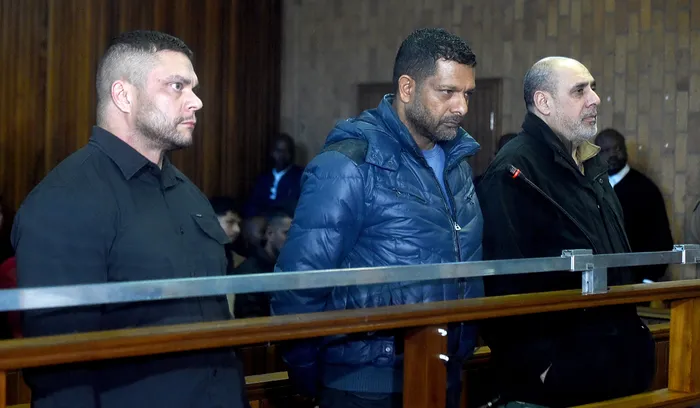
(FROM LEFT) Durban businessman Tariq Downes, Gauteng Crime Intelligence Head Major-General Feroz Khan, and Gauteng Hawks Head Major-General Ebrahim Kadwa appeared in the Kempton Park Magistrate’s Court on May 11. They face charges including corruption, defeating the ends of justice, and unlawful dealing in precious metals. The emerging concern is whether the Hawks remain fit for purpose, says the writer.
Image: Itumeleng English/ Independent Newspapers
Dr. Reneva Fourie
The Directorate for Priority Crime Investigation, better known as the Hawks, was created to be South Africa's premier weapon against organised crime, corruption and complex commercial offences.
Officially launched in 2009, following the controversial disbandment of the Scorpions, the Hawks were presented as a more accountable and integrated law-enforcement body capable of tackling the country's most sophisticated criminal networks.
Yet the events emerging from the Madlanga Commission of Inquiry suggest that South Africa's elite crime-fighting unit has become entangled with the very forces it was created to combat.
The Scorpions, established between 1999 and 2001 within the National Prosecuting Authority (NPA), had gained public support for tackling high-level corruption and organised crime but faced accusations of overreach.
Parliament passed the South African Police Service Amendment Act (Act 57 of 2008), transferring investigative functions to the SAPS and creating the DPCI as an independent directorate within it. Its mandate was to prevent, combat, and investigate national-priority offences.
Concerns were raised that locating the new unit within the South African Police Service would weaken its independence. Those fears were partially vindicated when the Constitutional Court, in the Glenister judgment and subsequent rulings, found that the legislative framework governing the Hawks failed to provide sufficient institutional independence to meet South Africa's constitutional obligations in the fight against corruption. Despite adjustments, concerns about executive influence persisted.
However, the evidence emerging from the Madlanga Commission suggests that the challenges facing the Hawks transcend questions of institutional design.
The Commission, chaired by retired Judge Mbuyiseli Madlanga, was established by President Cyril Ramaphosa to investigate allegations of collusion between politicians, police officials, prosecutors, intelligence operatives and other state actors. Recent testimonies have revealed systematic corruption embedded in structures meant to protect the public.
Perhaps the most alarming revelations concern two major cocaine seizures made during 2021. The first involved 541 kilograms of cocaine worth approximately R200 million, intercepted at Durban's Isipingo Depot.
Rather than being secured according to standard procedures, the drugs later disappeared from a Hawks facility in Port Shepstone. Lieutenant Colonel Gavin Jacob admitted to failing to follow basic forensic protocols. Crime scenes were not properly secured. Fingerprints were not collected. Key records were not maintained, and drugs were moved over 100 kilometres to an insecure site.
On 8 June 2026, the commission examined the Aeroton seizure of July 2021, in which 715 kilograms of cocaine valued at R286 million, smuggled from Brazil, were intercepted. Hawks investigator Lieutenant Colonel Nkoana Joseph Sebola testified that R55 million worth of the seized cocaine went missing directly from the state’s forensic science laboratory.
Testimony exposed how senior police and traffic officials monitored Transnet logistics information to intercept shipments for personal gain or to reallocate shipments to cartels. The testimony paints a troubling picture of how deeply drug cartels may have infiltrated South Africa's criminal justice system, logistics hubs, and senior law enforcement ranks.
A further breakthrough occurred when former Crime Intelligence head Feroz Khan dropped an urgent High Court bid to stop the commission from accessing his seized electronic devices.
Leaked court papers revealed that, among others, Khan allegedly used a political party leader to influence state security oversight processes by supplying engineered parliamentary questions intended to undermine the Inspector-General of Intelligence. Khan is also alleged to have leaked the protected home address and identity details of the primary complainant in the VBS Mutual Bank scandal to political figures.
Collectively, these disclosures reveal more than isolated misconduct. They suggest the existence of an ecosystem linking criminal syndicates, politically connected individuals, compromised officials and corrupt business interests in mutually beneficial networks.
The allegations also raise troubling questions about the effectiveness of the Office of the DPCI Judge, which was established as an independent oversight mechanism but appears unable to identify or prevent the alleged misconduct now being exposed before the commission.
The emerging concern is whether the Hawks remain fit for purpose. It would be unfair and inaccurate to suggest that every member of the organisation is corrupt. Many investigators continue to serve with professionalism, courage and integrity under exceptionally difficult circumstances.
Their efforts should not be overlooked. Nevertheless, institutions must ultimately be judged by outcomes and public confidence. The evidence emerging from the Madlanga Commission suggests an organisation whose credibility has been profoundly damaged.
The disbandment of the Scorpions remains controversial nearly twenty years later. The possibility that the Hawks themselves may require fundamental restructuring, or even complete replacement, has become a necessary consideration.
South Africa may once again need to build a genuinely independent, strictly vetted, professionally insulated and constitutionally protected investigative body capable of confronting corruption without fear or favour.
Yet institutional design alone is not a cure for corruption. Independence, oversight mechanisms and constitutional protections are essential, but they cannot compensate for individuals who choose to abuse public office for personal gain. Ultimately, the most effective deterrent to corruption is not the existence of rules but the certainty of consequences.
Corruption flourishes when wrongdoing is tolerated, investigations are delayed, and accountability is selective. Responsibility for enforcing that accountability extends throughout the chain of command, from immediate supervisors and senior managers to directors-general, ministers and ultimately the President. Ethical governance must be demanded and enforced at every level of the state.
Clarity on the newly announced priority crimes unit headed by Lieutenant General Nhlanhla Mkhwanazi is also required. Is this structure intended to supplement the Hawks, operate alongside them, or address perceived shortcomings within existing investigative institutions? South Africans deserve clarity on its mandate, reporting lines, powers and relationship to existing institutions.
Yet amid the bleakness, there is reason for cautious optimism. The Madlanga Commission is exposing what many suspected but could not prove. Sunlight remains one of the most powerful disinfectants in any democracy.
The ashes currently being uncovered may ultimately provide the foundation for renewal. If the evidence is acted upon with courage and consistency, the scandal engulfing the Hawks could become the catalyst for building a criminal justice system that is truly independent, accountable and worthy of public trust.
* Dr Reneva Fourie is a policy analyst specialising in governance, development and security.
** The views expressed do not necessarily reflect the views of IOL or Independent Media.