Football and Politics: The 2026 World Cup of Shame
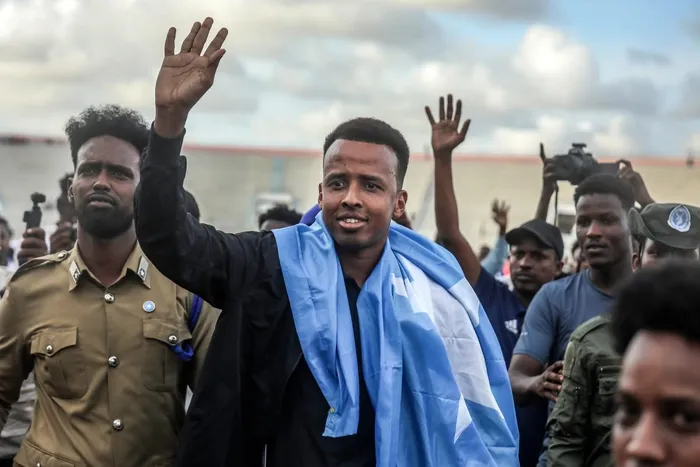
Somali international referee Omar Abdulkadir Artan waves to supporters while draped in the Somali flag as he is welcomed ahead of a solidarity football match after returning to Somalia in Mogadishu on June 10. Artan, who in 2025 was named men's referee of the year by the Confederation of African Football (CAF), was barred from entering the US on Saturday.
Image: AFP
Benedito Tadeu César
I've followed football for almost my entire life, not only as a fan, but also as a researcher. In 1981, I defended my dissertation, " The ' Gaviões da Fiel and the Eagle of Capitalism or The Duel'," in the Postgraduate Program in Social Anthropology at Unicamp, considered the first academic master's thesis in Brazil about an organised fan group.
In that work, I sought to understand football as a social, cultural, and political phenomenon, far beyond the four lines of the field.
At that time, football and sport in general were not yet considered "serious" subjects by much of Brazilian academia. Many saw these manifestations as minor issues, unworthy of the attention of the social sciences.
The consolidation of the sociology and anthropology of sport in Brazil would only occur years later, thanks to the work of several researchers who demonstrated how football expresses social conflicts, collective identities, political disputes, economic interests, and worldviews. Today, this seems evident. Forty-five years ago, it was not.
Perhaps that's why it's impossible to watch the events surrounding the 2026 World Cup without a profound sense of unease.
Over decades of studying politics and society, I've learned that football has never been isolated from power struggles. Governments, economic interests, international conflicts, and ideological projects have always found in sport a privileged space for projection and influence. What changes are the historical circumstances and the degree of visibility of these interferences?
Football, power and politics
The history of international sport offers numerous examples of this relationship between sporting competition and political power. Major competitions have frequently been used as instruments for projecting national prestige, ideological affirmation, and symbolic dispute between states.
The Berlin Olympics in 1936, held under the Nazi regime, remain one of the best-known examples of this political instrumentalisation of sport. Decades later, the Munich Olympic Games in 1972 offered another dramatic and painful example of the deep intertwining of sport and politics.
The kidnapping and murder of eleven Israeli athletes by members of the Palestinian organisation Black September shocked the world and transformed a sporting celebration into the stage for a geopolitical tragedy with global repercussions.
The episode brutally demonstrated that international conflicts do not necessarily remain outside the stadiums and Olympic villages. They can cross their gates and occupy the centre stage on the world stage.
This relationship is even more intense in football. No other sport simultaneously mobilises so many feelings, so many collective identities, so many economic resources, and so many political interests. Football moves billions of spectators and billions of dollars across all continents.
Heads of state, governments, global corporations, international organisations, and economic groups are constantly vying for influence over this gigantic planetary spectacle. Precisely for this reason, it demands from sports entities, governments, and international organisations an even greater commitment to transparent, universal, and coherent criteria.
The political weight of football can explain many decisions. It cannot justify them when they are marked by discretion. Nor can it serve as an excuse for the omission of democratic governments and national federations that, faced with similar situations, adopt radically different positions according to the strategic interests of the actors involved.
For this reason, the 2026 World Cup risks going down in history as the World Cup of Shame.
Iran behind closed doors
Held jointly by the United States, Canada, and Mexico, the competition takes place under the shadow of the military escalation in the Middle East.
The United States has participated in military actions against Iran and continues to offer political, diplomatic, and military support to Israeli operations in Gaza and Lebanon. In this context, one of the teams that qualified for the World Cup has begun to face obstacles imposed precisely by one of the host countries of the competition.
The facts are well known.
Members of the Iranian delegation had difficulty obtaining entry authorisation to the United States. Officials from the Iranian Football Federation were prevented from entering the country and had to return to Iran, weakening the administrative and technical structure of the national team. US authorities also imposed special restrictions on the Iranian delegation's stay in US territory.
This is not just any bureaucratic issue. This is a situation that compromises the principle of equal conditions among participants in an international competition.
Other delegations were also affected by unusual procedures. Iraqi striker Aymen Hussein was subjected to approximately seven hours of interrogation upon landing in the United States to participate in the tournament.
A photographer from the Iraqi delegation was denied entry after a lengthy period of questioning. Episodes like these demonstrate that foreign policy and geopolitical tensions are directly interfering with the sporting environment of the competition.
FIFA's silence
So far, FIFA has not offered a public response commensurate with the seriousness of these events. The organisation, which frequently presents itself as the guardian of the universality of football, seems to passively accept situations that affect the equal treatment of participating national teams.
FIFA's silence inevitably draws a comparison with the treatment given to Russia after the invasion of Ukraine in February 2022. At that time, FIFA and UEFA quickly suspended the Russian national teams and clubs from their competitions.
Russia was excluded from the Qatar World Cup and several other international tournaments. The International Olympic Committee recommended the removal of Russian athletes and officials from international sporting competitions, triggering a wide network of sporting sanctions.
The justifications were well-known: the defence of the values of sport, international peace, and human rights.
Double standards
The question today is not about defending Russia or demanding new punishments. The question is about consistency.
If the international sports community considers it legitimate to adopt sanctions in certain conflicts, why are similar criteria not even discussed when the United States and Israel are involved in military actions that cause thousands of deaths, the destruction of entire cities, and strong condemnation from international organisations and broad sectors of world public opinion?
The response seems uncomfortable. There are acts of aggression that provoke immediate international outrage. And there are massacres – some denounced by broad sectors of the international community as genocidal practices – that continue to be treated with complacency, silence, or diplomatic justifications.
The omission of democracies
The problem lies not only in the decisions of the sports organisations. It also lies in the silence of governments and national federations. To date, no significant boycott movement has been organised. No substantial pressure has been exerted on FIFA. No collective mobilisation has emerged to question the restrictions imposed on the Iranian national team.
The history of sport offers distinct examples. For decades, the apartheid regime in South Africa was the target of international sporting isolation. In that case, it was understood that neutrality was impossible in the face of such blatant injustice.
Today, however, neutrality seems to have been replaced by selectivity.
A moral issue
The World Cup continues its course. The sponsors carry on with their business. The broadcasts reach billions of viewers. The leaders give speeches about integration between people. But reality insists on invading the playing fields.
Therefore, this could be called the Cup of Shame.
Shame on us for normalising war.
Shame on the silence of the sports institutions.
Shame on the unequal application of political criteria.
Shame on the inaction of democratic governments in the face of situations that, in other contexts, would be cause for outrage and sanctions.
Shame on us for the lack of international solidarity.
It's shameful that a participating team faces restrictions imposed by a host country without this provoking an adequate reaction from world football authorities.
Football remains one of the most important cultural expressions on the planet. Precisely for this reason, it cannot serve as a smokescreen to conceal injustices or to normalise practices that would be condemned in other circumstances.
When politics invades the pitch to restrict the rights of some and preserve the privileges of others, the issue ceases to be merely a sporting one.
It becomes a matter of morality.
* Benedito Tadeu César is a political scientist and retired professor from the Federal University of Rio Grande do Sul (UFRGS). This article was originally published at https://www.brasildefato.com.br/
** The views expressed do not necessarily reflect the views of IOL or Independent Media.