The Role of Modernisation in Shaping Africa-China Relations
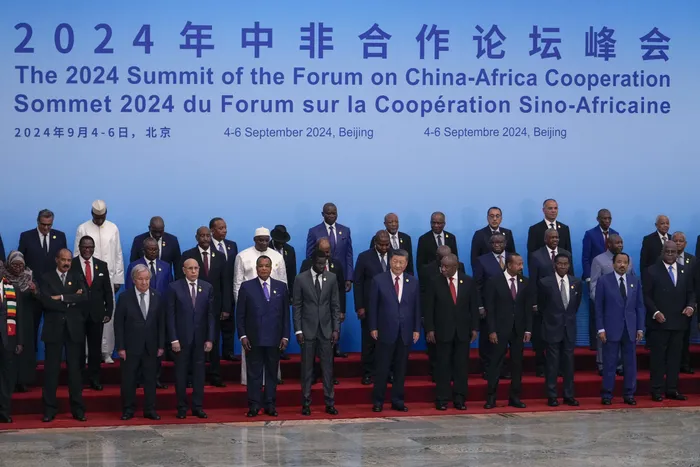
China's President Xi Jinping (centre) with leaders from African countries at the opening ceremony of the Forum on China-Africa Cooperation (FOCAC) at the Great Hall of the People in Beijing on September 5, 2024. China and Africa have consistently emphasised respect for sovereignty and independence as part of their vision of modernisation, says the writer.
Image: AFP
Dr. Sizo Nkala
The theme of modernisation is becoming increasingly prominent in the discourse on Africa-China relations.
At the 2024 Forum on China-Africa Cooperation (FOCAC) Summit held in Beijing, China, modernisation was the main theme, which called on Africa and China to jointly “advance modernisation and build a community with a shared future”.
The term modernisation appeared 40 times in the 2024 FOCAC Action Plan. In comparison, it appeared only two times in the 2021 FOCAC Action Plan. A little over a year after the 2024 FOCAC Summit, China and South Africa signed the Initiative on Cooperation Supporting Modernisation in Africa on the sidelines of the G20 Summit that was hosted in South Africa in November 2025.
Clearly, modernisation is emerging as the undisputed buzzword in the Sino-African relationship. But what exactly does modernisation mean in the context of China-Africa relations? In simple terms, modernisation means development in the broadest sense of the word.
The two sides have defined the path to modernisation as consisting of three key variables, namely industrialisation, agricultural modernisation, and green development. To build modern and prosperous societies in line with the African Union’s Agenda 2063 and China’s second centenary goal, Chinese and African leaders believe that these three areas should be top priorities.
As the major drivers of modernisation, agricultural development, green development and industrial chain cooperation were among the ten areas for partnership identified by China and Africa during the FOCAC 2024.
On agriculture, China committed to promoting research on agricultural technologies suited to African conditions, encouraging the local production of key inputs such as pesticides, fertilisers, and machinery, and expediting the implementation of China-Africa cross-border agricultural products storage logistics.
Other critical steps to be taken to enhance Africa’s agricultural modernisation include setting up the China-Africa Agricultural Sciences and Innovation Union, establishing joint laboratories and research centres on modernised agriculture, and supporting the mechanisation of agriculture in Africa to promote agricultural productivity.
In his speech at the FOCAC Summit, President Xi Jinping promised to send 500 Chinese agricultural experts to Africa, train 1000 Africans in agriculture and build 100 demonstration villages for agricultural development.
Over 300 million people in Africa (about 20 per cent of Africa’s population are facing hunger, with some countries like Zimbabwe, Zambia, and Malawi having up to 40 per cent of their people affected by acute food insecurity. The agricultural sector in Africa absorbs more than 50 per cent of the continent’s workforce.
While the region boasts 60 per cent of the world’s uncultivated arable land, it remains a net food importer with a food trade deficit of US$15 billion. As such, the modernisation of agriculture would significantly boost Africa’s agricultural productivity and alleviate concerns about food security while also adding to the continent’s export revenues. A lot is being done on the ground to realise the agricultural modernisation dream in Africa.
Several projects, including Africa’s largest hybrid rice demonstration park in Guinea, the Juncao technology training project in Zimbabwe, and the Leveraging Satellite-based Digital Solutions for Climate-Resilient Agriculture project in Tanzania, among others, are being implemented with the help of Chinese experts.
This is in addition to the 24 agricultural technology demonstration centres already set up across Africa, with the help of China, that have introduced over 300 agricultural technologies.
Industrialisation is another key pillar of the China-Africa modernisation vision.
Manufacturing value added contributes less than 13 per cent of Africa’s GDP. The African continent is the source of a paltry 2 per cent of global manufacturing value added. Asia, largely driven by China, contributes 57 per cent of global manufacturing value added.
Without industrialisation, the modernisation drive in Africa will screech to a halt. China and Africa are committed to working together to develop Africa’s manufacturing sector by creating ‘Made in Africa’ products, promoting the development of micro, small and medium enterprises (MSMEs) and using Africa’s natural resources to help the continent move up the global value chains.
China is committed to facilitating the set-up of special economic zones, free trade zones and industrial parks to drive industrialisation in Africa. African leaders, on their part, vowed to improve their countries’ business and investment environments to attract more foreign direct investment.
Since the 2024 FOCAC Summit, Chinese enterprises have been involved in setting up mineral processing plants in several African countries, including the Democratic Republic of Congo, Niger, Burkina Faso, Zimbabwe, Guinea, and Mali, to mention a few. These plants will ensure that Africa’s mineral resources are processed on the continent rather than being exported in their raw state.
In the agro-processing sector, Chinese companies have built cocoa and phosphate-processing plants in the Ivory Coast and Zambia, respectively. These industrialisation efforts will create much-needed jobs for the continent’s young population and improve Africa’s terms of trade in the global market. African leaders must act with speed in ensuring that a conducive environment exists for the continent’s industrial take-off.
Chinese and African leaders are under no illusions about the importance of green development in the modernisation process.
Climate change poses a threat to humanity. Africa is one of the most affected regions by climate change effects like drought, floods, heatwaves, and drastically changing weather patterns. Thousands of people lose their lives while millions more are displaced due to climate change events across Africa.
It is estimated that the continent loses over US$10 billion annually due to climate change disasters through the destruction of public infrastructure and farms. As such, green development is no longer an option. It is a strategic imperative. China will have an important role to play in Africa’s green development journey.
At the 2024 FOCAC Summit, China committed to implementing 30 clean energy and green development projects and establishing a Special Fund for Africa-China Green Industrial Chain. It is already Africa’s biggest supplier of clean energy technologies, including solar, wind, hydro, and geothermal power.
Moreover, after the 2024 FOCAC Summit, Chinese enterprises have been involved in building numerous solar and wind farms and hydro and geothermal power stations across Africa. The biggest of the Chinese-backed clean energy projects in Africa is the Julius Nyerere Hydropower Station, built by Dongfang Electric Corporation (DEC) – a Chinese enterprise.
The plant has a total installed power generation capacity of 2115MW. The plant has the potential to produce over 40 per cent of Tanzania’s total power output, which will boost access to energy in Tanzania while substantially cutting greenhouse gas emissions.
Thus, China and Africa have a clearly defined vision of modernisation. This vision is underpinned by several fundamental principles, namely peace and security, justice and equity, win-win cooperation, putting people first, diversity and inclusiveness, and eco-friendliness.
Africa’s past modernisation efforts, which were largely driven and led by Western countries, failed because they were devoid of these principles.
China and Africa have consistently emphasised respect for sovereignty and independence as part of their vision of modernisation. This will ensure that modernisation is truly a win-win process.
* Sizo Nkala is a Senior Research Fellow at the University of Johannesburg Centre for Africa-China Studies.
** The views expressed do not necessarily reflect the views of IOL or Independent Media.