Ramaphosa Impeachment: Quest for the Truth Must be Parliament's Priority
PHALA PHALA SAGA
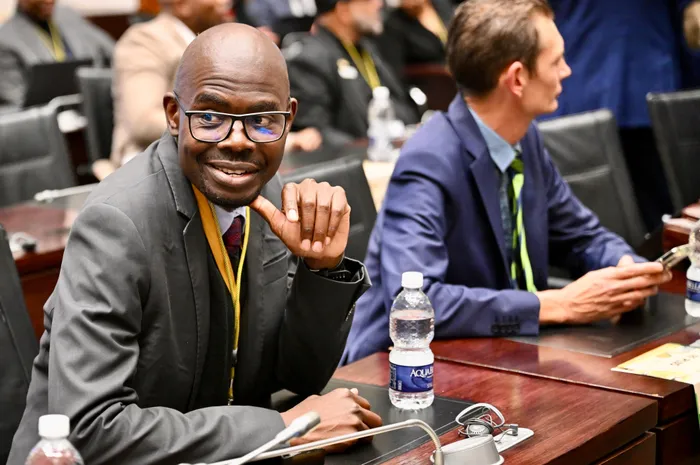
Rise Mzansi parliamentarian Makashule Gana (left) was elected as the Chairperson of Parliament's Section 89 Impeachment Committee on June 01. If public opinion regards Ramaphosa’s impeachment as a threat to the GNU, then the decision becomes immensely complicated, says the writer.
Image: Parliament RSA
Prof. Dirk Kotzé
The latest impeachment developments targeted at President Ramaphosa take one invariably back to the situations of Presidents Mbeki and Zuma. Over the past 32 years, only President Mandela’s term of office was not threatened by a premature termination.
Mbeki was recalled by the ANC’s NEC and then resigned as national president. Zuma resigned immediately before his parliamentary impeachment process could commence after numerous failed motions of no confidence. In both instances, it happened when they were no longer the ANC President but only the national President.
The current situation is different: Ramaphosa is both ANC and national President. No motions of no confidence have been tabled against him. The impeachment initiative is managed by the ATM and EFF parties and does not come from within the ANC.
It is primarily based on a dossier of evidence originating from Arthur Fraser, the former Director General of the State Security Agency and later of Correctional Services. The fact that Ramaphosa removed him as part of the post-state capture clean-up in intelligence is a motive force in these dynamics.
The impeachment, therefore, does not amount to a recall by the ANC but is driven by the ATM and EFF parties. Ramaphosa must therefore defend himself against other parties and not internal dissent (or factionalism) in the ANC.
The impeachment event is not only about Ramaphosa but also about the Government of National Unity (GNU). The voting pattern for the election of the new chairperson of the impeachment committee and the supporters of the impeachment motion are positioned in terms of where the parties stand in relation to the GNU.
The “progressive caucus” (MKP, EFF, ATM, UAT, Dal-Jamaah, UDM, Patriotic Alliance, etc) did not support the election of Makashule Gana of Rise Mzansi as the new impeachment committee chairperson.
All of them, except for the UDM and PA, are also critical of the GNU. A Ramaphosa impeachment will put the GNU at stake, because he will then most likely be succeeded by Paul Mashatile. The DA and FF+ will then, in all probability, be removed from government while the MKP and EFF will join it. Either a reconfigured GNU or a smaller coalition government would then prevail.
Irrespective of how many parliamentarians are present at the final vote, a successful impeachment in South Africa requires the support of 267 of the National Assembly’s members. Anything more than 133 votes against impeachment would prevent its acceptance.
The ANC has 159 members, which means that it cannot afford for more than 20 of its members to break ranks in such a vote. In this respect, for Ramaphosa, the risk is if Paul Mashatile’s supporters see the impeachment moment as an opportunity for them to break ranks, vote in favour of impeachment and fill the new vacuum in the ANC.
Can we expect a lot of political grandstanding during impeachment proceedings? It is almost inevitable that it will happen. The explanation for it lies in the impeachment proceedings in many parts of the world.
Successful presidential impeachments happened in Brazil, South Korea, Madagascar, Peru, Paraguay, Ecuador, Lithuania and Indonesia. The best-known failures of impeachment procedures were those of American presidents Bill Clinton and Donald Trump.
Why are impeachments all over the world prone to political grandstanding and, most of the time, decided by partisan political positions? Impeachment is normally a semi-judicial parliamentary investigation led by legal officers, while much of the interrogation is conducted by parliamentarians who are politicians. The process’s outcome is a report with the committee’s conclusions and recommendations, which are discussed by all the parliamentarians and voted upon.
In parliaments with a lower and upper house, the impeachment investigation is done in the lower house and decided by a vote, whereafter it is referred to the upper house for the final vote. The failure of Clinton’s impeachment was because the Senate overturned the decision by the House of Representatives. In South Africa, however, the decision will be taken only by the National Assembly.
A precedent exists in the case of the successful impeachment of Busisiwe Mkhwebane, the former Public Protector. The National Assembly vote in her case followed party lines. What politicises the current situation even more is the fact that President Ramaphosa is the number one politician in South Africa.
As head of government, he epitomises the political domain. Added to this is the proximity of the local government elections in November 2026 to this process. It is predictable that in this election, the parties will target the ANC’s problem with unethical conduct and corruption amongst many of its members and public representatives.
The Madlanga Commission, many arrests and court cases provide the ammunition for this criticism. An impeachment procedure which seeks to prove that Ramaphosa also acted unlawfully or in conflict with the Constitution automatically politicises the situation.
For those who want to view impeachment as an instrument seeking the truth, does it have the potential to achieve such an objective, or is the political environment more pervasive and will ultimately determine the outcome?
Parliamentary impeachment in South Africa consists of processes presenting the charges to the president, presenting evidence in support of the charges by legal practitioners as well as evidence presented by the president’s legal representatives in defence of him, cross-examination of all the witnesses and questions by the members of the impeachment committee. It resembles, very much, the procedures of the recent ad hoc parliamentary committee on the matters raised by Lt-Gen. Mkhwanazi, as a semi-judicial process.
The main difference is the absence of a judge who must reach a conclusion and deliver a binding judgment. The committee will rather decide its conclusions and recommendations for the National Assembly. After a general debate, all the assembly members will vote on it, and successful impeachment requires a two-thirds majority.
Given the fact that political party members are responsible for the final decision, it makes it a political one, and a minority of one-third or more can prevent a positive impeachment decision. The most important determinant is therefore the position of that third.
How will the parties in the GNU position themselves throughout this process?
It is most unlikely that all the GNU members will assume the same approach. It is already evident that the UDM and Patriotic Alliance have adopted a critical stance. The DA, in particular, but most probably also the IFP, Rise Mzansi and FF+, do not want to commit themselves at the moment to a particular position. They want the process to take its course and be influenced by the evidence presented to the committee.
But their interest in the continuation of the GNU under Ramaphosa leadership has been explained already, and that could lead them in their final vote. However, it could become more complicated if evidence is presented to the committee which is seriously compromises Ramaphosa.
Especially during the time of elections, parties will have to calculate whether their support for Ramaphosa would compromise them in the public eye or whether a critical stance against him would strengthen the parties’ public support. Added to that: Ramaphosa has become synonymous with the GNU.
Opinion polls indicate widespread support for it. If public opinion regards Ramaphosa’s impeachment as a threat to the GNU, and that the GNU parties must support him, then the decision becomes immensely complicated. In this respect, the LGE is a serious complication, firstly for the ANC, but secondly also for the other GNU parties. For the “progressive caucus”, it is a godsend.
* Prof Dirk Kotzé, Department of Political Sciences, Unisa.
** The views expressed do not necessarily reflect the views of IOL, Independent Media or The African.