Conference of the Left Lays Groundwork for a New Patriotic Front
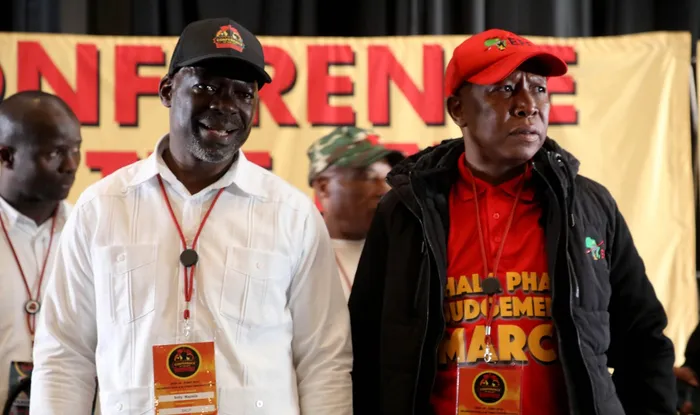
SACP General-Secretary Solly Mapaila and EFF leader Julius Malema at the opening of the Conference of the Left held in Boksburg on May 29. The Conference of the Left should therefore be understood not as an end in itself, but as the beginning of a longer and more necessary national conversation, says the writer
Image: Timothy Bernard/Independent Media
Zamikhaya Maseti
Last week, the South African Communist Party (SACP) successfully convened the much-discussed Conference of the Left.
The significance of this gathering should not be underestimated. It arrived at a moment when the South African body politic finds itself confronting profound questions about the future of democracy, economic transformation, social justice and the enduring relevance of progressive politics in an era marked by uncertainty, inequality, unemployment and ideological drift.
Predictably, the Conference triggered a lively debate. Several questions were posed. Is there anything left of the South African Left? Does the Left still possess the intellectual and organisational capacity to influence the national discourse?
Was the SACP motivated by a genuine desire to renew progressive politics, or was this merely an attempt to settle political scores within the Alliance? Some went even further, casting aspersions on the initiative and ridiculing it as the behaviour of a jilted partner seeking relevance after years of political frustration.
Such criticism, while expected, misses the central point. The question before us is not whether one agrees with every position advanced at the Conference.
Rather, it is whether South Africa requires a platform through which progressive forces can engage critically with the country's mounting challenges. On this score, the answer is an unequivocal yes.
Indeed, the General-Secretary of the SACP, Solly Mapaila, deserves commendation for having successfully persuaded and brought together a diverse range of political formations, activists, intellectuals and social movements to engage in a collective conversation about the state of the nation and the future trajectory of our democracy. This was no small feat.
The South African political landscape is characterised by deep ideological differences, competing strategic visions and, in some instances, long-standing historical grievances. Yet, despite these realities, the Conference succeeded in creating a space for dialogue, reflection and engagement.
More importantly, Mapaila managed to steer participants towards points of convergence while avoiding unnecessary provocations that could have produced premature fragmentation. Any gathering that seeks to unite progressive forces must begin not with a catalogue of differences, but with an honest assessment of shared challenges and common objectives.
This is what renders much of the criticism rather unconvincing. The mere mention of the participation of the Umkhonto weSizwe Party appeared to intensify the hostility of some commentators towards the initiative.
For them, the presence of the MK Party was sufficient grounds upon which to dismiss the entire gathering, irrespective of the substantive issues under discussion. Such a disposition reveals a troubling tendency within our political discourse, namely, the inclination to reject engagement not based on ideas, but based on who occupies the conference hall.
What was even more interesting, and indeed puzzling, was the decision of the African National Congress not to participate. I found myself silently posing a simple question: why?
I asked this question precisely because my understanding of the ANC has always been informed by its historical character and strategic orientation as articulated in its own foundational documents.
For decades, the ANC described itself as a disciplined force of the Left. If the 2007 Strategy and Tactics document is anything to go by, the ANC regarded itself as an integral component of the broad Left, committed to the advancement of the National Democratic Revolution and the pursuit of a more egalitarian social order.
Has the ANC abandoned this strategic pillar? Has it consciously redefined its ideological location within South African politics? Or are we witnessing a temporary departure dictated by the complexities of coalition governance and the realities of the Government of National Unity? These are not frivolous questions. They go to the very heart of the ANC's identity, mission and historical purpose.
Perhaps the answers will emerge from the policy debates leading towards the 2027 National Conference. Perhaps forthcoming policy documents will provide greater clarity regarding what increasingly appears to be a significant ideological shift.
They may also clarify the movement's contemporary posture towards monopoly capital, a question that has occupied the South African Left for generations and remains unresolved in the minds of many activists, workers and intellectuals.
There are, most certainly, some amongst us who seek refuge in cognitive dissonance and ideological amnesia. They invoke the traditions of the movement when it suits their immediate political objectives and conveniently discard those same traditions when they become politically inconvenient.
In doing so, they expect society to forget what the ANC itself has historically proclaimed about its ideological orientation, its strategic alliances and its self-description as a disciplined force of the Left. Such a posture does not resolve contradictions. It merely postpones an honest reckoning with them.
More fundamentally, they refuse to confront the political significance of the electoral outcome of 29 May 2024. The reality is neither complicated nor open to interpretation. An electoral outcome of approximately 40 per cent represented a profound political moment in democratic South Africa.
It signified the loss of an outright governing majority and reflected a measurable decline in popular support. Whether one celebrates or laments this outcome is beside the point. The political fact itself remains indisputable.
If that reality had been fully appreciated, the ANC may well have approached the Conference of the Left differently. It may have viewed the gathering not as a threat, nor as an inconvenience, but as an opportunity to engage potential allies, reconnect with progressive constituencies and participate in an important conversation about the future of transformative politics in South Africa.
This observation becomes even more relevant when one considers that the country is steadily approaching the Local Government Elections scheduled for November 2026. In a political environment characterised by coalition governments, fragmented electoral mandates and shifting voter loyalties, strategic isolation is rarely a virtue.
Successful political movements do not retreat from engagement. They seek dialogue, cultivate alliances and continuously reassess the balance of social and political forces.
The irony is that the ANC itself once understood this principle better than most. Throughout its history, it built broad fronts, forged strategic partnerships and united diverse social forces around a common programme of national liberation. Its greatest victories were achieved not through political isolation but through the patient construction of alliances capable of advancing a shared national objective.
Consequently, the refusal to participate in the Conference of the Left may ultimately prove to be a missed opportunity. At a minimum, it represented an opportunity to listen. At best, it could have provided a platform through which the ANC might reconnect with constituencies that increasingly feel alienated from the contemporary political establishment. A movement that seeks renewal cannot afford to be absent from conversations concerning its own historical constituency.
History teaches us that political organisations seldom decline because they engage too broadly. More often, they decline because they become prisoners of their own assumptions, mistaking past victories for permanent entitlements and historical legitimacy for an inexhaustible political resource. The electorate, however, is rarely sentimental. It judges political parties not on the basis of what they once represented, but on the basis of what they presently offer.
Indeed, the central question confronting the ANC today is not whether it remains electorally dominant, for the electorate has already rendered its verdict on that matter. The question is whether the movement still possesses the ideological confidence to occupy the political space that it once claimed as its own.
Political organisations can recover from electoral setbacks. What proves far more difficult is recovering from ideological uncertainty. It is precisely this question that the Conference of the Left has placed squarely before the ANC and the broader progressive movement.
The Conference of the Left should therefore be understood not as an end in itself, but as the beginning of a longer and more necessary national conversation. Whether it succeeds or fails will depend on what follows.
Yet its greatest contribution may already have been made. It has compelled South Africans once again to confront fundamental questions about power, inequality, economic justice, democratic renewal and the future of progressive politics.
The Council established through this process may yet evolve into a broader patriotic front capable of influencing the political trajectory of the country. Such a development should not be dismissed as fanciful speculation. If current electoral trends persist and the ANC's support continues to decline below the 40 per cent threshold, South Africa could enter a new phase of coalition politics by 2029.
Under such circumstances, progressive forces may find themselves compelled to construct new instruments of political cooperation in order to prevent the consolidation of a governing coalition anchored in Zionism and Conservative Republicanism. This reality is neither distant nor hypothetical. It is already beginning to confront us.
Indeed, 2029 is not a far-off political horizon. It is a little more than two and a half years away. The strategic choices made today may well determine the character, ideological orientation and class content of the South African State that emerges tomorrow.
* Zamikhaya Maseti is a political economy analyst and holds a Magister Philosophae(M.Phil) in South African Politics and Political Economy from the erstwhile University of Port Elizabeth(UPE), now Nelson Mandela University.
** The views expressed do not necessarily reflect the views of IOL or Independent Media.