Mob Justice and Vigilantism Threaten South Africa's Democratic Foundations
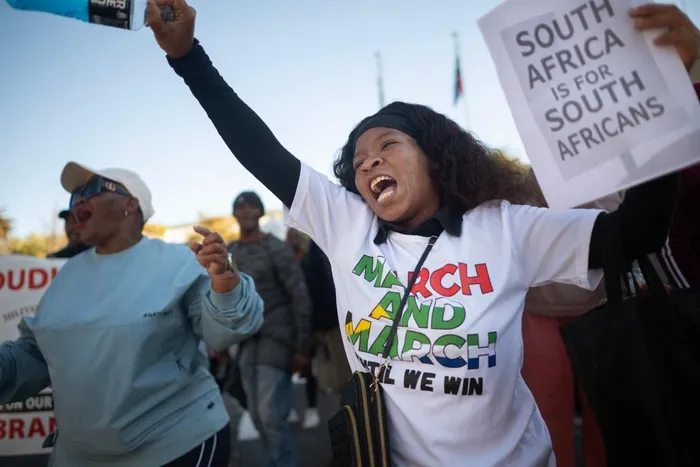
Demonstrators take part in a protest against undocumented migrants outside Parliament in Cape Town on May 8. Public anger directed at migrants creates instability and diverts attention from the policy failures that produced the crisis, says the writer.
Image: AFP
Dr. Reneva Fourie
Millions of South Africans are grappling with unemployment, rising living costs and declining confidence in public institutions. At the same time, internal migration from rural areas to major cities has placed increasing strain on urban housing, healthcare, education and municipal services.
Informal settlements continue to expand in areas already burdened by overcrowding and fragile infrastructure, deepening frustration among many communities. Yet directing anger toward fellow human beings based on nationality is a dangerous response; one that risks intensifying these challenges rather than solving them.
South Africa is once again confronting painful scenes that are spreading rapidly across social media and dominating public debate. Videos of marches against foreigners, angry crowds, some expressing tribal sentiments, and visibly intimidated individuals are circulating widely across digital platforms, fuelling fear, outrage and division.
Underlying these tensions is a growing sense of disillusionment. Many South Africans feel unheard, unsafe and economically trapped. Many believe the government has failed to protect borders, enforce the law and create meaningful opportunities.
Addressing these heartfelt frustrations requires an honest, disciplined conversation about migration, crime and economic hardship, in a way that protects both national security and human dignity.
A responsible discussion on migration requires clear distinctions. Illegal immigrants, legal immigrants, asylum seekers, refugees, economic migrants and criminals occupy different legal and moral categories. Legal immigrants who follow the law and contribute to society should not be treated as outsiders.
Genuine refugees fleeing war or persecution deserve protection under domestic and international law, but require faster and more efficient asylum processing to reduce years of legal limbo. Criminals should face prosecution for their offences regardless of nationality.
Poor economic policy decisions have contributed significantly to these conditions. Weak industrial growth, outsourcing of core state functions, excessive austerity, corruption and poor governance have limited inclusive development and reduced opportunities for stable employment. Young people entering the labour market face severe barriers to economic participation.
Small businesses face rising operational costs and insecurity. Public resources intended for development and service delivery have too often been diverted through corruption and patronage networks. These failures have damaged confidence in the state and weakened social stability.
Border management has also suffered from poor policy choices and institutional decline. Outsourcing important elements of border control without adequate oversight has weakened accountability and operational effectiveness.
Corruption among some officials has enabled the movement of undocumented individuals, illicit goods and organised criminal networks across porous borders. Communities witnessing these failures lose faith in the state's ability to manage migration fairly and enforce the law consistently.
Confidence in the criminal justice system declines further when violent offenders avoid prosecution or when corruption shields criminal activity from investigation.
These realities require serious reform and competent leadership. Anti-foreign national mobilisation cannot solve structural economic problems or institutional weaknesses.
Violence against foreign nationals cannot restore employment, rebuild infrastructure or strengthen the rule of law. Public anger directed at migrants creates instability and diverts attention from the policy failures that produced the crisis. It also places innocent people at risk of intimidation, assault and collective punishment.
The emergency meeting of the Justice, Crime Prevention and Security Cluster on 25 May is a welcome, though delayed, recognition of the growing crisis. Likewise, the JCPS Cluster’s call for responsible, peaceful protests ahead of the intended national shutdown/march at the end of June is necessary to prevent violence and protect lives and property.
However, it highlights a continued pattern of reactive rather than proactive leadership, focusing on damage control rather than a comprehensive strategy.
The government must address both the frustrations of citizens and the practical realities of migration more effectively. An extensive campaign that communicates its strategy to strengthen border security, combat corruption and dismantle networks involved in the illicit trafficking of people, drugs, weapons and other contraband must be undertaken.
Authorities should also explain how they intend to intensify coordination among law enforcement agencies and border officials, while concretely reducing unemployment and poverty. Investment in housing, healthcare, schools and infrastructure in high-arrival areas to alleviate the pressure in those communities is equally important.
Furthermore, the visa and residency systems should operate efficiently so that legitimate applications are processed without excessive delays. Family-based and long-term residency pathways linked to the right to work would provide greater stability for many households already contributing to local communities.
Immigrants who receive work authorisation quickly are more likely to participate formally in the economy, contribute through taxation and support economic activity rather than remain trapped in informal systems that increase vulnerability and anger.
Political leaders in South Africa carry a duty to engage directly with communities participating in these marches. Whether intentional or not, all foreign nationals are currently being affected by the aggression arising from it.
Leaders, like Jacinta Ngobese-Zuma, Herman Mashaba and Gayton McKenzie, should remain calm, factual and responsible. Statements that inflame public anger create further instability and deepen mistrust between communities. Political organisations, faith groups, trade unions and civic bodies can help rebuild social trust through dialogue and education.
The recent celebration of Africa Day creates an important moment for reflection across the continent. Leaders throughout Africa carry a responsibility to address the conditions that force people to flee instability, conflict and economic collapse.
Intrastate conflict continues to destroy communities, weaken institutions and limit development opportunities. African leaders must take responsibility for ending these conflicts and creating stable environments that encourage investment, tourism and long-term growth. Economic development and social stability across the continent would reduce the pressures driving dangerous migration and human trafficking networks.
Humanity and compassion remain essential principles during periods of hardship. Communities facing economic pressure still carry a responsibility to uphold the dignity and safety of others. Individuals accused of criminal conduct should be handed over to the police and processed through the legal system, and the police should be held accountable.
Mob justice and vigilantism erode the foundations of constitutional democracy and encourage further lawlessness. A society that normalises collective punishment weakens respect for law and human rights across all communities.
A prosperous South Africa requires lawful governance, social responsibility and moral courage. Citizens have every right to demand secure borders, effective policing and accountable leadership.
However, we also carry a duty to reject hatred, violence and collective blame. The protection of human dignity and the enforcement of law should co-exist within a democratic society.
South Africa can confront its challenges through reform, justice and responsible leadership. It cannot build a stable future through fear directed at vulnerable people.
* Dr Reneva Fourie is a policy analyst specialising in governance, development and security.
** The views expressed do not necessarily reflect the views of IOL or Independent Media.