Lack of Vaccine Sovereignty Exposes Africa's Leadership Deficit
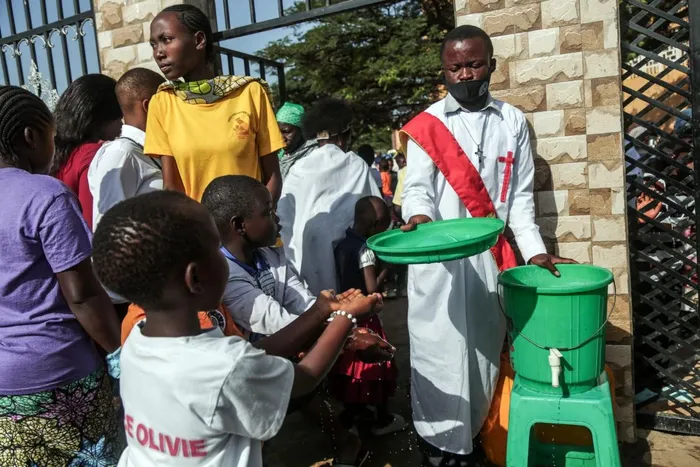
A deacon helps young parishioners wash their hands before entering the church following local authorities’ instructions to limit the spread of the Ebola outbreak ahead of a mass at Bunia Cathedral in Bunia, Democratic Republic of Congo on May 24, 2026.
Image: AFP
Kim Heller
The children of Africa are perishing. A child born on the African continent is far less likely to reach age five than one born almost anywhere else in the world.
In 2025, the UN Inter-agency Group for Child Mortality Estimation reported that of the 4.9 million children who died before they could celebrate their fifth birthday, the overwhelming majority were in sub-Saharan Africa. This must rank among the most heartbreaking failures of post-independence Africa.
This catastrophic child death toll is not the mishap of history, but a fatal symptom of a continent caught up in war, displacement, economic dependency, and recurring crisis. The result is collapsing healthcare systems, broken supply chains, and chronic vaccine shortages. Vaccine delays alone have cost hundreds of thousands of young lives.
Common, curable illnesses become death sentences, especially among the rural poor. Malnutrition lingers in refugee camps. Mothers desperately attempt to soothe sick children in overcrowded clinics where medication, medical staff and even electricity are frequently lacking. Across large parts of the continent, mothers bury children every day.
The shortfall in domestic financing for universal primary healthcare and vaccine manufacturing has been enormously costly in human lives. However, many African leaders continue to rely on foreign financial assistance as their primary strategy for survival.
Dependency has become deeply crystallised in post-independent Africa, and begging-bowl politics has been institutionalised. Donor funding and foreign debt arrangements have too often superseded self-funding and self-sufficiency. This is structural surrender — and a living testimony to the afterlife of colonialism in Africa.
Many post-independence leaders have recklessly traded sovereignty for the easy drip of donor dollars, as though liberation can somehow be donor-funded. Proactive stewardship has been replaced with reactive crisis management.
Governments that fail to shield innocent children from preventable death place the future of their nations in jeopardy. Nations that cannot safeguard the well-being of their children have little right to speak lyrically of liberation. Wails of colonial ills will not soothe the cries of parents who have lost sick children.
The lack of vaccine sovereignty is a chronic sign of Africa's desperate state of dependency. It is deeply unhealthy that Africa consumes a significant share of the world's vaccines yet manufactures a minuscule fraction. African lives remain at the back of the vaccine queue, as they did under colonialism and during the COVID-19 pandemic.
This lack of vaccine sovereignty places millions of African lives at risk and is a shameful indictment of a continent unable to guarantee its own health security. A continent that cannot independently finance its core developmental priorities remains trapped in a cycle of compromised sovereignty.
In a truly decolonised Africa, continent-wide pharmaceutical and vaccine manufacturing hubs would be financed locally and strategically protected. There would be sustained investment in nurturing and retaining African scientists, researchers, and medical professionals rather than exporting them to serve wealthier economies.
Leaders of genuinely sovereign African nations would understand that without health security, there can be no national security and no meaningful liberation from neo-colonial domination. Africa needs far greater self-reliance — not another handout of aid.
Julius Nyerere understood that liberation could never be founded on international loans, charitable donations or imported solutions. He recognised the vital relationship between self-determination, people-centred development, and continental dignity. Africa's current crop of leaders needs to radically reorder their priorities.
A reimagining of the African Union and regional institutions is required to ensure that these bodies are obsessed with developing joint financing mechanisms rooted in self-reliance, regional solidarity, and long-term sustainable development.
Until these bodies function as architects of sovereign development, they will remain administrators of dependency. Pharmaceutical plants that produce vaccines tailored to African disease profiles and developmental needs are essential. Scientific innovation should become part and parcel of national and continental development strategies.
Walter Rodney understood that liberation demands the construction of independent political and economic systems capable of sustaining dignity, sovereignty, and collective prosperity. These are the foundations upon which genuine African liberation must be built.
Some African countries are decisively shifting towards greater self-funding as a necessary act of decolonisation. Rwanda's community-based health insurance scheme, Mutuelles de Santé, built on local contributions, taxation and efficient revenue collection, has reduced dependence on external donors and improved access to healthcare.
Kenya has increased investment in local pharmaceutical and vaccine production capacity to reduce reliance on imports. South Africa is expanding its domestic production of essential medicines and vaccines, while Ghana has embarked on an ambitious programme to manufacture vaccines locally.
Africa's child mortality crisis is a health emergency. It is a sad outcome of a generation of post-colonial leadership in Africa that has settled for dependency over sovereignty and crisis management over the proactive construction of resilient systems.
Self-financing is not merely an economic strategy. It is a necessary investment in the future. The project of decolonisation cannot be completed while African nations remain dependent on foreign powers to finance their most basic developmental and humanitarian needs.
A truly sovereign government must be able to feed, heal, educate, and protect its people without relying on foreign financing. Africa's children cannot continue to be trapped in the brutal cycle of permanent crisis management, donor appeals and preventable death.
Children should be laughing joyfully in schoolyard playgrounds, not crying out in pain in poorly equipped hospitals. It is time for African leaders to stop outsourcing the survival of their countries and continent to others. African leaders must invest in Africa. African leaders must invest in the African child. Anything less is a betrayal.
* Kim Heller is a political analyst and author of No White Lies: Black Politics and White Power in South Africa.
** The views expressed do not necessarily reflect the views of IOL or Independent Media.