NPA's Bungling of Sibanyoni Trial Raises Concerns Over Judicial Integrity
COMBATING CORRUPTION
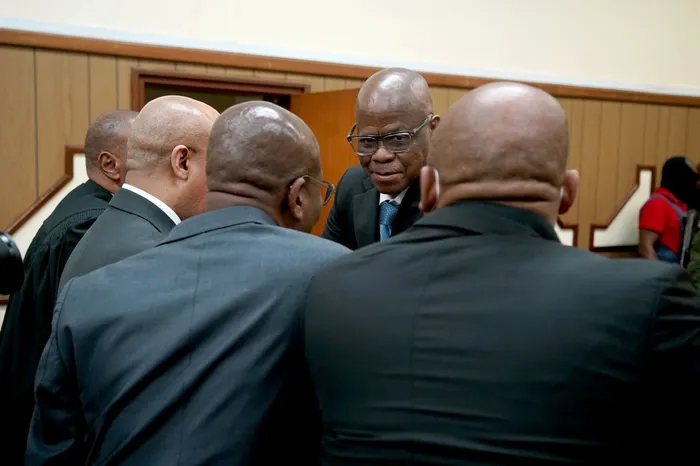
Taxi boss Joe ‘Ferrari’ Sibanyoni (centre) consults with his legal team after extortion and money laundering charges against him and his co-accused were struck off the court roll in the Kwaggafontein Magistrate’s Court, Mpumalanga, on May 13.
Image: Oupa Mokoena/Independent Media
Prof. Bheki Mngomezulu
Lieutenant-General Nhlanhla Mkhwanazi, the Provincial Commissioner of KwaZulu-Natal (KZN), will go down in the annals of history as someone who opened South Africans' eyes to the deep-rooted rot in the South African Police Service (SAPS) and other related institutions.
But Mkhwanazi’s efforts will amount to nothing if the NPA lacks capacity and the political will to redeem its public image.
Taxi tycoon Joe “Ferrari” Sibanyoni and three co-accused walked free when the judge argued that the absence of state prosecutor Mkhuseli Ndaba caused an unnecessary delay. This decision raises several questions.
Was the so-called ‘delay’ justifiable compared to other cases that have clearly been delayed? Why did the judge not postpone the case? What did the NPA do when Ndaba indicated that he was not going to be present in court? Can the public pin its trust in the NPA after this incident, which comes after many others, such as that of Tim Omotoso?
Since Mkhwanazi’s media briefing in 2025, a lot has happened in South Africa. The decision by President Cyril Ramaphosa to invoke Section 84(f) of the Constitution by appointing the Madlanga Commission was informed by this briefing, as was the parliamentary ad hoc committee appointed in accordance with Rule 253 of the Rules of the National Assembly.
What is concerning is that high-ranking police officers have been implicated in wrongdoing. On July 13, 2025, President Ramaphosa placed Minister of Police, Senzo Mchunu, on special leave following allegations that he colluded with criminal elements to carve out a plan to disband the Political Killings Task Team (PKTT) in KwaZulu-Natal.
Ten months later, Mchunu continues to earn his full salary of R2.69 million per annum. Meanwhile, Prof. Firoz Cachalia, who replaced him on August 1, 2025, also receives a full salary with all the accompanying benefits.
As if this was not enough, General Fannie Masemola, who is the National Police Commissioner and thus the country’s top cop, was arrested. He was charged with violating part of South Africa's Public Finance Management Act by failing to provide proper oversight in the controversial awarding of a health contract of R360 million to Cat Matlala.
In August 2025 Masemola was accused of abusing slush funds from the secret service account of crime intelligence to purchase two properties, one in Pretoria (Veroz Boutique Hotel) and another one in Midrand in Johannesburg (Kyalami Lodge) without following proper procedures. By March 2026, no less than 12 police officers had been arrested on procurement-related charges.
In September 2025, Masemola suspended his Deputy National Commissioner, Shadrack Sibiya, following an accusation made by Mkhwanazi that Sibiya tried to disband the PKTT in KZN.
Lt-Gen Dumisani Khumalo, who heads crime intelligence, was arrested for fraud and corruption relating to the purchase of a boutique hotel in Pretoria North costing an estimated R22.7 million and a commercial building in Durban, said to be valued at R22.8m million.
The media briefing hosted in April 2026 by suspended Mpumalanga Police Commissioner Daphney Manamela, in which she implicated Masemola in a R5 million bribe by Bobby Motaung, paints a very bleak picture of the police service in this country.
The cases enumerated above are not the only ones. As of May 11, 2026, two more high-ranking police officers were arrested. These were Major-General Feroz Khan (Crime Intelligence) and Major-General Ebrahim Kadwa (Gauteng Hawks head). The arrests relate to a 2021 investigation involving the seizure of R62 million in unwrought gold at OR Tambo International Airport.
The two officers were accused of defeating the ends of justice following their alleged ordering of the release of Tariq Downes, the security company owner who was found with the gold in 2021, claiming that he was an undercover agent.
Given these and many other cases that have surfaced in the ongoing Madlanga Commission, the question becomes: how have these cases contributed to the diminishing or even the total obliteration of public trust in the entire justice system in South Africa?
This question can be answered by asking a related question: how many more cases remain unknown to the public? Put differently, how deep does the rot go and for how long has it been going?
Mkhwanazi should be commended for opening the eyes of South African citizens to the endemic corruption in our justice system. For years, the South African public pinned its trust in the Hawks and crime intelligence for their protection. Little did they know that some of the people they look up to and revere are on the wrong side of the law.
Chapter 2 Section 7(2) of the Constitution states that “the state must respect, protect, promote and fulfil the rights in the Bill of Rights.” Failure by any state institution to uphold this section of the constitution amounts to dereliction of duty and therefore violation of the constitution.
The danger of a trust deficit between the public and state institutions is that people may be tempted to take the law into their own hands. This is well explained by one of the international relations theories called the Frustration-Aggression theory. According to this theory, once people are frustrated, they resort to illegal means of doing things to redeem themselves.
Such a situation is a precursor to a failed state. In a nutshell, a failed state is a sovereign country that has lost its ability to perform its basic national functions of governance. This includes maintaining security in the country, providing public services, and enforcing the rule of law. If the justice system is rotten to the core, there can be no hope for having a capable state that protects its citizens.
Revelations from the Madlanga commission will hopefully deter others within the security cluster from selling the country through their illegal activities.
Lessons could be drawn from this depressing situation. Firstly, meritocracy should guide appointments. Secondly, monitoring and evaluation should be thorough. Thirdly, wrongdoers should be prosecuted.
* Prof. Bheki Mngomezulu is Director of the Centre for the Advancement of Non-Racialism and Democracy at Nelson Mandela University.
** The views expressed do not necessarily reflect the views of IOL or Independent Media.