From Resistance to Democracy: The Plight of SA's Youth Remains Dire
JUNE 16 UPRISING
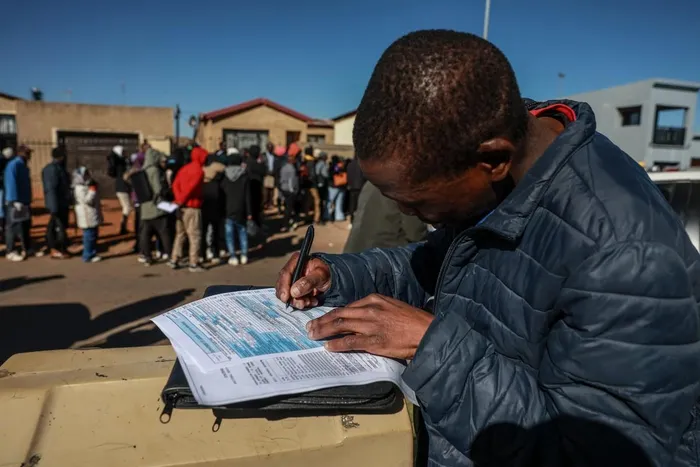
An unemployed youth fills in the Department of Unemployment and Labour's work seeking registration form while queuing with others at a centre in Chiawelo, Soweto on June 27, 2025. The generation of 1976 did not struggle only for formal political rights.They fought for human dignity, equality and social transformation, says the writer.
Image: AFP
Dr. Reneva Fourie
This year marks the 50th anniversary of the June 1976 uprisings, when thousands of young South Africans marched against the decree that Afrikaans be made the sole medium of instruction in black schools.
The state responded with lethal violence. Hundreds died in the initial days, with estimates of up to 575 deaths by early 1977 from the spreading unrest. The commemoration reminds us of the power of youth when driven by shared interests and a common purpose.
The events of 1976 created the conditions for the more widespread youth mobilisation of the 1980s, which played a vital role in the pressure that eventually forced the apartheid regime into negotiations.
Youth organisations became central to mass resistance campaigns that made many townships ungovernable for the apartheid regime. Young people built student organisations, civic movements, underground networks, MK units, worker alliances and community structures that challenged apartheid rule.
Thousands of young activists were detained without trial, tortured, exiled or killed between 1976 and 1994. Several thousand left the country to join Umkhonto we Sizwe (MK). Between 1985 and 1989, nearly 48,000 of the 80,000 people detained by the apartheid regime were under the age of twenty-five.
Young leaders such as Solomon Mahlangu, Stanza Bopape, Ashley Kriel and countless others, who went unrecognised, became symbols of sacrifice and courage. This history demonstrates that young people can reshape national trajectories when they are organised and determined.
The democratic breakthrough of 1994 created political rights for all South Africans. It also inherited deep structural inequalities produced through centuries of colonialism and apartheid. Those inequalities continue to shape the lives of young people today.
South Africa remains one of the most unequal societies in the world. Wealth, land ownership, access to finance and economic opportunity remain concentrated in a small section of society, while millions of young people experience unemployment, insecure work, unaffordable education and social exclusion.
Young people remain the largest demographic group in the country. Official 2024 statistics indicate that people aged 15–34 accounted for about 21 million, or 33.1% of the national population.
This means that the future of South Africa depends heavily on the participation, development and political consciousness of its youth, yet youth unemployment remains a national crisis. Statistics South Africa reported that youth unemployment increased from 36.8% in 2014 to 44.6% in 2024, with the expanded youth unemployment rate reaching a staggering 54.9%.
Millions of young South Africans remain excluded from formal employment, education and training systems. Government programmes such as the Presidential Employment Stimulus, the National Youth Development Agency, public employment schemes and skills development initiatives have created opportunities for many young people.
However, the scale of the crisis remains severe because economic growth has been too weak to absorb the burgeoning youth population.
These challenges are compounded by structural barriers that continue to limit youth economic participation. Many schools in working-class communities still face overcrowding, poor infrastructure, under-resourcing and unequal access to technology. University and college students still face financial exclusion, accommodation shortages and debt burdens.
Rural communities continue to experience weak transport systems, low industrial investment and limited access to digital infrastructure. The labour market often demands experience from first-time job seekers who have never had access to stable employment opportunities.
Monopolies in major sectors further restrict meaningful youth participation in the economy. Young entrepreneurs face major challenges in accessing capital, markets and supply chains. Informal workers and township businesses struggle with insufficient public investment and weak local economic development. These conditions perpetuate generational inequality and poverty.
Political participation among young people has also declined. Large numbers of eligible young voters remain unregistered or disengaged from formal politics. Out of an estimated 21.3 million eligible citizens aged 18–39 in the country, only 11.13 million registered to vote in 2024, and only 5.7 million actually cast a ballot.
Low youth economic and political participation creates conditions for instability. Countries with large youth populations and high unemployment often experience social unrest, weakened democratic legitimacy and political fragmentation.
Chile experienced large-scale student and youth mobilisations connected to inequality, education costs and economic exclusion. Kenya is experiencing repeated youth-led protests regarding high fuel prices, the high cost of living, unemployment and governance concerns.
Economic grievances have also led to a surge in far-right populism among youth in Europe. These examples show that societies that marginalise young people face prolonged social tension and institutional instability.
An approach centred on collective effort can help overcome these constraints. The same capacity for organised collective action that challenged apartheid can now be directed toward dismantling the structural barriers that continue to exclude young people from economic and political life.
Young people can strengthen non-racialism and social cohesion by rejecting xenophobia, tribalism, racism, chauvinism and economic injustice. Through community service, dialogue and inclusive spaces in schools, universities and workplaces, youth can reduce stereotypes and build unity. Cultural tolerance grows when young people engage with one another’s histories, languages and artistic traditions.
Economic participation can improve through youth-led cooperatives, digital enterprises and local manufacturing initiatives. Young entrepreneurs can create opportunities by pooling resources, sharing skills and developing products for local markets.
Access to mentorship, incubators and training programmes remains essential. Engagement with government initiatives can help unlock funding and connect youth with value chains in agriculture, technology and creative industries.
Political participation can expand through voter registration drives, policy education workshops and civic forums. Young people who engage with municipalities, legislatures and community councils gain experience that strengthens democratic governance. Constructive participation can ensure that government initiatives better address the needs of youth.
The generation of 1976 did not struggle only for formal political rights. They fought for human dignity, equality and social transformation. The youth of today inherit that responsibility. South Africa needs young people who are politically active, economically productive, socially conscious and committed to democratic values.
The country’s future depends on organised youth leadership that places human development, social justice and collective progress at the centre of national life.
* Dr Reneva Fourie is a policy analyst specialising in governance, development and security.
** The views expressed do not necessarily reflect the views of IOL or Independent Media.